Jang Donghyuk Reaches Seventh Day of Hunger Strike... Meets with Lee Junseok
People Power Party and Reform New Party to Strengthen Cooperation on Dual Special Investigations
Lee Junseok, leader of the Reform New Party, returned early from an overseas trip on January 21 to meet with Jang Donghyuk, leader of the People Power Party, who is currently on a hunger strike. Both parties plan to strengthen their cooperation to urge the acceptance of a dual special prosecution regarding the Unification Church and the Democratic Party’s nomination bribery allegations.
That morning, Lee visited the National Assembly Rotunda to encourage Jang, who was on the seventh day of his hunger strike. Lee, who had originally planned to return to Korea on January 23 after conducting parliamentary diplomacy in Mexico and Guatemala with Deputy Speaker of the National Assembly Joo Ho-young of the People Power Party, moved up his return schedule.
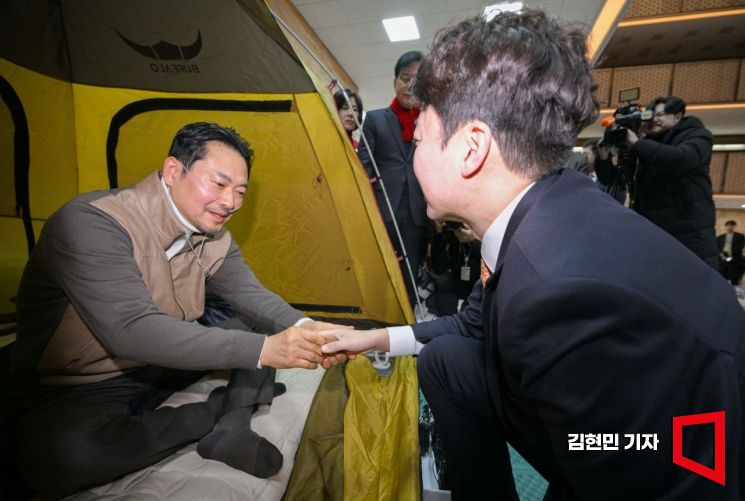 Lee Junseok, leader of the Reform New Party, is visiting Jang Donghyuk, leader of the People Power Party, who is on the seventh day of a hunger strike demanding the acceptance of a 'dual special prosecution' regarding the Unification Church and nomination bribes, at the National Assembly Rotunda on January 21, 2026. Photo by Kim Hyunmin
Lee stated, "There are concerns that this could turn into a prolonged struggle, as the Lee Jaemyung administration is refusing the special prosecution that is clearly necessary and is instead trying to water down the issue. You, as the leader, must take the role of commander to strengthen cooperation between the two parties." He also expressed his intention to discuss with party leaders, including Song Eon-seok, floor leader of the People Power Party, to devise a joint action plan.
Jang said, "This is all the opposition can do," adding, "It is very regrettable that the ruling party has not shown any response at all." Jang, whose health has deteriorated rapidly since the previous day, met Lee while wearing a nasal oxygen device.
After the meeting, Lee said in a briefing, "If suspicions related to Shincheonji are found to involve political connections or quid pro quo, they can also be handled by the special prosecution. However, expanding the scope of the investigation to a comprehensive special prosecution as the Democratic Party suggests goes against the original purpose; a comprehensive and a special (prosecution) cannot go together."
Regarding the idea of a joint hunger strike, he added, "Given the Democratic Party's current stance, we may have to consider something even stronger than a hunger strike. I will try to come up with the best possible approach."
The People Power Party has again proposed to the Democratic Party that separate special prosecutions be launched for the Unification Church and Shincheonji. The People Power Party and the Reform New Party have been demanding a Unification Church special prosecution, claiming that Min Junggi’s special prosecution team, which investigated allegations related to First Lady Kim Keonhee, obtained statements that the Unification Church had given money to Democratic Party figures such as Representative Jeon Jae-soo but did not investigate further. On the other hand, the Democratic Party opposes including allegations related to Min Junggi’s special prosecution in the investigation, calling it "politically motivated," and instead is pushing for a dual special prosecution into both the Unification Church and Shincheonji, including allegations that Shincheonji intervened in the People Power Party’s national convention. Song, the floor leader, told reporters that day, "We suggested launching separate, robust special prosecutions for the Unification Church and Shincheonji, but the Democratic Party continues to refuse, and they have not provided a clear explanation for why."
© The Asia Business Daily(www.asiae.co.kr). All rights reserved.












