Financial Burden from M&A Intensifies
Management Troubles Persist Despite CEO Change
Stores Continue Normal Operations
On January 14 (local time), the Financial Times (FT) and other outlets reported that Saks Global, the parent company of the luxury department store chains Saks Fifth Avenue and Neiman Marcus in the United States, has filed for bankruptcy protection.
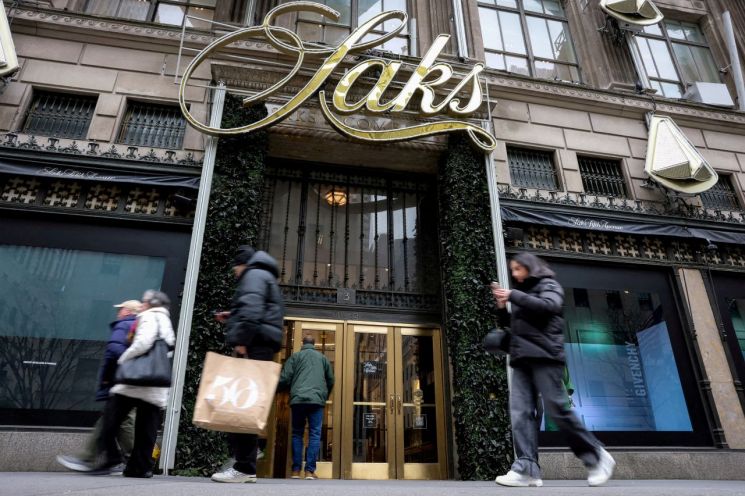 The global flagship store of Saks Fifth Avenue after filing for bankruptcy protection. Photo by Reuters Yonhap News
According to FT, Saks Global filed for bankruptcy protection under Chapter 11 of the U.S. Bankruptcy Code in court on January 13, the previous day. The company’s financial situation reportedly deteriorated to the point where it was unable to pay about 100 million dollars (approximately 150 billion won) in debt interest last month.
Saks Global was established in 2024 through the merger and acquisition of HBC, the former parent company of Saks Fifth Avenue, and the Neiman Marcus Group. The two department store companies, which had been struggling with poor performance due to the rise of online shopping, joined forces in hopes of creating a synergy effect, but failed to overcome management difficulties even after the merger. In particular, the increased financial burden from raising funds for the 2.7 billion dollar merger and acquisition is cited as a major factor. The company recently replaced its Chief Executive Officer (CEO) in an effort to normalize operations.
The Washington Post (WP) reported that this bankruptcy protection filing came after the company’s “premature gamble” to become a powerhouse in luxury retail through the merger ended in failure.
The North American luxury department store industry has been hit hard as luxury brands expand their own stores directly and consumers shift to online shopping. The Wall Street Journal (WSJ) wrote that luxury groups such as LVMH and Kering now have power beyond department stores, and most brands now open their own stores to compete with distribution partners, noting that even Saks’ legacy could not serve as a shield in the face of debt and structural industry decline.
Currently, Saks Global operates 33 Saks Fifth Avenue stores, 36 Neiman Marcus stores, 2 Bergdorf Goodman stores, and 77 Saks OFF 5TH stores. According to Bloomberg, the company stated in a press release on this day that all brand stores continue to operate normally following the bankruptcy protection filing.
Saks is not the only department store company to have faced decline due to generational change. Last year, Hudson’s Bay, a Canadian department store company with a history of over 350 years, also entered bankruptcy protection proceedings.
© The Asia Business Daily(www.asiae.co.kr). All rights reserved.












