Six Artists Explore the Sensibilities and Archetypes of Korean Painting
Tradition Expands Beyond Past Forms into the Language of Today
The exhibition "Hwado (The Way of Painting)," held at Gallery Hyundai's New Building and Dugahun Gallery, reinterprets the "painterly archetype" of Korean contemporary painting through a contemporary lens. Featuring around 75 works by six actively working artists, the exhibition explores how uniquely Korean visual sensibilities, compositional approaches, and attitudes toward perceiving the world-elements that cannot be reduced to any single era or style-are being varied and expanded within today's painting.

The "painterly archetype" referenced by the exhibition does not remain at the level of reproducing or inheriting past forms. Instead, it investigates the points where visual DNA, accumulated over long periods, is reactivated as it encounters everyday senses, technology, and new media. Tradition is not a fixed legacy, but a living language that operates anew through the perspectives of today. The exhibition broadens the scope of "Koreanness" to include even the shamanistic worldviews and sensibilities that have long been excluded or tabooed in this process.
The spatial arrangement is clearly organized by artist. On the first floor of Gallery Hyundai's New Building, works by Kim Jipyung are on display; the second floor features Park Bangyoung and Lee Dowon; and the basement level one presents works by Kim Namkyung and Ahn Sungmin. At Dugahun Gallery, visitors can encounter the work of Jung Jaeun.
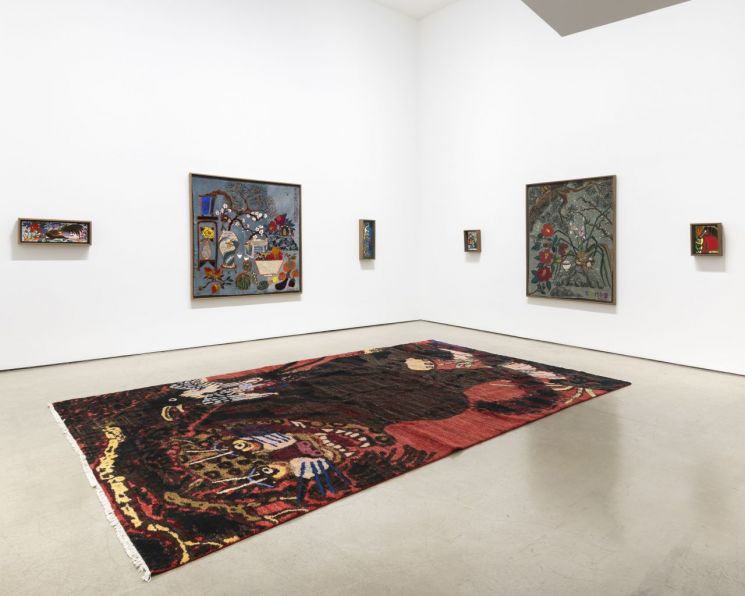
Kim Jipyung views East Asian painting formats such as chaekgado (bookshelf paintings), landscape painting, and mounting as structures that are reconfigured according to the era and social context, rather than as "closed frameworks." By rearranging discarded fragments of paintings and decorative elements, Kim evokes marginalized existences and omitted images, drawing new narratives from the fissures in tradition. In "Diva-Mu (Shaman)" (2026), Kim employs devices that bring to the fore the voices of shamans and women, as well as those pushed to the background, connecting the senses that existed "outside tradition" to alternative possibilities of the archetype. The "Brilliant Shell" series, referencing the folk painting "Hofido," expands symbolism and abstraction to newly weave the mystical power and narrative of the tiger into a contemporary sensibility.
On the second floor, Park Bangyoung and Lee Dowon translate the openness and irregularity of late Joseon dynasty folk painting into contemporary painting. Park Bangyoung uses hanji (traditional Korean paper) and ink as a base, adding mixed materials such as pearls, gold powder, and acrylic to create scenes where text and image coexist on a single canvas. The phrases arranged on the canvas function as part of the painting, evoking companionship with nature and attitudes toward life. Lee Dowon, instead of following institutionalized art education, combines natural materials collected from around the world with traditional ink to construct spontaneous compositions. While borrowing forms from traditional painting such as "Still Life with Objects" and "Great Spring Amidst Snow," Lee dismantles the hierarchy of symbols to place nature, animals, and humans as equals, thereby more actively revitalizing the original freedom inherent in tradition.
On the basement level one, the "structure" of traditional painting is expanded through its combination with technology. Ahn Sungmin creates surreal narratives by juxtaposing or deconstructing and recombining folk painting motifs with contemporary objects. The "Cloud Water_Scroll," utilizing laser cutting, translates the logic of repetition and transmission in production into digital terms, invoking not only images but also the systems of production, reproduction, and distribution. Kim Namkyung introduces a subtle 15-degree tilt to the strict order of chaekgado, destabilizing the viewpoint and proposing a sensory device that breaks away from fixed interpretations. The "Vignette" series, in which fragmented scenes come together to form a loosely connected whole, reflects the multi-layered perceptual structures of contemporary times.
 Interior view of the 'Hwaido (以道, The Way of Painting)' exhibition hall. Courtesy of Gallery Hyundai
At Dugahun Gallery, Jung Jaeun adopts the narrow folding screen format of "Irwolobongdo" (Sun, Moon, and Five Peaks) and repeats and varies the same painting motif. By varying the depth of color, density of lines, and the luminous effects of gold and silver powder, Jung alters the atmosphere of the canvas and reveals the potential for variation within repetition. The large-scale "Irwolobongdo" (2017) expands into a vertically symmetrical structure, creating a scene of "reflection" and visualizing a cosmological concept of circulation and balance. The "Chaekgado" and "Chaekgeori" series establish a stable tension through restrained color fields and the rhythm of geometric structures.
"Hwado" does not fix tradition as a form of the past, but redefines it as a "living archetype" that is regenerated within contemporary sensibilities. Rather than merely recalling images from the past, the exhibition captures the moment when the aesthetic DNA inherent within us is expressed in a contemporary language, simultaneously presenting the identity and the possibilities for expansion of modern Korean painting. The exhibition runs through February 28.
© The Asia Business Daily(www.asiae.co.kr). All rights reserved.

![Clutching a Stolen Dior Bag, Saying "I Hate Being Poor but Real"... The Grotesque Con of a "Human Knockoff" [Slate]](https://cwcontent.asiae.co.kr/asiaresize/183/2026021902243444107_1771435474.jpg)
















