Reports from 11 Affiliated Public Institutions in the Environmental Sector
On January 14, the Ministry of Climate, Energy and Environment announced that it received work reports from 11 affiliated public institutions in the environmental sector at the Government Sejong Complex and reviewed key tasks and priorities.
This work report session was held to assess whether each institution is establishing and implementing effective plans to carry out the new government's policy agenda and deliver tangible results to the public, as well as to check their fulfillment of public responsibilities as state-run organizations. The meeting was presided over by Minister Kim Seonghwan, with the heads of public institutions, the Vice Minister of the Ministry, and the directors of relevant bureaus and departments in attendance.
For Korea Water Resources Corporation, the ministry reviewed plans to strengthen responses to water-related disasters such as floods and droughts, strategies to advance water purification plant operations using artificial intelligence (AI), and plans to develop renewable energy using water resources, including floating solar power. The ministry also called for enhanced cooperation with related agencies to link power generation dams, reservoirs, and estuary barrages in preparation for climate disasters, as well as focused support for water industry startups.
In particular, the ministry requested efforts to improve the competitiveness of seawater desalination by linking it with renewable energy and developing low-power technologies. Regarding the newly implemented seasonal management system for algal blooms this year, the ministry emphasized thorough advance preparations, including reviewing effective strategies for opening weirs.
For Korea Environment Corporation, the ministry reviewed implementation management plans for the Emissions Trading Scheme and the mandatory use of recycled materials, as well as measures to strengthen the resource circulation of used automobile batteries, including enhancing the effectiveness of the National Battery Circulation Cluster.
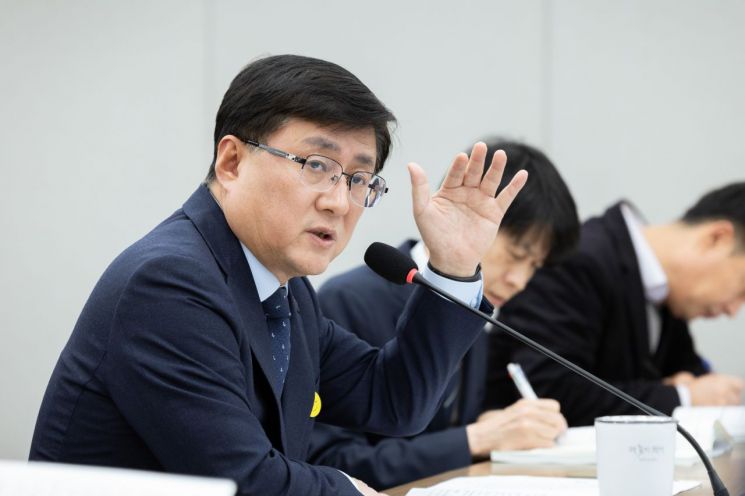 Climate, Energy and Environment Ministry's Environmental Sector Affiliated Agencies Work Report
(Seoul=Yonhap News) Kim Sung-hwan, Minister of the Ministry of Climate, Energy and Environment, is speaking at the work report meeting of environmental sector affiliated agencies held at the Government Sejong Complex on January 14, 2026. [Provided by the Ministry of Climate, Energy and Environment. Resale and database prohibited]
Photo by Yonhap News (End)
For Korea National Park Service, the ministry reviewed comprehensive operation and management plans following the designation of Geumjeongsan National Park, strategies to enhance ecosystem services such as introducing a national recreation park system, and wildfire response systems. In particular, the ministry focused on plans to address illegal occupancy facilities within national parks and stressed the need for swift removal and strict law enforcement to eradicate illegal activities at their source. The ministry also called for collaboration with related agencies, customized promotional activities, and the development of visitor programs to increase visits by foreign tourists to national parks.
For the National Institute of Ecology, the ministry urged more systematic and proactive efforts to make the institution an international attraction that people from around the world want to visit, by linking local ecological resources such as the Janghang Wetlands. For Korea Environmental Industry and Technology Institute, the ministry reviewed plans to promote carbon-neutral technology development, expand green finance, and foster the carbon-neutral industry.
For the Metropolitan Landfill Management Corporation, the ministry reviewed the landfill facility operation system in line with this year's ban on direct landfill in the metropolitan area, as well as plans to utilize idle land for resident-participation solar power projects. The ministry emphasized the need to quickly expand the pilot project to reduce greenhouse gases (methane) using simple incinerators, which is currently being implemented at some small-scale local landfill sites, to the entire country.
Along with reviewing each institution's key initiatives, the ministry strongly called for responsible roles as public institutions, including industrial safety, the eradication of corruption, job creation, and balanced regional development, as well as robust management innovation that meets public expectations.
Minister Kim stated, "By bringing together the capabilities of the Ministry and public institutions, we will do our utmost to create a sustainable society where people and nature coexist and to enhance the precious value of the environment."
© The Asia Business Daily(www.asiae.co.kr). All rights reserved.












