Conscious of Japan-China Tensions
"Emphasizing a Strong Relationship with South Korea to the World"
Attention on Whether a Minister Will Be Dispatched to 'Takeshima Day'
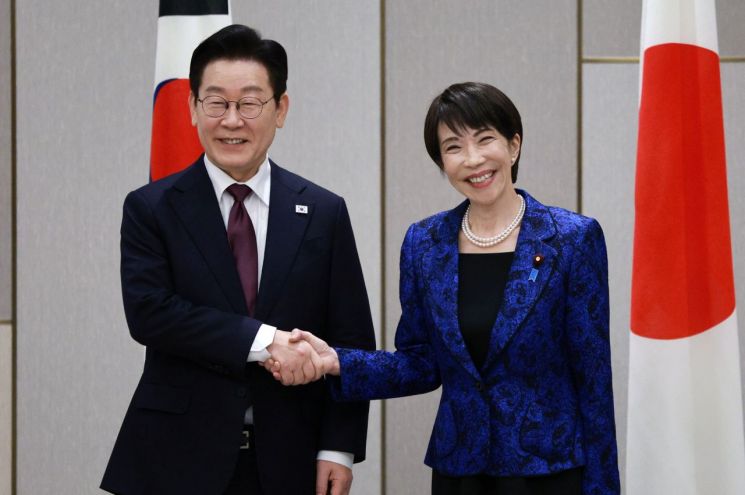 President Lee Jae-myung (left) and Japanese Prime Minister Sanae Takaichi shake hands ahead of the expanded talks at the summit venue in Nara Prefecture, Japan, on the 13th. Photo by Yonhap News
On January 14, major Japanese media outlets highlighted the achievements of the previous day’s summit between President Lee Jae-myung and Japanese Prime Minister Sanae Takaichi, particularly emphasizing progress in economic security negotiations such as supply chain cooperation. However, some analyses also pointed out that sensitive issues remain, such as the Dokdo dispute, which is intertwined with the two countries’ differing perceptions of history and territory.
After the summit, Prime Minister Takaichi stated in a joint press announcement that the two countries agreed to pursue cooperation to strategically secure mutual interests in the field of economic security and to continue discussions among relevant ministries. She added, "I had in-depth discussions with President Lee on supply chain cooperation."
The conservative Sankei Shimbun interpreted the push for economic security cooperation as being mindful of export controls on dual-use goods by China. Yomiuri Shimbun also reported that the aim of strengthening economic security cooperation is to coordinate with South Korea amid growing economic pressure from China. Asahi Shimbun analyzed that, with Japan-China relations deteriorating due to remarks made by Prime Minister Takaichi, she is also seeking to demonstrate a solid relationship with South Korea both domestically and internationally.
In November of last year, Prime Minister Takaichi hinted at possible intervention in the event of a Taiwan contingency during a parliamentary session, leading to a deterioration in bilateral relations. China has since demanded a retraction of her remarks and has increased economic pressure, but Japan has shown no signs of backing down. On January 6, China escalated its pressure by introducing export controls on dual-use (military and civilian) goods containing rare earth elements against Japan.
Cooperation on Remains DNA Analysis Downplayed
However, Sankei Shimbun downplayed the humanitarian agreement between the two leaders to cooperate on DNA analysis of remains from the Josei undersea coal mine in Yamaguchi Prefecture.
In the joint press announcement, President Lee stated, "In 1942, an accident at Japan’s Josei coal mine resulted in the drowning deaths of 183 Koreans and Japanese, and it was only last August-over 80 years later-that the remains were discovered." He added, "The two countries have agreed to proceed with DNA analysis to identify the remains, and the relevant authorities will hold practical discussions on the specifics."
The newspaper noted that while President Lee is pursuing pragmatic diplomacy, some of his supporters are disappointed with his handling of historical issues. It commented, "There appears to be an intention to highlight progress in cooperation by choosing the Josei coal mine issue, where confrontation between the two countries is less likely to surface."
Ministerial Dispatch to 'Takeshima Day' Is the Key Issue
With "Takeshima Day" (Japan’s name for Dokdo) scheduled for February 22, the Dokdo issue has been identified as a potential source of conflict in bilateral relations.
Prime Minister Takaichi, who has a conservative support base, argued during last year’s Liberal Democratic Party presidential election that the government representative sent to the Shimane Prefecture-hosted Takeshima Day event should be upgraded from a parliamentary vice-minister to a full minister. However, since becoming Prime Minister, she has taken a more pragmatic approach, such as postponing visits to the Yasukuni Shrine.
Sankei Shimbun predicted that the response to Takeshima Day would be a test for President Lee’s pragmatic diplomacy. Yomiuri Shimbun reported that, ahead of the Takeshima Day event, there is caution on the Korean side about reigniting conflict, and interpreted President Lee’s remarks-"Let us manage the uncomfortable and negative aspects well and minimize them as we move toward a better future"-as a call for a measured response.
At a regular press briefing on the same day, Chief Cabinet Secretary Minoru Kihara, spokesperson for the Japanese government, was asked whether a minister-level official would be dispatched to next month’s event. He replied only, "We will respond appropriately based on the overall situation." Asahi Shimbun reported that among Japanese government officials, there is a growing expectation that a minister will not be sent to Takeshima Day.
© The Asia Business Daily(www.asiae.co.kr). All rights reserved.












