Summit Lasts 88 Minutes... Joint Press Announcement
Agreement to Continue Working-Level Consultations on Identifying Josei Coal Mine Victims' Remains
Takaichi Stresses Regional Peace and Security Cooperation, but Avoids Mentioning China
Bui
President Lee Jaemyung, who is visiting Nara Prefecture in Japan to continue shuttle diplomacy between South Korea and Japan, met with Japanese Prime Minister Sanae Takaichi for 88 minutes and agreed to hold concrete working-level consultations to identify the remains of victims from the Josei Coal Mine. In addition, while relations between China and Japan are deteriorating due to export bans on rare earth elements and other measures, President Lee emphasized the need for communication and cooperation among South Korea, China, and Japan, and also agreed to maintain close coordination on North Korea policy. In contrast, Prime Minister Takaichi stressed the need to strengthen South Korea-Japan and South Korea-US-Japan cooperation for complete denuclearization of North Korea and regional peace and stability, but avoided making direct comments regarding relations with China.

After the summit on the 13th, President Lee announced in a joint press statement that "the two countries will proceed with DNA testing to identify the remains from the Josei Coal Mine accident, and specific matters will be discussed through working-level consultations between the relevant authorities." He added, "I find it meaningful that, through this summit, we were able to achieve small but significant progress on historical issues." Prime Minister Takaichi also responded positively to the agreement, saying, "I welcome the coordination between South Korea and Japan."
The Josei Coal Mine was an undersea mine where over 130 Korean laborers were forcibly conscripted during the Pacific War. In 1942, the mine collapsed, resulting in the deaths of 183 Koreans and Japanese, including Japanese nationals. It was only in August last year, more than 80 years later, that remains were discovered for the first time.
While both leaders agreed to closely coordinate on North Korea policy, a difference in stance between South Korea and Japan regarding China was evident. In the press statement, President Lee emphasized to Prime Minister Takaichi the importance of the three Northeast Asian countries-South Korea, China, and Japan-finding as much common ground as possible to communicate and cooperate together.
Prime Minister Takaichi responded by saying, "We have agreed to pursue cooperation to strategically secure mutual interests in the field of economic security and to continue discussions between the relevant ministries," adding only that she and President Lee held in-depth discussions on supply chain cooperation. By avoiding direct comments on the worsening China-Japan relationship due to China's export bans on rare earth elements and other measures, she appeared to be requesting strengthened supply chain cooperation between South Korea and Japan.
President Lee also reiterated his commitment to the complete denuclearization of the Korean Peninsula and presented a vision for peace through the resumption of dialogue. He explained, "South Korea and Japan have reaffirmed their shared commitment to the complete denuclearization of the Korean Peninsula and the establishment of peace, and agreed to maintain close coordination on North Korea policy." In response, Prime Minister Takaichi said, "Japan, South Korea, and the United States will cooperate and respond closely to achieve the complete denuclearization of North Korea." However, regarding the issue of Japanese nationals abducted by North Korea, while Prime Minister Takaichi expressed gratitude for President Lee's strong support during the summit, President Lee did not include this matter in his official statement.
Strengthening Cooperation on Transnational Crime, Agreement to Adopt Joint Statement... Deepening Collaboration on AI and Intellectual Property Protection
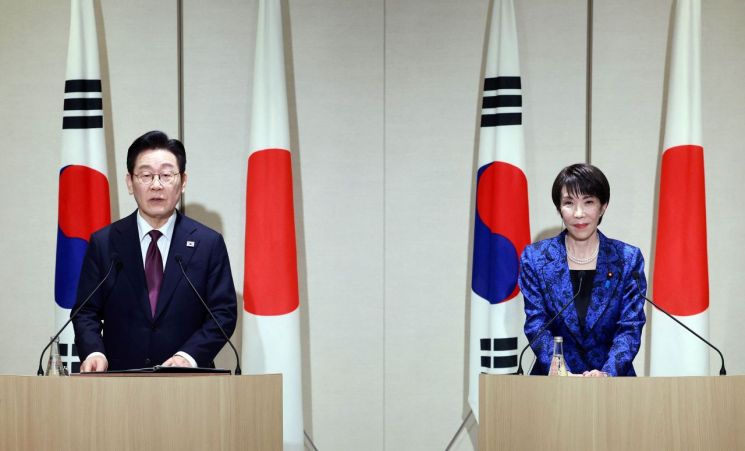
The two countries also agreed to strengthen cooperation and coordination in the economic sector and in responding to transnational crimes, building on the foundation of shuttle diplomacy established thus far. President Lee stated, "We agreed on the need for comprehensive cooperation to go beyond trade-centered collaboration and jointly establish economic security, science and technology, and international norms," adding that discussions between the relevant authorities would begin for this purpose. In particular, President Lee noted, "We also agreed to continue working-level consultations to deepen cooperation in areas such as artificial intelligence (AI) and intellectual property protection."
In the social sector, both sides acknowledged the achievements of the "South Korea-Japan Common Social Issues Council," established last year, which has discussed topics such as low birth rates and aging populations, balanced national development, agriculture and disaster prevention, and suicide prevention. President Lee stated, "Let us produce tangible results in addressing common challenges such as regional growth." Regarding the response to transnational crimes such as scam offenses, he explained, "Japan has decided to participate in the international cooperation council launched by our National Police Agency, and we have also agreed to adopt a joint statement to provide institutional support for this cooperation."
President Lee also proposed expanding people-to-people exchanges. He said, "In this era of 12 million people-to-people exchanges, enhancing mutual understanding among future generations is the foundation of a future-oriented South Korea-Japan relationship." He proposed measures such as simplifying immigration procedures, encouraging school trips, and expanding the current mutual recognition of technical qualifications, which is limited to the IT sector, to other fields.
This summit between South Korea and Japan was the fifth since President Lee took office, and the second since former Prime Minister Shigeru Ishiba resigned and Prime Minister Takaichi assumed office. The summit lasted a total of 88 minutes, with a 20-minute small-group meeting and a 68-minute expanded meeting. After completing the small-group and expanded meetings and holding a joint press statement, the two leaders also had a one-on-one conversation and dinner together.
'Transformed into Drummers': South Korean and Japanese Leaders Perform 'Golden' by K-Pop Demon Hunters Together During Conversation... On the Second Day of the Visit, Both Leaders Tour Horyu-ji

During the conversation, the Japanese side arranged a surprise event that had not been disclosed in advance. Both leaders wore blue uniforms prepared by the Japanese side and sat together in front of drums from "Pearl," a leading Japanese musical instrument brand, to give an impromptu drum performance. According to the Blue House, this event was specially prepared by the Japanese side to symbolically demonstrate the rapport and closeness between the two leaders, as they performed "Golden" by K-Pop Demon Hunters and "Dynamite" by BTS together, turning the conversation into a special occasion for cultural exchange.
Kim Namjoon, spokesperson for the Blue House, stated, "At this event, President Lee remarked, 'Today, I fulfilled a lifelong dream. I have wanted to play the drums since I was a child.' Prime Minister Takaichi personally explained how to play the drums to President Lee and led the joint performance." At the event, Prime Minister Takaichi presented drumsticks to President Lee, and both leaders signed their drumsticks and exchanged them. Kim added that the uniforms worn by the leaders were embroidered with their respective national flags and English names, further symbolizing the friendship and mutual respect between the South Korean and Japanese leaders, even during this unexpected event.
Meanwhile, on the second day of the visit, January 14, President Lee and Prime Minister Takaichi toured Horyu-ji, a representative cultural heritage site in Nara Prefecture, as part of a friendship event in the morning. The two leaders listened to explanations from a Horyu-ji monk about the temple and its stone pagoda. President Lee reportedly commented, "It is truly magnificent." Horyu-ji is the oldest wooden structure in the world and was registered as Japan's first UNESCO World Heritage Site in 1993. In particular, the wooden statue of Avalokitesvara Bodhisattva (Baekje Gwaneum) preserved at Horyu-ji is believed to have been made by a Baekje artisan as a gift or by a Baekje person who migrated to Japan.
© The Asia Business Daily(www.asiae.co.kr). All rights reserved.