"Warrant to Compel Kim Beomseok's Attendance if He Fails to Appear as a Witness"
The Democratic Party of Korea has submitted a request for a parliamentary investigation into Coupang, which has been uncooperative with the joint parliamentary hearing, regarding large-scale personal data leaks and industrial accidents and deaths involving workers. The party also stated that if Coupang Inc. founder and chairman Kim Beomseok continues to refuse to appear before the National Assembly, they are considering issuing a warrant to compel his attendance.
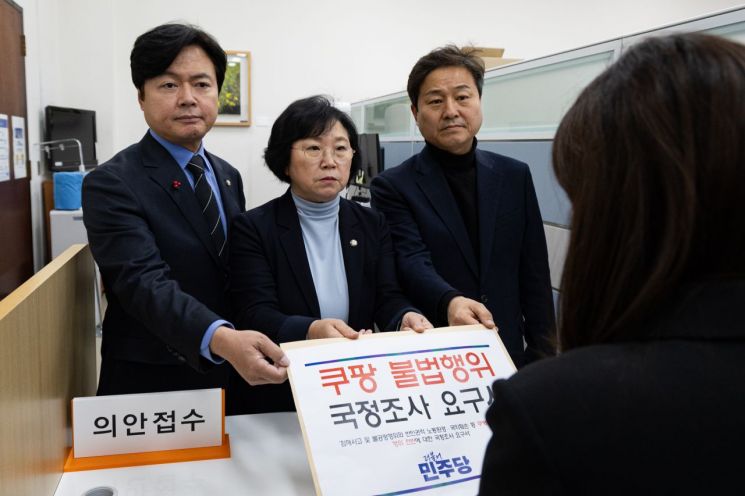
On December 31, Kim Hyun, ruling party secretary of the Science, ICT, Broadcasting and Communications Committee, Kim Youngbae, ruling party secretary of the Foreign Affairs and Unification Committee, and Kim Hyunjung, floor spokesperson, submitted a request for a parliamentary investigation into Coupang’s illegal corporate activities to the National Assembly’s bill department.
Despite joint parliamentary hearings being held from the previous day through today, Coupang has shown an uncooperative attitude, with Chairman Kim’s absence and insufficient submission of materials. The Democratic Party has already announced its intention to pursue a parliamentary investigation. The scope of the investigation includes personal data leaks, worker deaths and industrial accidents, and issues related to unfair business practices.
Issuing a warrant to compel Chairman Kim’s attendance is also under consideration. Kim Hyun told reporters, “A parliamentary investigation must be carried out by agreement between the ruling and opposition parties. If the investigation plan is adopted and witnesses are selected, but Chairman Kim remains unresponsive, we will issue a warrant to compel his attendance.”
Kim Hyunjung, the floor spokesperson, stated, “If we exhaust all means to require his attendance and Chairman Kim still refuses to appear, we have already requested that the relevant authorities consider not only filing a complaint but also imposing an entry ban. According to Article 11 of the Immigration Control Act, if a foreign national is deemed likely to harm the domestic economy or society, an entry ban can be imposed.”
According to the Act on the National Assembly’s Investigation of State Affairs, a parliamentary investigation can proceed if requested by at least one-quarter of the total members. Once the request is submitted, the Speaker of the National Assembly forms an investigation committee through consultations between the ruling and opposition negotiation groups. The committee then submits an investigation plan, detailing the purpose, matters, scope, and methods, to the plenary session for approval.
Kim Hyunjung emphasized, “The People Power Party refused to agree to the joint parliamentary hearing and instead demanded a parliamentary investigation. If the People Power Party does not participate in this investigation, it will be clear that their previous statements were untrue. The People Power Party must actively cooperate with the parliamentary investigation without further excuses.” The People Power Party boycotted the joint hearing, insisting that a parliamentary investigation should be pursued instead.
© The Asia Business Daily(www.asiae.co.kr). All rights reserved.












