Joint Declaration by the Task Force for the Roadmap to Reduce Actual Working Hours
"Goal: Reduce Working Hours to Around 1,700 Hours by 2030"
For the first time, the government, labor unions, and business groups have jointly declared a social agreement to reduce actual working hours. The tripartite parties have set a shared goal of lowering South Korea’s actual working hours to the annual 1,700-hour range, which is the average among Organisation for Economic Co-operation and Development (OECD) countries, by 2030. They also agreed to jointly pursue improvements in the working hours system and innovations in work methods to shift away from practices centered on long working hours.

On December 30, the Ministry of Employment and Labor held a public briefing at the R.ENA Convention Center in Jung-gu, Seoul, to announce the results of discussions by the “Actual Working Hours Reduction Roadmap Task Force” and released the tripartite joint declaration. This declaration involved participation from the government, labor groups such as the Federation of Korean Trade Unions and the Korean Confederation of Trade Unions, as well as business groups including the Korea Employers Federation and the Korea Federation of SMEs.
In the joint declaration, the tripartite parties diagnosed that Korean society is undergoing a major transformation in its industrial and social structure due to factors such as low birth rates, an aging population, digital transformation, and the spread of artificial intelligence (AI). They acknowledged that, although institutional reforms have been implemented to improve the structure of long working hours, certain industries and workplaces still rely on such practices, resulting in actual working hours that remain above the OECD average.
The tripartite parties stated that reducing actual working hours is not simply about decreasing the total amount of work, but is a core task for restoring work-life balance and creating conditions that allow workers to plan for their futures. They emphasized that this is particularly important for improving the quality of life for working parents and the younger generation, as well as being a key solution to alleviating the low birth rate. At the same time, they agreed that reducing actual working hours is a national task essential for boosting productivity and achieving sustainable growth.
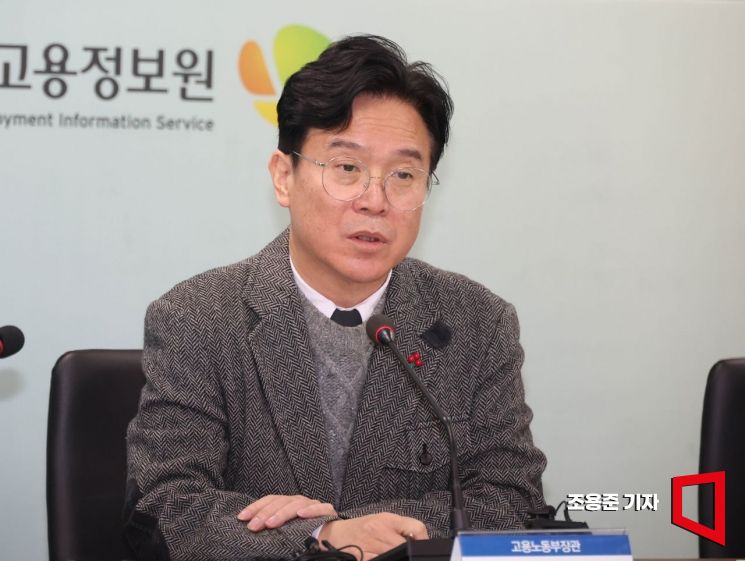 Kim Younghoon, Minister of Employment and Labor, is attending and speaking at the final report meeting of the "AI Industrial Transformation and Job Forum" held at the Korea Research Institute for Vocational Education and Training in Jung-gu, Seoul on December 17, 2025. Photo by Jo Yongjun
Accordingly, the tripartite parties pledged to work together to reduce actual working hours to the OECD average of around 1,700 hours per year by 2030. They set as a joint goal that reducing actual working hours will not only improve workers’ quality of life and help prevent industrial accidents, but also expand labor market participation among vulnerable groups such as youth, women, and the elderly, while providing a foundation for enhancing corporate productivity and innovation capabilities.
The declaration also clarified the division of roles. Labor and management agreed to cooperate in improving unreasonable practices that lead to long working hours and in creating workplaces where people can work efficiently and be fairly compensated. The government will support the effective reduction of actual working hours in the field through legal and institutional improvements, labor inspections, and customized support for vulnerable sectors. The tripartite parties shared the view that reducing actual working hours is a process of shifting from quantitative to qualitative labor and agreed to seek necessary alternatives together.
Transforming a labor culture centered on long working hours into a productivity-focused and efficient work culture is another key aspect of the joint declaration. The tripartite parties agreed that the flexibility of working hours should not be a means to expand long working hours, but rather a system that enables the reduction of actual working hours through more efficient work. They presented a direction to reduce inefficient practices such as unnecessary overtime and meetings and to shift toward more efficient ways of working through focus, collaboration, and the use of technology. The government will support this by improving systems and enhancing the work environment.
Guaranteeing workers’ rest and safety was also specified as an important principle. The tripartite parties confirmed that sufficient rest and safety are core tasks of working hours policy and agreed to strengthen protective measures in areas with high health burdens, such as shift work and night work. They pledged to work together to guarantee workers’ right to recovery by ensuring adequate rest periods, annual leave, and the active use of half-day leave.
The declaration also included the principle of preventing new disparities from arising during the process of reducing actual working hours, depending on company size, industry, or employment type. To ensure that the benefits of reduced working hours are shared equally among all workers, labor and management will strengthen cooperation, while the government will expand consulting services, automation and digital transformation (DX), and financial support for small and medium-sized enterprises and small business owners.
The tripartite parties agreed to use this joint declaration as an opportunity to continue social dialogue based on coexistence and trust. Starting with the discussions of the “Actual Working Hours Reduction Roadmap Task Force,” they plan to continue consultations to address the national task of reducing actual working hours.
Minister of Employment and Labor Kim Younghoon stated, “This is an occasion where the tripartite parties responsibly promise the public the results of sincere communication and compromise on the long-standing social issue of reducing actual working hours,” adding, “This joint declaration will strengthen trust among the tripartite parties and serve as an important milestone for future social dialogue.”
© The Asia Business Daily(www.asiae.co.kr). All rights reserved.













