Industrial Activity Trends for November 2025
"Base Effect Compared to October and Chuseok Holiday"
Last month, consumption saw its largest decline in 21 months due to base effects. In contrast, indicators for production, investment, and construction-particularly centered on semiconductors-showed slight improvement, highlighting a mixed economic outlook.
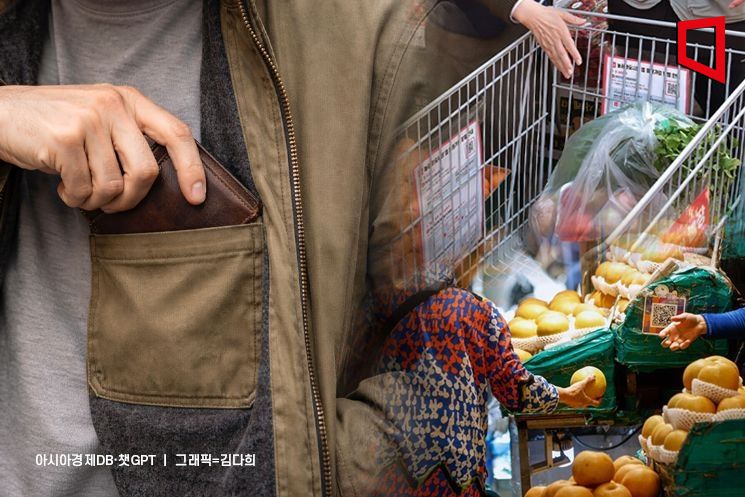
According to the "November 2025 Industrial Activity Trends" released by the National Data Agency on December 30, retail sales last month fell by 3.3% compared to the previous month. This marks the largest drop in 21 months since February of last year, when it fell by 3.5%. Retail sales recorded negative growth in August (-2.4%) and September (-0.1%), but turned positive in October (3.6%) thanks to the Chuseok holiday and consumption coupons. However, due to base effects, sales sharply declined again in just one month.
The sluggish consumption was evident across all product categories. Sales of non-durable goods, including food, beverages, and pharmaceuticals, decreased by 4.3% from the previous month. Semi-durable goods, such as clothing and leisure, hobby, and sporting goods, also dropped by 3.6%. Durable goods sales, including telecommunications devices and computers, fell by 0.6%. By retail type, large discount stores (-8.3%) and supermarkets/general merchandise stores (-4.8%) saw particularly sharp declines. In contrast, non-store retail and passenger car/fuel retailers maintained an upward trend.
The primary reason cited for the sharp contraction in consumption was the base effect from the surge in October. Lee Dowon, Director of Economic Trend Statistics at the National Data Agency, explained, "Rather than the effect of the livelihood recovery consumption coupons disappearing, it was mainly due to the reverse base effect from the surge in October and the shift in consumption timing." The extended Chuseok holiday led to earlier purchases of food and beverages, and an early cold snap concentrated winter clothing sales in October, resulting in a decline last month.
The sharp rise in the won-dollar exchange rate was also mentioned as a factor restraining consumer sentiment. Lee noted, "With the exchange rate rising, the prices of imported consumer goods and overseas direct purchase items have increased, which may reduce related consumption." However, he added that it is difficult to calculate the exact contribution. Regarding the impact of online shopping or specific platform issues, such as the Coupang hacking incident last month, he stated, "It is difficult to say that incidents occurring in November were fully reflected in the indicators."
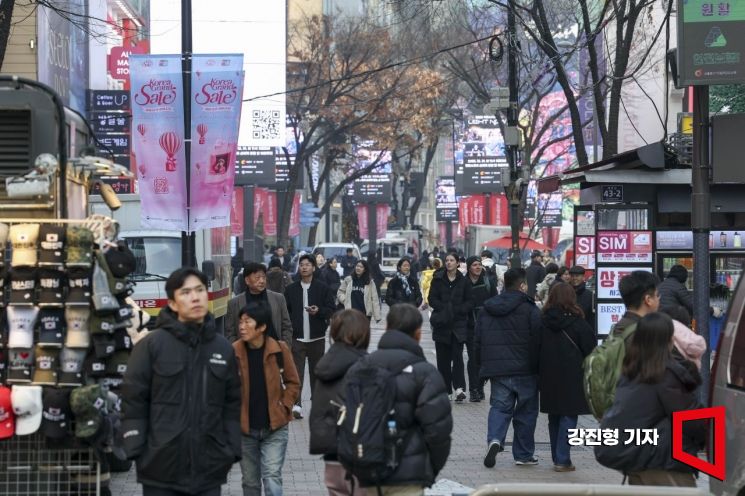 On the 17th, a banner announcing the "2026 Korea Grand Sale" was hung on Myeongdong Street in Jung-gu, Seoul. The Korea Grand Sale is Korea's representative shopping tourism festival, held since 2011 based on private sector participation in various fields such as aviation, accommodation, shopping, food and beverage, experiences, and convenience services to promote foreign tourists' visits and consumption during the off-season for inbound tourism. Especially this time, the event period has been moved up to December to allow more foreigners to benefit. 2025.12.17 Photo by Kang Jinhyung
Unlike consumption, production showed improvement, led by semiconductors. In November, total industrial production increased by 0.9% compared to the previous month. After a decline in August (-0.3%), it rebounded in September (1.3%), fell again in October (-2.7%), and then turned positive within a month.
The production recovery was driven by semiconductors and electronic components. Semiconductor production increased by 7.5% from the previous month, while demand for mobile organic light-emitting diodes (OLEDs) rose due to robust new smartphone sales, resulting in a 5.0% increase in electronic component production. As a result, manufacturing output rose by 0.6% from the previous month. Lee assessed, "There was a base effect from a sharp decline in semiconductor production last month, and the semiconductor market itself remains robust due to end-of-year and quarter-end effects as well as contract volume reflections." Service sector production also increased by 0.7%, mainly in finance and insurance, association, repair, and personal services, supporting the overall rise in industrial production.
Investment indicators also rebounded slightly. Facility investment increased by 1.5% from the previous month. While the base effect from a 14.1% plunge in October was significant, machinery investment-including general industrial machinery-rose by 5.0%, driving the overall increase. Construction completion (constant price), which reflects construction industry output, increased by 6.6% from the previous month due to higher building construction performance. This was influenced by an expansion in both residential and non-residential construction volumes.
Overall, the three major industrial activity indicators-production, retail sales, and facility investment-were all heavily affected by base effects, making it difficult to accurately assess the economic trend.
Economic sentiment indicators also remained mixed. The coincident composite index cyclical component, which shows the current economic situation, fell by 0.4 points from the previous month, marking two consecutive months of decline. The drop was attributed to decreases in the domestic shipment index, manufacturing output, and construction completion. In contrast, the leading composite index cyclical component, which predicts future economic trends, rose by 0.3 points from the previous month. This was due to improvements in some leading indicators, such as the KOSPI index and interest rate differentials. Lee stated, "We are watching to see if the rebound since the beginning of the year will continue, but recovery in construction and domestic shipments is still not clear, so the economic improvement trend is being delayed."
© The Asia Business Daily(www.asiae.co.kr). All rights reserved.













