November 2025 Industrial Activity Trends
Consumption Sees Largest Decline in 21 Months
"Base Effect from Consumption Coupons and Chuseok in October"
Last month, consumption saw its largest decline in 21 months due to base effects. In contrast, production and investment posted slight increases.

According to the "Industrial Activity Trends for November 2025" released by the National Data Office on the 30th, retail sales in November fell by 3.3% compared to the previous month. This marks the largest decline in 21 months since February of last year (-3.5%). Analysts attribute this to a base effect, as retail sales in October had risen by 3.6% due to the issuance of consumption coupons and the Chuseok holiday.
Total industrial production, which had decreased by 2.7% in October, increased by 0.9% in November. Facility investment, which had dropped by 14.1% in October, also rose by 1.5%. Overall, all three major indicators of industrial activity-production, retail sales, and facility investment-were heavily influenced by base effects, making it difficult to accurately assess the economic trend.
Specifically, retail sales of non-durable goods such as food, beverages, and pharmaceuticals fell by 4.3%, and sales of semi-durable goods such as clothing and recreational goods decreased by 3.6%. Durable goods, including telecommunications devices and computers, also declined by 0.6%. However, compared to the same month last year, sales of durable goods such as passenger cars (up 4.1%) and non-durable goods such as pharmaceuticals (up 0.2%) increased, resulting in an overall 0.8% year-on-year rise in retail sales.
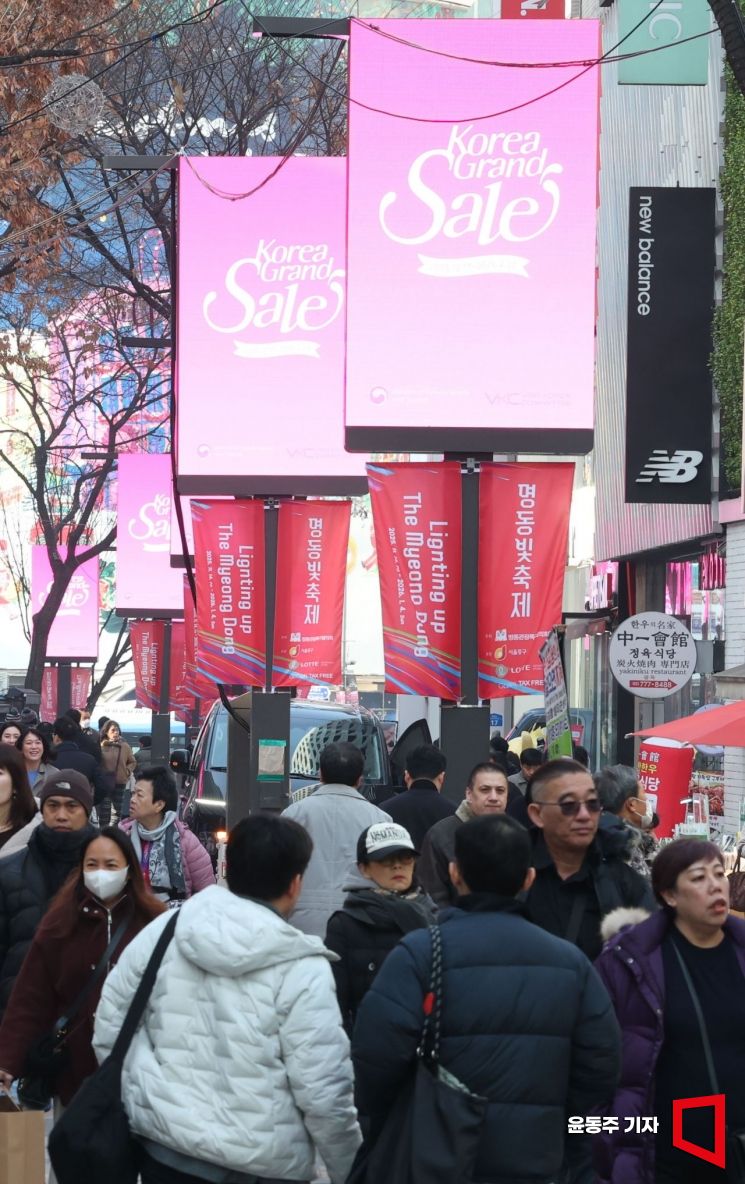 On the 17th, the promotional video for the 2026 Korea Grand Sale is being displayed on an electronic billboard set up on Myeongdong Street in Jung-gu, Seoul. 2025.12.17 Photo by Yoon Dongju
Production increased, with service sector output rising by 0.7% thanks to growth in financial and insurance services (2.2%) and association, repair, and personal services (11.1%). Mining and manufacturing output also climbed by 0.6%, driven by increases in semiconductors (7.5%) and electronic components (5.0%).
Facility investment grew by 1.5% from the previous month, as investment in machinery such as general industrial equipment and semiconductor inspection devices increased. Construction output rebounded, rising by 6.6% from the previous month, as both non-residential and residential building performance improved. However, compared to the same month last year, construction output decreased by 17.0%.
Economic indicators were mixed. The coincident composite index, which reflects current economic conditions, fell by 0.4 points from the previous month. In contrast, the leading composite index, which forecasts future economic trends, rose by 0.3 points, influenced by a rise in the KOSPI and widening interest rate differentials.
© The Asia Business Daily(www.asiae.co.kr). All rights reserved.













