As movie attendance declined, it was found that the rate of direct participation in cultural and artistic events by Koreans decreased this year. The direct attendance rate refers to attending cultural and artistic events in person, without using media such as TV or smartphones.
Although the rate of direct attendance at cultural and artistic events decreased, the participation rate in such events increased, and the annual leave usage rate approached 80%, marking the highest level since the survey began.
The Ministry of Culture, Sports and Tourism, together with the Korea Culture and Tourism Institute, announced the results of the 2025 national statistics in the cultural sector on December 26: ▲National Survey on Cultural and Artistic Activities, ▲National Leisure Activity Survey, ▲and Workers' Vacation Survey.
Movie Attendance Rate Drops by 6.4 Percentage Points...Pop Music and Art Increase
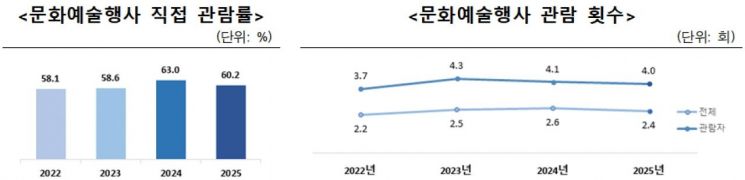
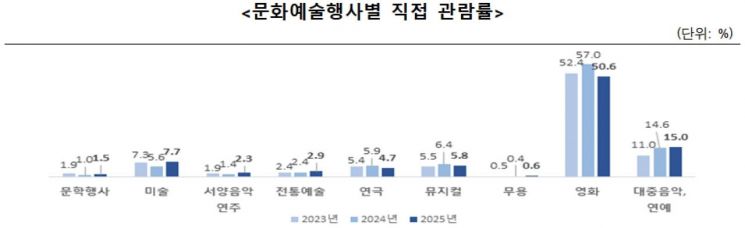
The "direct attendance rate at cultural and artistic events," a key indicator of cultural enjoyment, was 60.2%, a decrease of 2.8 percentage points from the previous year. By category, attendance rates were as follows: movies (50.6%), pop music and entertainment (15%), art (7.7%), and musicals (5.8%). The movie sector maintained the highest attendance rate among all categories but saw a 6.4 percentage point drop from the previous year. In contrast, pop music and entertainment increased by 0.4 percentage points, and art rose by 2.1 percentage points compared to last year.
The "average number of direct attendances at cultural and artistic events" was 2.4 times, a decrease of 0.2 times from the previous year. By age group, those aged 15-19 saw a 2.1 percentage point increase compared to 2024, but all other age groups experienced a decline in direct attendance rates. The decline was most pronounced among those in their 40s, with a drop of 7.1 percentage points.
However, the "indirect attendance rate at cultural and artistic events" using various media such as smart devices was 72.0%, up 0.4 percentage points from the previous year. All categories except movies (which fell by 1.1 percentage points) either maintained or increased their rates, with pop music and entertainment showing the largest increase (up 1.8 percentage points from the previous year).
The "participation rate in cultural and artistic events," which refers to participation in presentations, exhibitions, and creative activities related to culture and the arts, was 5.8%, up 1.1 percentage points from the previous year. The "experience rate of cultural and arts education" was 8.6%, a 2.2 percentage point increase from the previous year. This indicates that while simple viewing activities decreased, active participation in cultural and artistic events increased.
Average Daily Leisure Time: 3.8 Hours...Average Spending: 185,000 Won
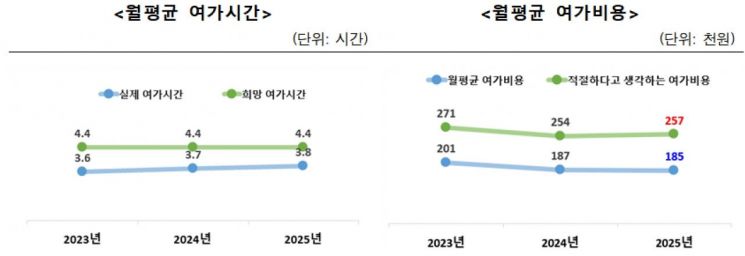
The average number of "leisure activities participated in at least once" per person in Korea was 15.7, a decrease of 0.7 compared to the previous year. This figure represents the number of leisure activities, out of a total of 88 detailed types, that each person participated in at least once.
The average daily leisure time per person was 3.8 hours on weekdays, an increase of 0.1 hours from the previous year. However, average monthly leisure spending was 185,000 won, a decrease of 2,000 won from the previous year.
The proportion of "continuously participated leisure activities" was 43.2%, up 4.7 percentage points from the previous year. The rate of leisure activity participation increased across all age groups and genders, with notable increases among those aged 15-19 (up 14.3 percentage points), those in their 50s (up 5.7 percentage points), and those in their 40s (up 4.6 percentage points). Satisfaction with leisure life also increased by 2.4 percentage points from the previous year, reaching its highest level since 2016.
By type of leisure activity, participation rates in "sports" and "culture and arts" increased by 2 percentage points and 1.8 percentage points, respectively, compared to the previous year. However, participation in "hobbies and entertainment" and "viewing of cultural and artistic events" decreased by 2.5 percentage points and 1.3 percentage points, respectively.
Looking at individual leisure activities, "watching mobile content and online video services (OTT)" increased by 5.1 percentage points, "running and jogging" by 2 percentage points, and "meeting friends" by 1.2 percentage points. In contrast, "watching television (TV)" decreased by 4 percentage points, and "watching movies" dropped by 1.9 percentage points, indicating a growing preference for active participation over simple viewing.
Regarding "leisure companions," the breakdown was as follows: alone (56.6%), with family (29.4%), with friends or significant others (11.6%), with club members (1.6%), and with colleagues (0.7%). The proportion of people spending leisure time alone, with club members, or with colleagues increased, while the proportion spending time with friends/significant others or family decreased, indicating a growing preference for leisure companions within social relationships. The main purposes of leisure activities were personal enjoyment (39.8%), peace of mind and relaxation (23.5%), and health (13.2%).
Annual Leave Usage Rate Hits Record High at 79.4%...Spending Rises to 2.21 Million Won
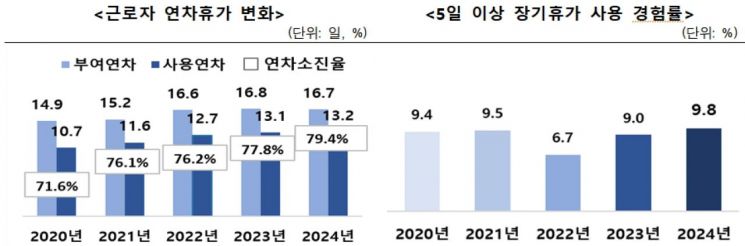
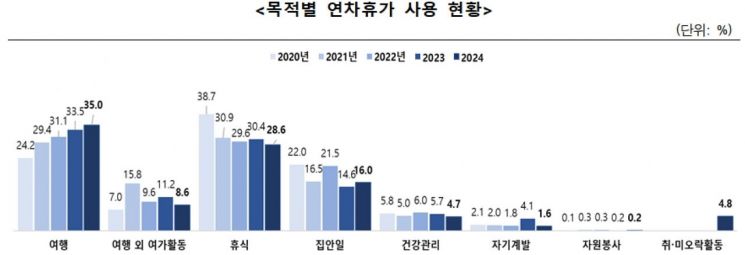
The annual leave usage rate was 79.4%, up 1.6 percentage points from the previous year, marking the highest level since the Workers' Vacation Survey began in 2018. Travel accounted for 35% of annual leave usage, maintaining the highest proportion since 2022, followed by rest (28.6%) and housework (16.0%).
Looking at monthly usage, August had the highest rate at 15.3%, indicating that annual leave is still concentrated during the summer vacation period. However, usage rates in February through June, October, and December increased compared to the previous year, showing a trend toward more evenly distributed vacation usage. The amount spent during annual leave was 2,212,000 won, and this figure has been steadily increasing. Spending was only 853,000 won in 2020, then rose to 1,133,000 won in 2021, 1,386,000 won in 2022, and 1,722,000 won last year.
The most important condition for smooth vacation use over the past five years has been "a free atmosphere for vacation use in the workplace." Workers' perceptions of vacation showed positive effects on life (76.1 points), improved work concentration (75.6 points), enjoyment from simply resting (75.1 points), and impact on productivity (74.6 points), indicating that using annual leave is perceived as having a significant positive effect on both personal life and workplace efficiency.
Detailed results of this survey will be available on the Culture Center website and the Cultural Arts Knowledge Information System in the future.
Lee Jeongwoo, Director General for Culture and Arts Policy at the Ministry of Culture, Sports and Tourism, stated, "This survey confirmed that the public's cultural and leisure activities are shifting toward a preference for more active participation," adding, "The Ministry will carefully analyze the status of cultural and leisure activities among the public and reflect these findings thoroughly in future policy planning."
© The Asia Business Daily(www.asiae.co.kr). All rights reserved.














