Presenting Future Strategies in Clean Energy, Aerospace, Tourism, and SOC
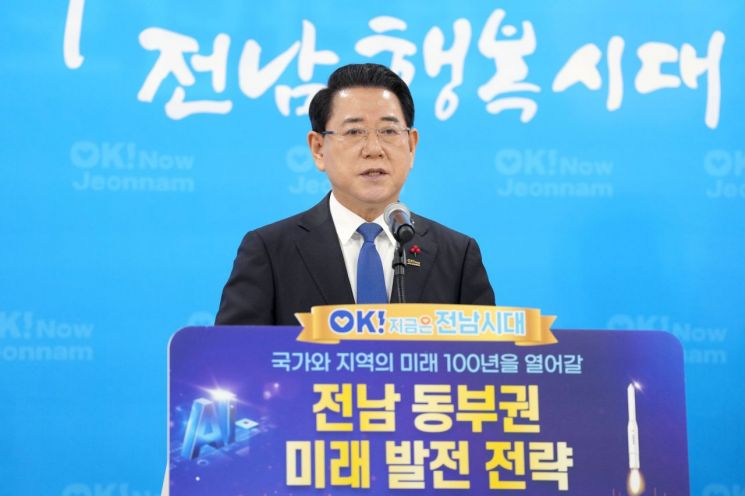 Kim Youngrok, Governor of Jeollanam-do, held a year-end press conference for the eastern region of Jeonnam on the 24th in the lobby on the first floor of the Yi Sun-sin Auditorium at the East Government Complex of Jeonnam Provincial Office, announcing the future development strategy for the eastern region of Jeonnam that will open the next 100 years for the nation and the region. Provided by Jeonnam Province
On the 24th, Kim Youngrok, Governor of Jeollanam-do, declared 2026 as the "First Year of the 100-Year Leap Forward for the Eastern Region" at the year-end press briefing held at the Eastern Regional Headquarters. He announced a development strategy to foster the eastern region as a core hub for Jeonnam's future growth.
Governor Kim visited the eastern region of Jeonnam, which is currently facing difficulties due to crises in the petrochemical and steel industries, and stated, "The eastern region, the heart of Jeonnam's economy that has led Korea's industrialization, is now going through one of the most challenging times ever." He added, "However, based on the strength of the residents who have persevered through these turbulent times, we will officially begin the second great leap forward for the eastern region."
He particularly emphasized, "We will secure future competitiveness through a transformative innovation that fundamentally changes the industrial structure," and declared, "We are proclaiming the upcoming Year of Byeongo as the 'First Year of the Great Leap Forward for the Eastern Region.' By maximizing the region's capabilities and strengths, we will deliver real changes that residents can feel."
Accordingly, Jeonnam Province plans to upgrade the petrochemical and steel industries with AI, decarbonization, and high-value-added technologies, and to establish a "battery and semiconductor cluster" to create a new axis of industrial growth in the eastern region.
To foster the Gwangyang Bay Area, which possesses a full-cycle battery ecosystem, as a "center for advanced materials," the province will pursue: ▲ designation of the Gwangyang Bay Area industrial complex as a national advanced strategic industry specialized complex for secondary batteries (1.26 trillion won); ▲ creation of the RE100 future advanced national industrial complex in the Gwangyang and Suncheon areas (1.2 trillion won); and, to develop Jeonnam as a key hub of the "Southern Semiconductor Innovation Belt," ▲ active attraction of semiconductor fabs and related upstream and downstream industries.
For the development of the hydrogen industry, a core industry of the future, the province will pursue: ▲ establishment of a hydrogen industry convergence platform equipped with LNG terminals, hydrogen pipelines, and hydrogen ports (5.03 trillion won); ▲ creation of a Southwest Coast hydrogen industry belt linked to the designation of a national hydrogen specialized complex; ▲ conversion of Gwangyang Steelworks to hydrogen-based steelmaking; ▲ development of a hydrogen industry-centered complex logistics district in the Yulchon Convergence Logistics Complex; ▲ fostering Yeosu and Gwangyang ports as key Arctic route ports (2.15 trillion won), among other initiatives.
To revitalize the petrochemical and steel industries, the province will promote: ▲ support for job-seeking expenses, employment allowances for workers, secondary compensation for SMEs, and technology commercialization (1.1 trillion won); ▲ a mega project for the transformation of the petrochemical and steel industries (4.6 trillion won); ▲ a CCUS cluster (2 trillion won); ▲ a specialized complex for materials, parts, and equipment for the chemical industry (1 trillion won); ▲ establishment of the Yeosu National Industrial Complex AX Demonstration Complex (20.5 billion won) and the Gwangyang Steel and Metal AX Support Center (22 billion won); ▲ construction of a digital-based resource circulation pilot complex (12.5 billion won); and ▲ attraction of a branch of the POSCO Future Technology Research Institute, Change Up Ground Gwangyang (17 billion won), and Scale-Up Demonstration Center (25 billion won) to foster innovative companies in batteries, new materials, and hydrogen. These efforts aim to firmly establish the eastern region as a core growth axis leading Korea's industrial transformation.
In addition, leveraging the advantage of the entire Jeonnam region being designated as a special zone for distributed energy, the province will foster the eastern region as a "clean energy hub" where industrial competitiveness and residents' income grow together.
To realize RE100 in the eastern region's industries, the province will: ▲ create a 13GW offshore wind power complex centered on Yeosu and Goheung and expand the energy basic income model with 5GW led by the public sector; ▲ construct offshore wind power support piers and hinterland complexes (300 billion won); ▲ expand large-scale solar power complexes, including agrivoltaics and floating solar power; ▲ build pumped-storage power plants in Gokseong (1.6 trillion won) and Gurye (1.5 trillion won); and ▲ actively promote the establishment of microgrids based on renewable energy and AI next-generation power grids centered on the industrial complexes in Yeosu and Gwangyang Bay Area. Based on these, the province will also ▲ attract leading data center projects and build regional data center clusters centered on key areas such as Gwangyang and Suncheon.
The province will also establish a "K-Space & Defense Innovation Belt" in the eastern region, centered on Goheung, integrating the space launch vehicle and advanced materials industries.
To lay the foundation for a K-Space & Defense hub, the province will: ▲ build a space and defense innovation cluster centered on Goheung and Suncheon (49 billion won); ▲ establish an advanced materials technology development and demonstration center in the Yeosu and Gwangyang Bay Area (79 billion won); ▲ construct a private space launch vehicle test facility (48.5 billion won); ▲ create a space and aerospace industry complex city with concentrated companies and research institutes (900 billion won) and a space launch vehicle science complex with space science education and experience functions (300 billion won); ▲ attract a second space center with next-generation launch capabilities such as reusable launch vehicles (1.14 trillion won); and ▲ attract a national defense drone combat training center (600 billion won) to inject new vitality into the region.
The province will also foster an "AI-based high-value-added agri-fisheries leading model" that creates high added value using AI and big data.
To develop the region as a core hub leading Korea's AI agri-fisheries innovation, the province will: ▲ create a green bio industry specialized cluster centered on Suncheon and Gokseong; ▲ build the Suncheon Smart Biotransformation Industrialization Platform infrastructure (30 billion won); ▲ establish the Goheung Smart Farm Innovation Valley (119 billion won), Smart Horticulture Complex (7.9 billion won), and Smart Livestock ICT (54.6 billion won); ▲ promote a smart farm microgrid demonstration project linked to the distributed energy special zone; ▲ create an AI Blue Food Tech Smart Complex (40 billion won); ▲ designate an AI Smart Fisheries Innovation Leading District (190 billion won); and ▲ advance the Boseong tea industry (11 billion won), expanding the agri-fisheries innovation model throughout the eastern region.
The province will also actively seek to attract large-scale international events by leveraging the excellent infrastructure and industries of the eastern region.
To firmly establish the eastern region of Jeonnam as a hub for hosting major international events in Korea, the province will: ▲ successfully host the 2026 Yeosu World Island Expo (167.6 billion won); ▲ bid to host the 2028 G20 Summit in Jeonnam; ▲ bid to host the 2028 United Nations Framework Convention on Climate Change Conference of the Parties (COP33); and ▲ promote the bid to host the World Universiade Games by gathering public consensus, ensuring that the achievements of regional development lead to growth in industry, tourism, and job creation.
Based on its beautiful natural scenery and large-scale tourism complexes, the province will also establish a "Wellness and Marine Tourism Belt" encompassing Jirisan, Seomjingang, and the Dadohae islands.
To foster the Jirisan area as a K-Temple travel hub, the province will: ▲ promote the Cheontaeam Geungnakbojeon (4.8 billion won), Cheoneunsa Natural Healing Center (16 billion won), and Hwaeomsa Traditional Culture Experience Center (3.2 billion won); and ▲ implement the Hwaeomsa Area Blue Tour Project (10.8 billion won). To create wellness and workation hotspots in the Seomjingang area in connection with southern region tourism development, the province will: ▲ develop Gwangyang Artcation (14.4 billion won), Gokseong Leisurecation (10.8 billion won), and Gurye Greencation (21.9 billion won); ▲ establish Gwangyang Gubongsan Tourism Complex (370 billion won), Gokseong Water Leisure Tourism Complex (380 billion won), and Gurye Osan Wellness Resort (18 billion won), creating tourism landmarks.
To establish a global tidal flat ecological belt connecting the tidal flats of the eastern region, the province will: ▲ create the Yeojaman National Marine Ecological Park (169.7 billion won); and ▲ build the Suncheon Tidal Flat Healing Tourism Platform (32 billion won). To develop a stay-type marine tourism hub, the province will: ▲ implement the Yeosu Island-It Trail project to create marine leisure facilities (30 billion won) and establish the Beauty & Spa Marine Wellness Center (21.3 billion won) in connection with the Baekri Seomseomgil; ▲ develop the Yeosu Integrated Marine Leisure Tourism City (1.098 trillion won) and International Marine Leisure Tourism Complex Center (200 billion won); ▲ create the Goheung Sunset Garden scenic spot (10.6 billion won) and Marine Art Land Tourism Complex (497.6 billion won); ▲ establish a premium resort linked to the National Dadohae Forest Healing Center (100.2 billion won); ▲ create the Boseong Healing Eco Village (14.8 billion won) and Yulpo Marine Complex Center (44 billion won); and ▲ introduce future-oriented tourism transportation infrastructure by establishing Urban Air Mobility (T-UAM, 121.9 billion won).
To foster Korea's leading marine history and cultural tourism destinations, the province will: ▲ create the Yi Sun-sin National Defense Culture Tourism Belt centered on the Jinnamgwan Hall of Jeolla Jwasuyeong; and ▲ develop Suncheon K-Disney (1.0011 trillion won), aiming to elevate the region as a cultural city of Korea.
Jeonnam Province will establish a "super-wide-area SOC" connecting industry, logistics, and tourism, linking Jeonnam's key hubs to the entire country.
To connect the eastern region, the southern coast, and the inland into a single living and economic zone, the province will: ▲ complete the Jeolla Line high-speed railway (1.9326 trillion won) and Gyeongjeon Line KTX Eum high-speed electrification (2.152 trillion won); ▲ newly operate the Suncheon-Gwangyang-Busan KTX Eum line; ▲ improve the Yeosu-Suncheon (1.9601 trillion won), Goheung-Gwangju Space Expressway (3.8094 trillion won), and Gwangyang-Sacheon Namhae Expressway (2.5846 trillion won); ▲ construct the Yeosu-Namhae subsea tunnel (806.7 billion won), Hwatae-Baekya (643.8 billion won), and Geumodo sea bridge (236.7 billion won); ▲ expand to four lanes for Goheung-Bongrae (652.1 billion won), Yeosu Dolsan Sinbok-Udu (483.2 billion won), and Gurye-Suncheon Hwangjeon (62 billion won). To develop Yeosu Airport as the representative airport of the southern coast and Namjung region in line with international tourism and business demand, the province will extend the runway (110 billion won) and promote international flights.
Governor Kim stated, "The sea, land, and industrial sites of the eastern region are filled with the sweat and dedication of the residents who built Korea." He emphasized, "It is thanks to this strength that today's Jeonnam Province and Korea are possible." He added, "We will focus all our capabilities to ensure that the vision for the eastern region leads to tangible changes on the ground," and requested continued interest and support from residents and the media.
© The Asia Business Daily(www.asiae.co.kr). All rights reserved.











