Implementation of Revised Height Restrictions in 2030
Potential Inclusion of Yangcheon District, Gimpo City, and Others in Regulation
High-Rise Development Faces Challenges Under Height Limits
Seeking Alternatives Such as Transitional Provisions
The Seoul Metropolitan Government has begun working on a compromise plan to mitigate conflicts between aviation safety and property rights ahead of the full implementation of the International Civil Aviation Organization (ICAO)'s height restrictions in 2030. This move comes amid concerns that expanding the regulated areas could lead to property rights violations and delays in maintenance and redevelopment projects due to height limitations.
On the 19th, the city held a seminar on "Application Measures for Gimpo Airport Height Restrictions" at the Seoul Museum of History. The event was attended by the director of Seoul’s Urban Planning Division, the director of the Airport Operations Division at the Ministry of Land, Infrastructure and Transport, as well as experts from the aviation industry.
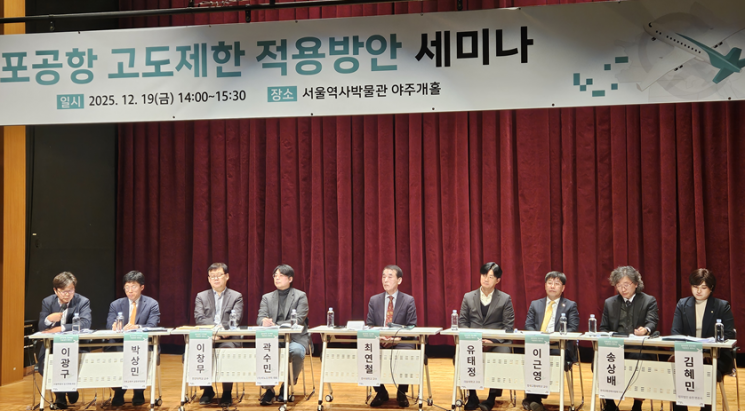 On the 19th, a seminar on "Gimpo Airport Height Restriction Application Plan" was held at the Seoul Museum of History, hosted by the Seoul Metropolitan Government. Photo by Lee Ji-eun
The core of the ICAO’s revised height restriction proposal is to ease the uniform regulation of obstacle creation, previously managed under the "Obstacle Limitation Surface (OLS)" system, by dividing it into "Obstacle Free Surface (OFS)" and "Obstacle Evaluation Surface (OES)." The Obstacle Free Surface is an absolute no-go zone that directly affects aviation safety, while the Obstacle Evaluation Surface can be conditionally developed after assessment. Once the revision is implemented, the area within an approximately 11-13 km radius of Gimpo Airport will be classified as a horizontal surface, with height limits potentially set at 45 meters, 60 meters, or 90 meters.
If the 60-meter horizontal surface limit is applied, it will be difficult to construct new apartment buildings taller than 17 stories. If the 90-meter limit is applied, new apartments exceeding about 25 to 30 stories will not be permitted. Areas newly expected to fall under the height restriction zone include Mok-dong in Yangcheon District, Yeongdeungpo District, Mapo District, Bucheon City, and Gimpo City in Gyeonggi Province. The revised proposal is scheduled for full implementation in November 2030, with the Ministry of Land, Infrastructure and Transport and ICAO currently finalizing the details.
During the discussion, concerns were raised about potential delays in maintenance and redevelopment projects due to the new regulations. Yangcheon District’s Urban Planning Division Chief, Yeo Sungwoo, pointed out, "If the revision is implemented, 13 out of the 14 Mok-dong New Town complexes currently undergoing reconstruction are expected to be included in the expanded obstacle evaluation surface area. Simply being subject to evaluation will impose additional time and cost burdens, causing harm to residents."
There were also calls for transitional provisions rather than a blanket application of the revised regulations. Attorney Kim Hyemin of Songcheon Law Firm emphasized, "When the new rules take effect in 2030, redevelopment projects already in progress may have to reassess their business viability, potentially starting over from scratch. To minimize property rights violations for association members and landowners, it is necessary to apply transitional provisions for a certain period in areas where redevelopment zones have already been designated."
The Seoul Metropolitan Government also expressed understanding of residents’ concerns, stating that it is considering allowing exceptions to the new regulations for projects that have already received project approval or have commenced construction. Lee Gwanggu, Director of the Urban Planning Division, said, "For sites that have obtained project approval or have already begun construction, we can review whether existing laws can be applied through supplementary provisions. However, this is an issue that requires careful consideration and balancing between aviation safety and property rights."
In addition, Seoul plans to form a joint task force with local governments near Gimpo Airport, including Gangseo District, Yangcheon District, and Gimpo City, to develop reasonable standards and submit recommendations to the central government.
The Ministry of Land, Infrastructure and Transport also responded that it would pursue system reforms reflecting local conditions. Park Sangmin, Director of the Airport Operations Division at the ministry, stated, "Some areas of Yangcheon District are currently outside the height restriction zone and thus have no height limits, but under the revised proposal, they could newly be designated as areas subject to aeronautical review. We will take note of these regional changes and consider local conditions during the system reform process."
© The Asia Business Daily(www.asiae.co.kr). All rights reserved.












