Korean Economy Projected to Grow 1.9% Next Year
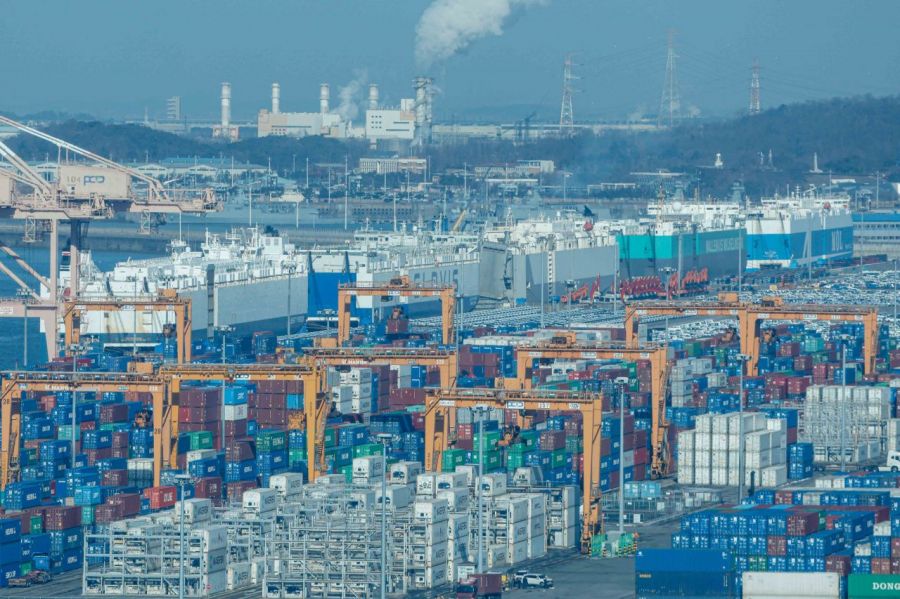 President Donald Trump signed a proclamation imposing a 25% tariff without exceptions on steel and aluminum products imported into the United States, and announced that tariffs on automobiles and semiconductors are also under consideration. On February 13, 2025, export vehicles and containers were waiting to be loaded at Pyeongtaek Port in Gyeonggi Province. Photo by Kang Jinhyung
The ASEAN+3 Macroeconomic Research Office (AMRO), which recently met with the government, has recommended that Korea establish credible fiscal rules to secure fiscal sustainability and implement measures to activate structural fiscal reforms.
In its "2025 Korea Annual Consultation" results released on December 19, AMRO stated, "The economy is showing signs of improvement this year, supported by a recovery in private consumption and robust exports," projecting Korea's economic growth rate at 1.0% for this year and 1.9% for next year. The ASEAN+3 Macroeconomic Research Office is an international organization that analyzes the economies of ASEAN, Korea, China, and Japan. AMRO's mission team visited Korea from December 8 to 19, conducting annual consultations with the Ministry of Economy and Finance, the Bank of Korea, the Financial Services Commission, and the Korea Development Institute (KDI), leading to these conclusions.
Regarding consumer prices, which are currently under upward pressure due to factors such as the high exchange rate, AMRO noted, "Inflation is being maintained at a level close to the Bank of Korea's target," and added, "The recent rise in service prices is due to increased input costs, and inflationary pressures are expected to remain contained." The inflation rate is projected to average 2.1% this year and to moderate slightly to 1.9% next year.
AMRO identified heightened trade tensions and rising real estate prices as risk factors for the Korean economy. It stated, "Strong trade and investment linkages with major countries are an advantage for Korea, but they could become vulnerabilities if trade or geopolitical tensions intensify." AMRO also pointed out that a sharper-than-expected slowdown in major economies and a recurrence of commodity price shocks could pose additional risks to the Korean economy.
Furthermore, AMRO assessed that "domestic vulnerabilities stem from the possibility of a sharp price adjustment in the Seoul housing market, project financing loan defaults at small regional savings banks and mutual credit cooperatives, and a medium-term decline in the labor force."
On monetary policy, AMRO concluded that the current monetary stance is appropriate, but noted, "If downside risks to growth increase, further interest rate cuts could be considered." It also emphasized the need to closely monitor the continued rise in Seoul housing prices and the exchange rate situation, given sluggish production growth and contained inflationary pressures.
Regarding the fiscal stance for next year's budget, AMRO stressed, "With debt increasing, it is crucial to establish reliable fiscal rules and activate structural fiscal reforms to ensure long-term fiscal sustainability."
While the fiscal stance for next year's budget is generally appropriate, AMRO advised that, considering limited fiscal space and monetary policy constraints, the authorities should be ready to implement targeted fiscal measures if downside risks materialize. It also recommended that temporary measures such as expansionary fiscal policies should be phased out as the economic situation normalizes, in order to maintain fiscal credibility.
AMRO further suggested, "Diversifying production capacity into core semiconductor areas will strengthen supply chain resilience." At the same time, it recommended continued improvements to population policies, including workplace reforms to enhance work-life balance and increase labor force participation, effectively raising the retirement age, and gradually reforming the immigration system to facilitate selective inflows of talent into industries facing severe labor shortages.
© The Asia Business Daily(www.asiae.co.kr). All rights reserved.












