Unexpected Rise in November Employment, but Unemployment Rate Hits Highest Level in Over Four Years
Uncertainty Over Future Interest Rate Path Grows
Fed Governor Waller: "Further Cuts Needed, but No Need to Rush"
International Oil Prices Rebound
On December 17 (local time), the three major U.S. stock indexes are showing mixed trends, remaining largely flat. Although the November employment report indicated a slowdown in the labor market, there were no signs of a collapse in employment. Additionally, as it has become harder to find clues regarding the future path of interest rates, the stock market is struggling to establish a clear direction.
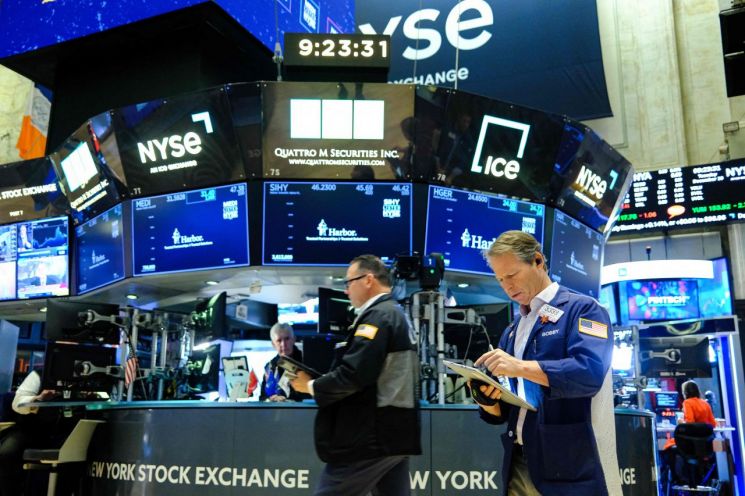 On the 16th (local time), traders are working on the trading floor of the New York Stock Exchange (NYSE) in the United States. Photo by AFP
As of 9:59 a.m. on the New York Stock Exchange, the Dow Jones Industrial Average, which is centered on blue-chip stocks, was up 230.54 points (0.48%) from the previous trading day, standing at 48,344.8. The S&P 500 Index, focused on large-cap stocks, was up 0.88 points (0.01%) at 6,801.14, while the technology-heavy Nasdaq Index was down 29.582 points (0.13%) at 23,081.879.
Wall Street is closely watching employment and inflation indicators. According to the November employment report released the previous day by the U.S. Department of Labor’s Bureau of Labor Statistics (BLS), nonfarm payrolls increased by 64,000, exceeding the market expectation of 45,000 compiled by Dow Jones. This marks a turnaround from October, when nonfarm payrolls decreased by 105,000 due to federal government workforce reductions.
However, despite the increase in employment, the unemployment rate rose to 4.6% in November, highlighting a weakening in the labor market. This figure is higher than both September’s 4.4% and the market expectation of 4.5%, marking the highest level in four years and two months since September 2021. The broader unemployment rate, which includes those who have given up seeking work or are working part-time for economic reasons, reached 8.7%, the highest since August 2021.
With employment indicators sending mixed signals, investors’ predictions regarding the future path of interest rates have become even more uncertain. The market expects that the December employment report, which will be released in early January next year, will be a more important indicator in determining the policy direction of the Federal Open Market Committee (FOMC) meeting scheduled for January 28.
Investors are now turning their attention to the November Consumer Price Index (CPI), which will be released on December 18. The market expects both the headline and core CPI to rise by 3.1% year-on-year, a slight increase from September’s 3.0%. This reflects a situation where the labor market slowdown and high inflation are occurring simultaneously.
Ian Lyngen, Managing Director and Head of U.S. Rates Strategy at BMO Capital Markets, commented on future inflation indicators, saying, “There is a high likelihood of a lukewarm reaction to employment data repeating itself,” and added, “This is because the qualitative issues seen in wage indicators could also apply to the CPI.”
Regarding the future path of interest rates, Christopher Waller, a member of the U.S. Federal Reserve Board of Governors, stated that the current benchmark interest rate is 1 percentage point above the neutral level and expressed the view that further rate cuts are needed. However, he emphasized that there is no need to rush the pace of rate cuts. Speaking at a CNBC forum, he said, “Since inflation remains high, we can take our time without rushing to cut rates,” and added, “We can gradually lower the policy rate to the neutral level.” Waller presented a scenario in which inflation continues to slow through 2026.
International oil prices are rebounding after U.S. President Donald Trump ordered a complete blockade of tankers traveling to and from Venezuela. As of 9:59 a.m. Eastern Time on the New York Mercantile Exchange (NYMEX), West Texas Intermediate (WTI) crude oil was up $0.71 (1.29%) from the previous session, trading at $55.84 per barrel. The previous day, WTI briefly fell below $55 per barrel for the first time since February 2021, amid expectations of an end to the war in Ukraine and increased supply. Brent crude, the global oil price benchmark, was also up $0.79 (1.34%) from the previous day, trading at $59.71 per barrel.
U.S. Treasury yields are showing a slight upward trend, particularly for short-term bonds. The 10-year U.S. Treasury yield, the global benchmark for bond rates, remained at 4.15%, the same as the previous day, while the 2-year U.S. Treasury yield, which is sensitive to monetary policy, was up 2 basis points (1 basis point = 0.01 percentage point) from the previous day at 3.5%.
By stock, Oracle is down 5.65% amid reports of difficulties in securing funding for the construction of a data center in Michigan. Paramount Skydance is down 4.66% after Warner Bros. Discovery recommended that its shareholders reject the company’s hostile takeover bid. Nvidia is down 2.1%.
© The Asia Business Daily(www.asiae.co.kr). All rights reserved.












