"2025 Overseas Real Estate Investment Seminar" Successfully Concludes
Following the government's October 15 real estate measures, uncertainty in the domestic real estate market is increasing, leading to heightened interest in overseas real estate among high-net-worth individuals. This trend is interpreted as an effort to seek new opportunities in global markets such as Japan and the United States, given the domestic regulatory environment.
According to the real estate industry on December 14, more than 80 prospective investors and industry professionals attended the "2025 Overseas Real Estate Investment Seminar" recently held at the Textile Center Building in Gangnam-gu, Seoul. The event, hosted by Cloud, a Japanese real estate investment advisory firm, was organized to assess the current state of the domestic real estate market and to share trends and tax strategies for major overseas markets including Japan, the United States, and Vietnam.
Chunlan Lee, CEO of Realrich Asset, who was the first presenter, stated, "From next year, a decrease in the number of new housing units will intensify the supply shortage," adding, "By 2028-2029, the number of new units could plummet to around 10,000, so the market is expected to be extremely challenging for the next five years." She further noted, "Amid these conditions, asset succession among the baby boomer generation is taking place both domestically and internationally," emphasizing, "It is a time when diversification of asset allocation is necessary."
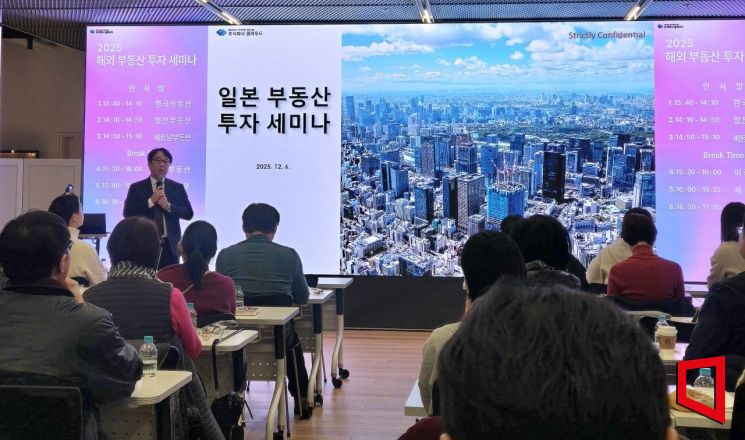 Hwang Soonchul, CEO of Cloud, is presenting on the outlook and investment strategies of the Japanese real estate market at the "2025 Overseas Real Estate Investment Seminar" held on the 6th at the Textile Center Building in Gangnam-gu, Seoul. Photo by Choi Seoyoon
Hwang Soonchul, CEO of Cloud, identified low interest rates and a weak yen as the key attractions of Japanese real estate investment. He said, "Even non-resident foreigners can obtain loans at interest rates of 1.8% to 2.5%, and with the yen at around 940 won per 100 yen, currency gains can also be expected." He also analyzed, "The office vacancy rate in Tokyo's five central wards (Chiyoda, Chuo, Minato, Shinjuku, Shibuya) is only in the 2% range, making it more stable than the Gangnam area, where the rate is in the 10% range." According to Daishin Securities' "November Japanese Real Estate" report, as of September, the office vacancy rate in Tokyo's five central wards was 2.7%, marking a decline for seven consecutive months. The average rent per pyeong was 21,092 yen (about 200,000 won), up 0.3% from the previous month, continuing a 20-month upward trend. However, Hwang cautioned, "Investments in the outskirts outside of key areas such as Tokyo's 23 wards should be approached with caution."
Sarah Yoon, head of Remax for New York and New Jersey, a global real estate franchise, highlighted the tax benefits of U.S. real estate. She explained, "For U.S. residents, up to 40 billion won per couple is exempt from federal estate tax," noting, "Considering Korea's high inheritance tax, this is advantageous for long-term asset transfer." However, she advised that when non-residents sell real estate, 10% to 15% of the sale price is withheld at source, so establishing a Limited Liability Company (LLC) can limit legal liability and provide tax flexibility. Yoon added, "If real estate is held in an individual's name, all personal assets are subject to compensation in the event of a lawsuit, but with an LLC, liability is limited to the assets held by the entity."
Dennis Pham, CEO of KOVIRE, a Vietnam and Korea real estate investment consulting firm, emphasized Vietnam's growth potential. He said, "Vietnam's urbanization rate is only 40%, so there is significant growth potential compared to the 80% rate in developed countries." He also pointed out, "There is no acquisition tax and the capital gains tax is only 2%." He particularly noted that Ho Chi Minh City has expanded to ten times the size of Seoul by merging with neighboring areas. Pham stated, "In the case of the Thu Thiem New Urban Area, GS E&C's Xi Apartments were sold at about 50 million won per pyeong, with a second round of sales scheduled for next year." He also advised, "Foreigners can only own up to 30% of units in each apartment project, and opening a bank account is mandatory. The refund process for application deposits can also be more complicated than in Korea due to local sales procedures."
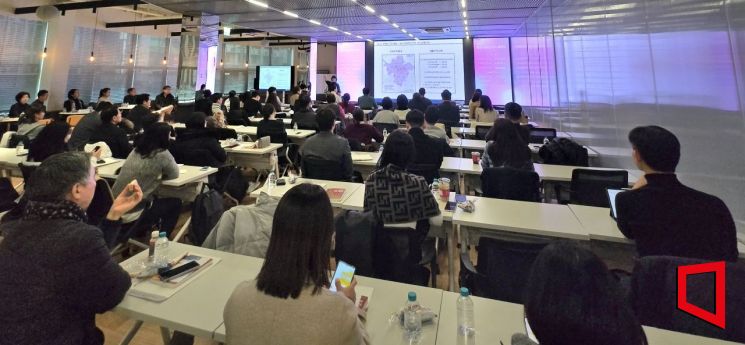 Chunlan Lee, CEO of Realrich Asset, is presenting on the outlook of the domestic real estate market after the October 15 measures at the "2025 Overseas Real Estate Investment Seminar" held on the 6th at the Textile Center Building in Gangnam-gu, Seoul. About 80 prospective investors gathered at the event venue that day. Photo by Seo-yoon Choi
The final session addressed the essential tax and legal procedures to be reviewed when acquiring overseas real estate. Heeseon Choi, CEO and tax accountant at Choi Tax Accounting Consulting, explained, "Overseas real estate is not included in the comprehensive real estate tax and does not affect the non-taxable status of a single home in Korea." However, she cautioned, "Under the Foreign Exchange Transactions Act, there is a reporting obligation at each stage of acquisition, holding, and disposal. Failure to comply may result in a penalty of 10% of the acquisition price, up to a maximum of 100 million won."
An event organizer stated, "Interest in overseas asset allocation is increasing due to changes in domestic real estate regulations and market conditions," adding, "We hope this seminar provided an opportunity to obtain accurate information about each country's market and risk management strategies."
© The Asia Business Daily(www.asiae.co.kr). All rights reserved.












