Super High-Rise and Underground-Connected Complex Buildings
Joint Inspection by City, District Offices, and Private Experts
Review of Disaster Prevention and Damage Mitigation Plans
The Seoul Metropolitan Government will conduct a comprehensive inspection of disaster response and support systems for all super high-rise buildings and underground-connected complex buildings within the city.
According to the Seoul Metropolitan Government on the 14th, the inspection will cover super high-rise buildings and underground-connected complex buildings as defined by the Special Act on Disaster Management for Super High-Rise and Underground-Connected Complex Buildings. The inspection will encompass all 27 super high-rise buildings and 220 underground-connected complex buildings in Seoul, totaling 247 buildings, and will continue until the 23rd.
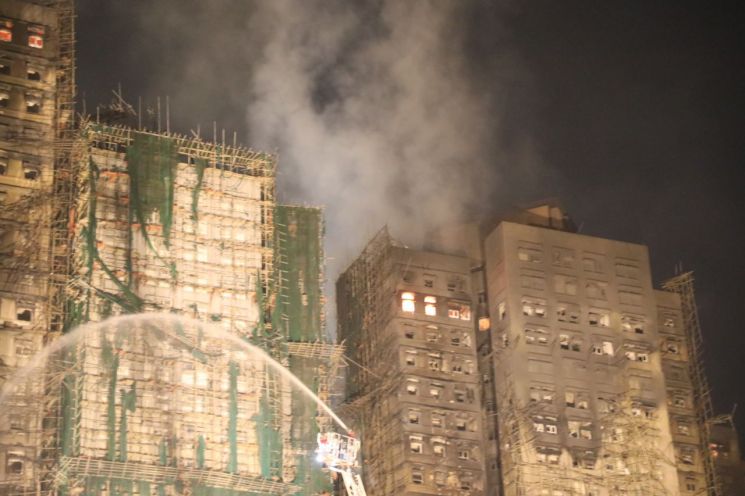 The high-rise apartment complex 'Wang Fuk Court' in Tai Po, northern Hong Kong, where a major fire recently occurred. Photo by Yonhap News.
A 'super high-rise building' is defined under the Building Act as a structure with 50 or more floors or a height of at least 200 meters. An 'underground-connected complex building' refers to a building whose underground section is connected to an underground station or underground shopping mall, with at least 11 floors or a designated use that accommodates 5,000 or more people.
The city will operate a joint inspection team composed of city officials, district officials, and private sector experts, focusing on a thorough review of disaster response and support systems to prepare for similar situations. The inspection will also concentrate on verifying compliance with statutory obligations. In particular, the adequacy of disaster prevention plans and damage mitigation plans, which must be established and implemented by building managers, will be examined in detail.
Additionally, the inspection will comprehensively review the installation and operation of integrated disaster control rooms, compliance with standards for evacuation safety zones, the organization and training records of initial response teams composed of on-site personnel, and the appointment and training of chief disaster managers. To ensure the inspection leads to practical improvements, the city will conduct on-site consulting with private sector experts in fire safety and disaster prevention, so that any issues that can be immediately addressed will be resolved on the spot.
The city will also assess deficiencies in disaster prevention and damage mitigation plans, taking into account the size, use, and year of completion of each building. Based on the standard manual and best practices developed by the Seoul Metropolitan Government, tailored improvement measures will be proposed for each facility. If any violations are identified during the inspection, the city will swiftly implement administrative actions in accordance with relevant regulations, such as issuing corrective orders, imposing fines, filing complaints, or notifying relevant agencies.
Lee Seongeun, Director-General for Disaster and Safety Planning at the Seoul Metropolitan Government, stated, "Super high-rise and underground-connected complex buildings pose a significant risk of mass casualties in the event of a disaster, so we will thoroughly check compliance with all legal obligations, from disaster prevention plans to on-site safety management systems." He added, "We will conduct rigorous inspections and pursue necessary institutional and on-site improvements to prevent tragedies like the recent high-rise apartment fire in Hong Kong."
© The Asia Business Daily(www.asiae.co.kr). All rights reserved.












