Putin to Make State Visit to India on December 4-5
Informal Talks Scheduled with Prime Minister Modi
EU Decides to Support Ukraine Using Frozen Russian Assets
Russia is further solidifying its strategic alliance with India. In the wake of the Russia-Ukraine war and the intensification of sanctions by the United States and the European Union (EU), Russia is seeking to ease its economic isolation by positioning India as a key ally.
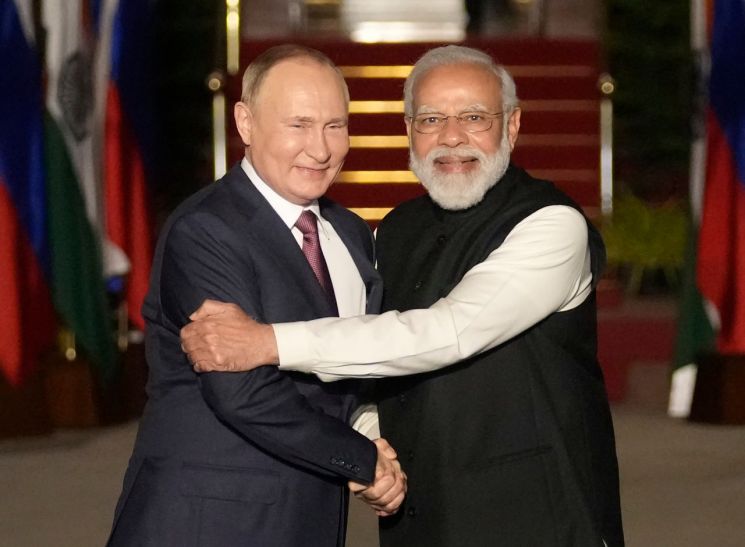 Russian President Vladimir Putin (left) and Indian Prime Minister Narendra Modi greet each other ahead of a meeting held on the 6th (local time) in New Delhi, India. Photo by AP
According to TASS news agency on the 3rd (local time), Russian President Vladimir Putin will pay a state visit to India from December 4 to 5. President Putin is scheduled to arrive in New Delhi on the afternoon of the 4th and hold an informal meeting with Indian Prime Minister Narendra Modi at his official residence. Afterwards, the two countries plan to sign a 'Strategic Economic Cooperation Program.'
The last time President Putin visited India was in December 2021. Just two months later, Russia launched a full-scale invasion of Ukraine, and since then, India has become the largest purchaser of Russian seaborne crude oil, according to an analysis by the Financial Times (FT) published on this day. Despite not joining the sanctions against Russia, India was criticized by U.S. President Donald Trump, who accused Prime Minister Modi of supporting Russia's war machine and imposed a 25% tariff on Indian products last August.
Despite pressure from the United States and other Western countries, economic and military cooperation between Russia and India is expected to grow even stronger. The FT reported, "On the 2nd, the Russian State Duma ratified an agreement allowing the deployment of troops, warships, and aircraft on each other's territories."
The strengthening of ties between Russia and India is attributed to the further tightening of Western sanctions against Russia, as well as the lack of progress in discussions to end the Russia-Ukraine war. On the 2nd, President Putin held talks with the United States regarding a ceasefire between Russia and Ukraine, but after a five-hour marathon negotiation, the two sides failed to narrow their differences, particularly over territorial issues.
On the following day, the 3rd, the EU announced that the governments of its 27 member states and the European Parliament had agreed to completely halt imports of Russian natural gas starting in the fall of 2027. Due to varying economic circumstances, European member states had previously been reluctant to ban Russian gas imports, but ahead of the 19th round of economic sanctions against Russia, they reached a consensus on a 'two-year total ban.' This move is seen as a strategy to maximize pressure on Russia, leaving negotiation as its only option.
On the same day, despite strong opposition from Belgium, the EU decided to use frozen Russian assets held in Europe to support Ukraine. Ursula von der Leyen, President of the European Commission, emphasized that this financial support will "enable Ukraine to lead peace negotiations from a position of strength." she emphasized.
© The Asia Business Daily(www.asiae.co.kr). All rights reserved.












