Google’s Dramatic Turnaround: Cracks Formed by the TPU
The Rise of TPUs and the Shaking of the Nvidia Ecosystem
Big Tech Expands Its Options: The Search for GPU Alternatives
Korea Still at the Starting Line: Reducing Nvidia Dependence Remai
'The search king' Google has reclaimed the AI throne. Google's recently unveiled AI, Gemini 3, has dramatically reversed the landscape, overtaking OpenAI (ChatGPT), which had been leading, as well as Anthropic (Claude) and Google itself, who were in pursuit. At the heart of this turnaround lies Google's self-developed semiconductor, the Tensor Processing Unit (TPU), which was created without relying on Nvidia's support. The AI industry has quietly welcomed the fact that Google was able to train a large language model (LLM) without purchasing Nvidia's expensive, cutting-edge graphics processing units (GPUs), but Nvidia remains confident in its position.
Google achieved a breakthrough by defeating a human in the game of Go with its AlphaGo AI, and enabled the emergence of generative AI with its Transformer research paper. Last year, Google even won the Nobel Prize in Chemistry with AlphaFold, its protein analysis AI.
Even Google, however, has faced tough challenges. After the launch of ChatGPT in 2023, its own offering, Bard, failed to live up to expectations. Bard was later renamed to what is now known as Gemini.
There were claims that it would be impossible for Google to catch up with OpenAI, which enjoys active support from Nvidia, but reality proved otherwise. Google gradually improved by training Gemini using its unique semiconductor, the TPU, developed in collaboration with Broadcom, and ultimately succeeded in overtaking its rivals. After the announcement of Gemini 3, OpenAI CEO Sam Altman even admitted, "We will have a hard time for a while." Users are also favoring Gemini 3 over ChatGPT 5.
◆The Savior Big Tech Needs to Keep Nvidia in Check= The reason Google's approach is drawing attention is simple: it is a victory achieved without Nvidia GPUs, which are considered essential for AI training.
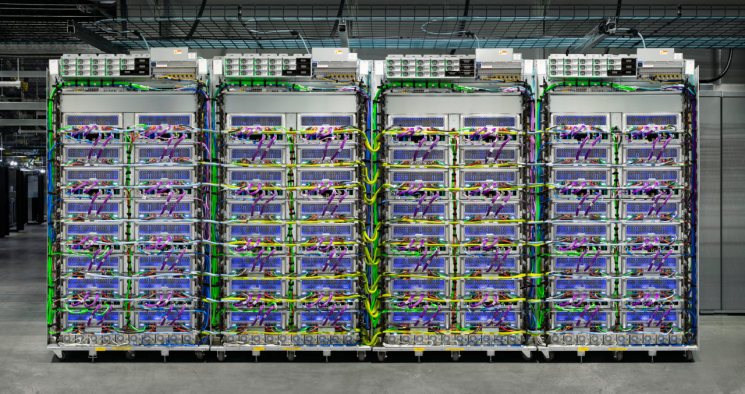
TPUs were not originally created for AI, much like how GPUs were initially designed for gaming. TPUs were introduced to accelerate search speeds, which is Google's area of expertise. While GPUs were born for graphics processing and later became general-purpose semiconductors for AI computation, Google's TPU is a custom (ASIC) semiconductor designed solely for deep learning acceleration. Only Google uses TPUs, achieving a vertically integrated system that encompasses both hardware and software. This contrasts with most AI companies, which have relied on Nvidia GPUs and the CUDA programming language.
Compared to GPUs, TPUs have fewer applications but consume less power, which is a key advantage. If a GPU is like an all-terrain SUV boasting versatility despite high maintenance costs, a TPU is like a sports car that demonstrates its true capabilities on a dedicated circuit.
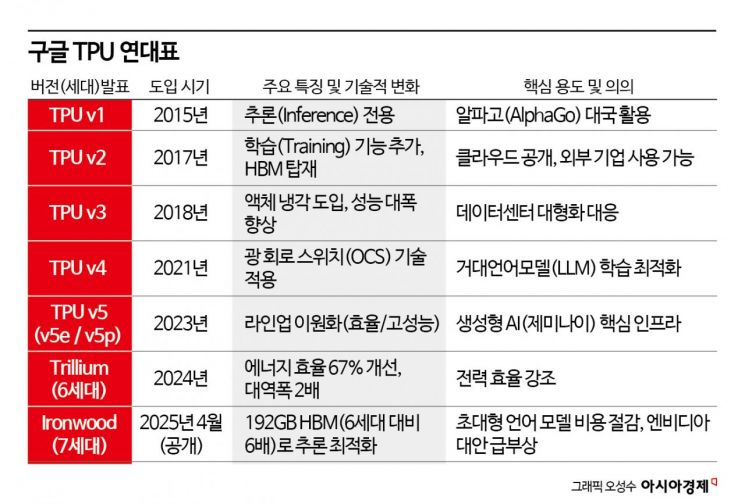
Of course, in terms of absolute performance, GPUs still outperform TPUs. Nvidia has drawn a clear line, stating in its blog that its technology is a generation ahead, even as it keeps an eye on the rise of TPUs. However, the market sees the rapid ascent of TPUs as a sign that cracks could emerge in Nvidia's ecosystem. Jay Goldberg, an analyst at SiPort, noted, "As TPUs enter their seventh generation, they have become more powerful and energy efficient, emerging as a strong alternative to Nvidia GPUs."
Although TPUs, previously used only by Google, are not sold externally, they can be accessed by others through the cloud. Reports that companies such as Safe Superintelligence (founded by OpenAI co-founder Ilya Sutskever), Anthropic, Salesforce, Midjourney, Apple, and even Meta are considering adopting TPUs reflect a backlash against Nvidia's overwhelming dominance. In a situation where it is difficult to secure enough Nvidia chips to meet demand, Google's TPU has become a viable alternative. Interest in TPUs is also driven by the potential to reduce investment costs in building data centers.
However, the prevailing view is that TPUs cannot fully replace Nvidia. Bloomberg pointed out that even Google acknowledges TPUs cannot substitute for Nvidia GPUs. Gaurav Gupta of Gartner explained, "Even Google is one of Nvidia's largest customers," adding, "In a rapidly changing environment, GPUs still offer higher performance and greater utility."
◆We Are Only Now Securing Nvidia GPUs...There Is No Alternative= The rapid rise of TPUs has significant implications for Korea as well. AI developers in Korea are currently trying to reduce their excessive dependence on Nvidia GPUs, which is why AMD attracted attention before Google TPU did.
The problem is that Korea has not even secured enough Nvidia GPUs. Without having built up the Nvidia ecosystem, it is difficult to also collaborate with AMD or Google.
An industry insider said, "I've heard that AMD's GPUs are quite good. But in practice, we can't use them freely." This is because modifying existing systems built with Nvidia's CUDA for another platform could lead to serious setbacks. While big tech companies, having already established large Nvidia-based ecosystems, can additionally utilize AMD or Google TPUs, Korea still needs to prioritize building its Nvidia infrastructure first.
This is why, even after securing as many as 260,000 Nvidia GPUs, there is still a need to seek alternatives. In particular, while domestic startups are trying to enter the market with NPUs, building a proper ecosystem will require both corporate efforts and government support. A government official also stated, "There is a clear reason to support NPU companies."
Mergers and acquisitions of related companies are already reshaping the industry globally. AI chip startup SambaNova is likely to be acquired by Intel. In the process, executives have moved to Korean AI chip startup Rebellions. The UK's Graphcore was acquired by SoftBank last year. Meta attempted to acquire Korea's FuriosaAI, but the deal did not go through. Another Korean startup, Rebellions, has merged with Sapeon and is embarking on a new challenge.
© The Asia Business Daily(www.asiae.co.kr). All rights reserved.













