Concerns Over Tech Stock Overvaluation Persist
Strengthening Preference for Safe-Haven Assets Boosts Treasuries, While Bitcoin Weakens
Nvidia's Third-Quarter Earnings in Focus on the 19th
FOMC Minutes to Be Released on the 19th, Employment Report on the 20th
All three major indices on the New York Stock Exchange opened lower on November 18 (local time). As concerns over an artificial intelligence (AI) investment bubble intensified, investor sentiment weakened, leading to a broad decline in technology stocks. The preference for safe-haven assets strengthened, pushing up Treasury prices while Bitcoin showed weakness.
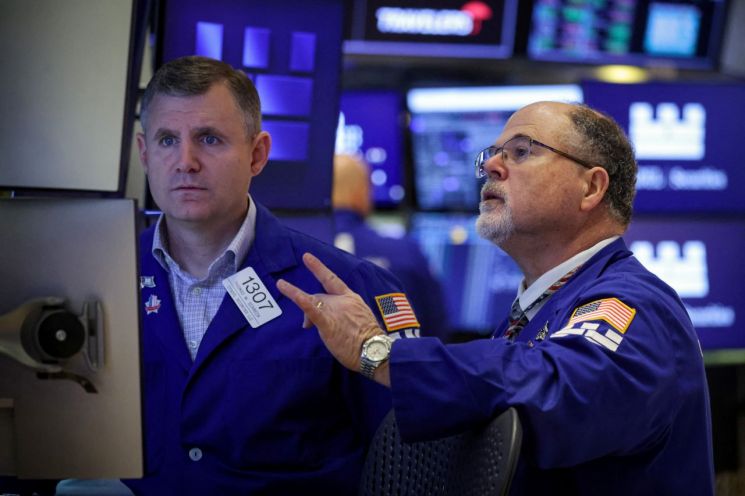 On the 17th (local time), traders are working on the trading floor of the New York Stock Exchange (NYSE) in the United States. Photo by Reuters Yonhap News
As of 9:51 a.m. on the New York Stock Exchange, the blue-chip Dow Jones Industrial Average was down 419.67 points (0.9%) from the previous trading day at 46,170.57. The large-cap S&P 500 index had fallen 49.17 points (0.74%) to 6,623.24, and the tech-heavy Nasdaq index was trading at 22,449.17, down 258.905 points (1.14%).
By stock, Nvidia was down 2.83%. Anxiety spread over the possibility that the AI investment cycle may have peaked after it was revealed that Thiel Macro Fund, led by billionaire investor and PayPal and Palantir founder Peter Thiel, had sold all of its Nvidia shares. Palantir was down 1.84%, and Microsoft (MS) had declined 2.29%. Home Depot was down 3.35% due to poor performance in its home improvement segment and a downward revision of its annual outlook.
Concerns over an overheated AI investment market continue to persist. Sundar Pichai, CEO of Alphabet, Google's parent company, said in an interview with the BBC released today, "There is a certain degree of irrationality in today's AI boom," adding, "No company is immune when the bubble bursts."
Jeffrey Gundlach, CEO of DoubleLine Capital and known as the "Bond King," also appeared on Bloomberg's "Odd Lots" podcast yesterday, diagnosing that current asset prices in the financial markets are excessively overvalued.
As risk appetite diminished, Bitcoin at one point fell below $90,000 today. This marks a significant drop from its all-time high of $126,000 recorded in early October.
The market is focusing on major events scheduled for this week.
On the 19th, Nvidia will announce its third-quarter earnings. Amid ongoing concerns about overvaluation, these results are expected to be a key variable shaping future market trends.
Also on the same day, the minutes of the October Federal Open Market Committee (FOMC) meeting will be released. The Federal Reserve has cut its benchmark interest rate by 0.25 percentage points in two consecutive meetings due to concerns over slowing employment, but opinions among Fed officials remain divided regarding the rate path for December. The upcoming minutes are expected to provide greater clarity on the Fed officials' economic and interest rate outlooks.
Michael Hartnett, Chief Investment Strategist at Bank of America Merrill Lynch Global Research, said, "If there is no rate cut next month, the market will face further correction," adding, "Current positioning is acting as a headwind, not a tailwind, for risk assets."
On the 20th, the September nonfarm payrolls report will be released. The government shutdown that began on the 1st of last month lasted a record 43 days, delaying the release of the September and October jobs reports. With the shutdown abruptly ending on the 12th, previously unreleased inflation and employment indicators will be announced sequentially. However, the October jobs report is expected to omit the unemployment rate due to disruptions in data collection.
Yields on U.S. Treasury bonds are declining. The 10-year U.S. Treasury yield, a global benchmark, was down 3 basis points (1bp = 0.01 percentage point) from the previous day at 4.09%, while the 2-year Treasury yield, which is sensitive to monetary policy, had fallen 4 basis points to 3.56%.
© The Asia Business Daily(www.asiae.co.kr). All rights reserved.












