Second Largest Number of HCRs in Korea: Balanced Achievements in Retention, New Selections, and Returns
Professor Ruoff Named for 12 Consecutive Years... Research Impact at a Global Level
The future of global science lies in Ulsan.
Nine faculty members from UNIST (President Park Jongrae) have been named on the list of '2025 Highly Cited Researchers (HCR),' representing the top 1% of the most influential researchers worldwide.
These researchers are evaluated at the top 1% level globally, making UNIST the second-largest contributor in Korea after Seoul National University. This is an increase of two from last year.
On November 12 (local time), Clarivate announced the list of 6,868 individuals selected as '2025 Highly Cited Researchers (HCR).'
The evaluation was based on the number of citations for SCI papers indexed in the 'Web of Science Core Collection' from 2014 to 2024, taking into account influence and citation performance across 22 fields.
This year, there are a total of 76 HCRs in Korea. With nine faculty members selected, UNIST rose to second place among Korean universities. The university drew attention as a regional institution with a large number of young researchers.
The UNIST honorees are: Distinguished Professor Rodney Ruoff, Invited Distinguished Professor Seok Sangil, Research Professor Kim Kwangsoo, Distinguished Professor Paek Jongbeom, Professor Lee Hyunwook, Professor Cho Seungwoo, Professor Yang Changduk, Professor Jung Hooyoung, and Professor Shin Taejoo. Of the seven selected last year, all were reselected, with Paek Jongbeom returning and Shin Taejoo newly joining the list this year.
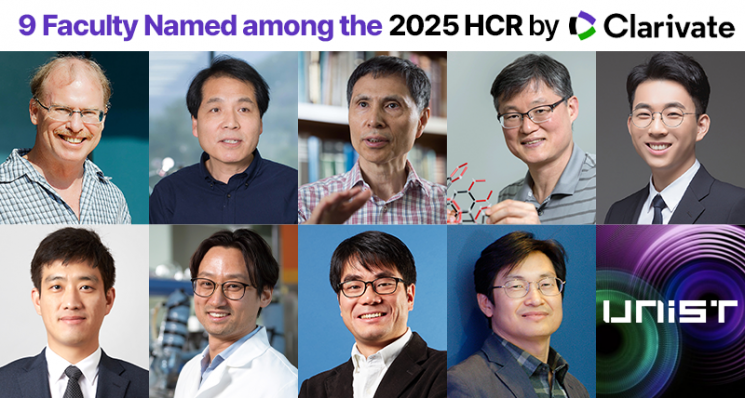 Nine UNIST professors selected as Highly Cited Researchers (HCR) in the top 1% worldwide. Top row from left: Rodney Luo, Seok Sangil, Kim Kwangsoo, Paek Jongbeom, Lee Hyunwook; bottom row from left: Cho Seungwoo, Yang Changdeok, Jung Hooyoung, Shin Taeju. Provided by UNIST
Distinguished Professor Rodney Ruoff holds the record for the longest consecutive inclusion on the HCR list, having been selected for 12 straight years since the first announcement in 2014. He has cemented an international reputation through research that spans materials science, chemistry, and physics. This year, he was recognized in the Cross-Field category.
Invited Distinguished Professor Seok Sangil and Research Professor Kim Kwangsoo have also maintained their streak, being selected in the Cross-Field category for eight consecutive years. Professor Seok is a world-renowned scholar in perovskite solar cells, while Professor Kim is an authority in machine learning and quantum theory-based new material design. Their continued achievements have demonstrated their competitiveness.
Distinguished Professor Paek Jongbeom is a global authority in graphene and two-dimensional materials. He has been named as an HCR for six consecutive years since 2018, totaling seven selections. After missing out last year, he has returned to the list.
Professor Lee Hyunwook is an expert in real-time transmission electron microscopy (TEM) analysis of secondary batteries. After six consecutive years in the Cross-Field category, he joined the materials science category this year, maintaining his streak for seven consecutive years.
Professors Cho Seungwoo, Yang Changduk, and Jung Hooyoung have also maintained their positions in the Cross-Field category for five and four consecutive years, respectively. Professor Cho is recognized for his achievements in biotechnology based on gene-editing technology; Professor Yang is focused on developing next-generation solar cells; and Professor Jung has produced research results by advancing TEM analysis technology.
Professor Shin Taejoo, newly selected this year, is an expert in advanced structural analysis technology based on synchrotron accelerators. He has identified the structures of various new materials using synchrotron analysis techniques.
President Park Jongrae stated, "Breakthrough technologies have emerged from researchers who have pursued challenging research and from research-focused universities that have supported their dedication. Based on this pioneering spirit, UNIST will continue to build a robust environment where researchers can achieve sustainable results."
Among Korean universities, the HCR selections are as follows: Seoul National University with 16, UNIST with 9, Sungkyunkwan University with 7, and Hanyang University with 6. By country, the numbers are: United States 2,670, China 1,406, United Kingdom 570, Germany 363, and Australia 312.
By institution, the Chinese Academy of Sciences leads with 258, followed by Harvard University with 170, Stanford University with 141, and Tsinghua University with 91. The full 2025 HCR list, along with analysis, evaluation, and selection criteria, can be found on the official Clarivate website.
© The Asia Business Daily(www.asiae.co.kr). All rights reserved.












