Visa Barriers Eased, But 'Labor Cost Bomb' Hits Korean Companies
An Unexpected Challenge for Large-Scale Investments
Sharp Rise in Costs to Secure Skilled Labor
Welding Labor Costs 2.5 Times Higher Than in Korea
Similar Situation at LG Energy Solution Construction Site
"Local Americans and Korean Professionals with Visas Paid $60,000 to $80,000 KRW per Hour"
Labor Cost Burden to Continue Even After Completion
Trump Administration Emphasized Direct Hiring of Americans
Dispatching Korean Professionals Remains Difficult
As Investments Ramp Up in Yongin and Pyeongtaek, Skilled Workers Needed in Korea Too
Large-scale investment projects by Korean companies underway in the United States are facing greater-than-expected labor cost pressures. Due to a shortage of skilled workers, local welders had to be hired, and in some cases, their daily wage reached as much as 700,000 KRW. Although visa issues have been partially resolved, making it easier to dispatch workers, the sharply rising cost of securing skilled local labor has emerged as an unexpected burden, significantly increasing construction costs. As labor cost pressures and skilled worker shortages persist, some factories in the U.S. are now experiencing actual delays in construction schedules.
According to industry sources on November 19, Samsung Electronics paid local welders up to $480 per day (approximately 700,000 KRW) for the construction of its foundry (semiconductor contract manufacturing) production line in Taylor, Texas. This amounts to nearly 15 million KRW per month based on a simple calculation. Compared to Korean welders, whose average daily wage ranges from 180,000 to 250,000 KRW, this is 2.5 times higher. An industry insider commented, "There are even jokes that it would be better to quit your current job and move to the U.S. to work as a welder."
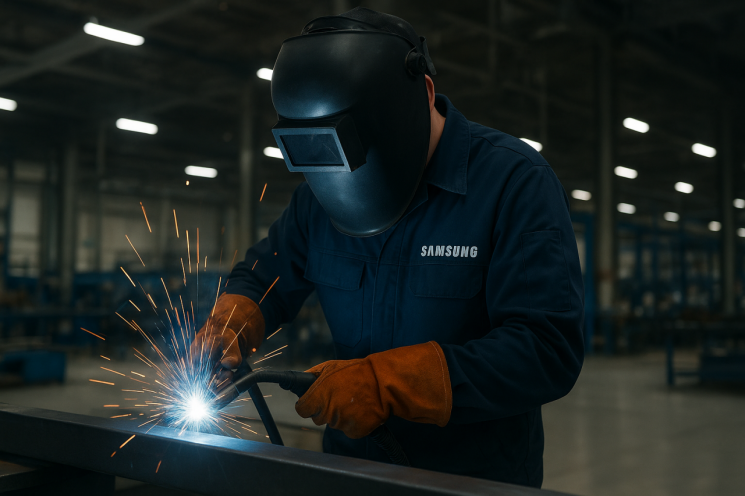 Samsung Electronics paid local welders up to $480 per day (approximately 700,000 KRW) for the foundry production line construction in Taylor, Texas. ChatGPT generated image
According to data from the U.S. job site ZipRecruiter, the average wage for welders in Texas is between $21 and $27 per hour (approximately 30,700 to 39,500 KRW). Samsung Electronics is reported to have paid various allowances on top of the average wage in Texas.
Among local skilled workers, the pay for electrical wiring and welding specialists is rising especially fast. As global demand for electricity surges, there is a high volume of work involving power facilities and electrical wiring, but it is difficult to find qualified personnel for these tasks.
Partner companies supplying construction workers for the LG Energy Solution plant in Georgia are facing similar circumstances. A representative from a partner company that supplies local construction workers said, "Local Americans or Korean professionals with visas are paid $45 to $60 per hour (approximately 65,800 to 87,800 KRW), while assistant workers receive about $35 per hour (approximately 51,200 KRW)." The representative also noted that it is not easy to secure expert-level skilled workers in a timely manner.
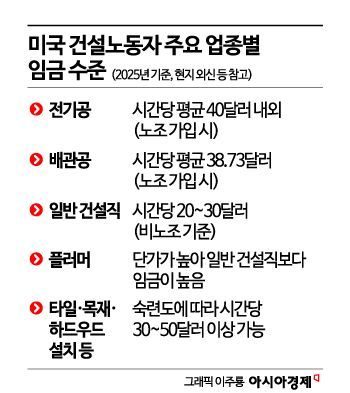
BlueOval SK, a joint venture between SK On and Ford Motor Company, is recruiting battery plant maintenance workers at an hourly wage of $32 to $38 (approximately 46,700 to 55,400 KRW). The hourly wage for assistant maintenance workers is set at $27 to $30 (approximately 39,400 to 43,800 KRW).
The minimum wage in the United States varies by state, and the amounts are all relatively high. As of this date, the federal minimum wage for American workers is $7.25 per hour (10,561 KRW), but in most states, it exceeds $15. As of August last year, the minimum wage in Seattle ranged from $17.25 (24,244 KRW) to $19.97 (28,067 KRW), the second highest in the world. In Washington State, it was $16.28 (22,051 KRW), the fourth highest. An industry official explained, "In large, advanced countries like the United States and Australia, the number of people available to work is relatively small compared to the number of jobs. Because labor is scarce, wages inevitably soar in such a social structure."
Since local hiring will remain unavoidable even after factories are completed, labor cost burdens are expected to continue. The Trump administration's strong demand for 'direct hiring of Americans' from the construction to the operational phase has also been pointed out as a factor increasing the burden on companies.
Even if visa issues are resolved and companies attempt to dispatch skilled workers from Korea, the situation is not easy. A representative of a major company’s partner said, "There was the visa issue, and with investments ramping up at SK in Yongin and Samsung in Pyeongtaek, skilled workers are also needed in Korea. There are no more professionals willing to go to the United States."
Some believe there may be room to reduce labor costs through wage negotiations, but this is not considered realistic. There have been suggestions to persuade American workers by offering wages similar to those of Korean workers, but given the strong awareness of the minimum wage in the local labor market, the industry consensus is that such measures are unlikely to be effective.
One proposed solution is to pay local workers in U.S. dollars and secure a large amount of dollars in advance when exchange rates are favorable, then use these funds exclusively for labor costs. Attorney Oh Kyungsik (Dentons Lee) commented, "Even companies from other countries like China find it difficult to operate factories in the U.S. because standards for prices and minimum wages are so different. Korean companies will try to adjust labor costs as flexibly as possible, but if the U.S. government tightens regulations, it will not be easy to avoid these challenges."
© The Asia Business Daily(www.asiae.co.kr). All rights reserved.













