Malaysian Teacher Reveals Incident
Controversy is growing after hate messages targeting foreigners were discovered at the home and on the vehicle of a Malaysian resident living in Yokohama, Japan. When the individual shared photos and expressed their feelings on social media, the issue of xenophobia and the rising anti-immigrant sentiment in Japanese society resurfaced.
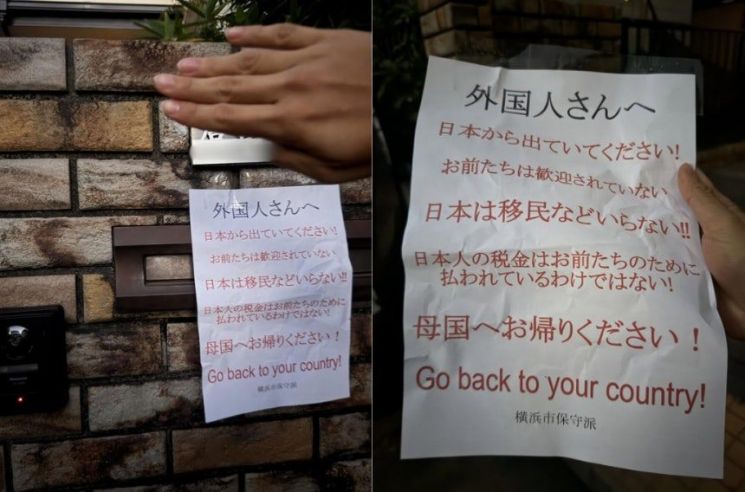
According to the South China Morning Post (SCMP) on the 15th, on November 11, Mr. A revealed on social media, "When I returned home after work, I found unidentified notes attached to my front door and car," and published photos of the incident. He introduced himself as an English teacher who settled in Yokohama last year.
The notes in the photos contained phrases such as "Japan does not want immigrants" and "Japanese taxes are not for foreigners." There was also a message in English: "Go back to your country." The sender was identified as "Yokohama Conservative Group." Additional posters were attached near the house and beside the car, with slogans like "STOP Immigration" and "Oppose immigration policies that destroy Japan."
Mr. A appealed, "I have no intention of invading Japan or causing harm. I just want to live and contribute in a country I love." He added, "I am aware that some foreigners behave inappropriately, but it is wrong to judge all foreigners by the same standard." He reported the incident to the police immediately, and was told that patrols would be strengthened.
As the post spread, Japanese online communities were filled with both criticism and concern. Many offered encouragement, saying, "This is not conservatism, just pure hate," and "Most Japanese people do not support such views." Some speculated that the awkward Japanese used in the notes suggested they might have been staged by a foreigner.
Recently, Japan has seen a series of hate incidents targeting foreigners, driven by a combination of economic stagnation, an increase in foreign workers, and a surge in tourists. Previously, a restaurant in Tokyo posted a notice on social media banning Korean and Chinese customers, which sparked intense criticism. While the Japanese Constitution allows restrictions on certain customers for linguistic reasons, discrimination based on nationality or race is prohibited.
According to the Japan National Tourism Organization (JNTO), more than 3.26 million foreign tourists visited Japan in September this year, marking the highest figure ever recorded for the month of September. The largest numbers of visitors came from China (780,000), South Korea (670,000), followed by Taiwan and the United States. From January to September this year, the cumulative number of visitors to Japan reached 31,650,000, surpassing 30 million in the shortest period on record.
© The Asia Business Daily(www.asiae.co.kr). All rights reserved.

![Clutching a Stolen Dior Bag, Saying "I Hate Being Poor but Real"... The Grotesque Con of a "Human Knockoff" [Slate]](https://cwcontent.asiae.co.kr/asiaresize/183/2026021902243444107_1771435474.jpg)














