Song Minsoon, who served as the last Minister of Foreign Affairs and Trade during the Roh Moo-hyun administration and is now 77 years old, expressed a critical view on November 12 regarding the Lee Jaemyung administration's plan to introduce nuclear-powered submarines. He likened the plan to "patrolling in a Maybach," arguing that considering the size of South Korea's reconnaissance waters, the introduction of nuclear submarines would be excessive.
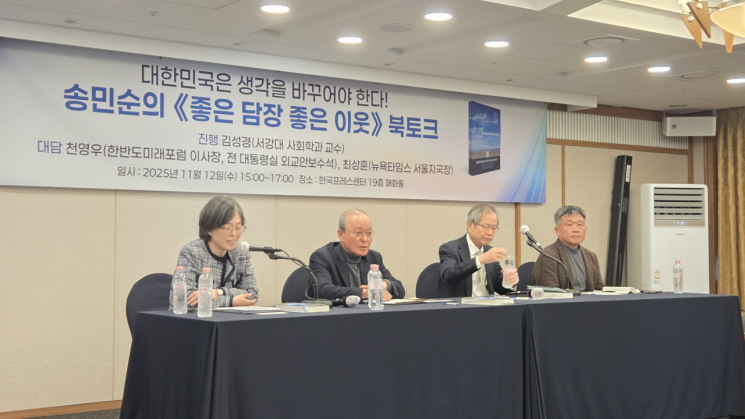 Former Minister of Foreign Affairs and Trade Song Minsoon (second from left) is holding a book talk for his new book "Good Fences Good Neighbors" on the afternoon of the 12th at the Press Center in Jung-gu, Seoul.
On the afternoon of the same day, during a book talk for his new release "Good Fences Good Neighbors" at the Press Center in Jung-gu, Seoul, Song was asked whether he believed South Korea needed nuclear submarines. He responded, "If you were to patrol a heavily congested area in Seoul, would it be more effective to have ten Sonatas or Grandeurs, or just one Maybach? Which is more efficient?" using this analogy to express his point.
He cited countries such as the United States and France, which possess nuclear submarines, and pointed out, "The exclusive economic zones (EEZ) of countries with nuclear submarines are about 5 million to 10 million square kilometers, so the areas they need to cover with submarines are extremely vast. In contrast, South Korea's EEZ is around 400,000 square kilometers." He further noted, "Even Canada, which covers 9 million square kilometers, is considering importing conventional submarines from South Korea."
Song also highlighted the limitations of the defense budget. He stated, "A single nuclear submarine costs at least 3 trillion won, and up to 5 trillion won depending on the options. Acquiring four nuclear submarines would consume the entire annual budget for improving Army, Navy, and Air Force equipment, which is about 17 trillion won." He expressed concern, saying, "The size of South Korea's Army is ten times that of its Navy. Allocating such a massive budget to Navy submarines would distort everything."
Song further criticized the government's decision to link nuclear submarines to tariff negotiations during the South Korea-U.S. summit held on the sidelines of the APEC meeting in Gyeongju. Having long argued in media interviews and other forums that South Korea should secure nuclear potential, he said, "If we secure the nuclear fuel cycle, including uranium enrichment, nuclear potential will naturally follow. However, because the government brought up nuclear submarines with the United States, the discussions stalled. It seems the issue has become complicated due to the enormous packaging of submarines." He added, "For the tariff negotiations, we should have used a card that fits the focus-in other words, uranium enrichment capability-at the negotiating table. The entanglement of such mismatched elements makes it appear as if South Korea is suddenly and voluntarily pursuing nuclear submarines, which I believe is dangerous."
Chun Youngwoo, Chairman of the Korean Peninsula Future Forum and former Senior Presidential Secretary for Foreign Affairs and National Security, who participated as a panelist at the event, said, "To counter North Korea's nuclear armament, we currently rely on the U.S. nuclear umbrella, but I fully agree with former Minister Song's view that we must secure nuclear potential in case the U.S. nuclear umbrella fails. Enriching nuclear fuel is essential for peaceful purposes and energy security." He further explained, "Many people mistakenly believe that we must revise the South Korea-U.S. nuclear agreement to enrich nuclear fuel. However, according to Article 11, Section 2 of the agreement, if U.S.-origin equipment transferred under the agreement is used, enrichment up to 20% is possible with U.S. consent. This means that if we do not use U.S.-origin equipment, there is no need for consent." In other words, if South Korea secures its own enrichment facility and equipment, there would be no limit on the level of enrichment.
However, Chun also pointed out, "The real issue is that we have made almost no progress in research and development related to nuclear fuel enrichment and reprocessing. Even if we devote ourselves to research for the next five years, it would still be uncertain. Thus, talking about revising the nuclear agreement now is premature and only serves to raise unnecessary alarm."
© The Asia Business Daily(www.asiae.co.kr). All rights reserved.












