Bessent Speaks in CNBC Interview
Scott Bessent, United States Secretary of the Treasury, stated on the 5th (local time), one day before the U.S. Supreme Court's hearing on the legality of reciprocal tariffs, that even if the government loses the case, there are other legal means to impose tariffs on trading partners.
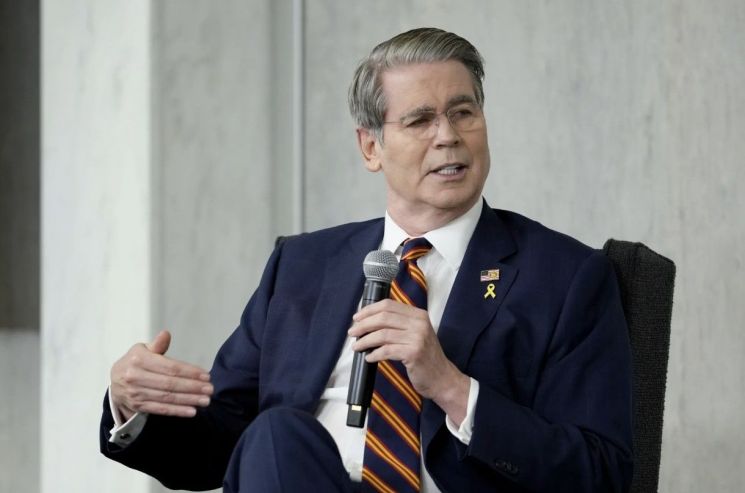
In a CNBC interview on the 4th, Secretary Bessent predicted that the Donald Trump administration would win the case, but added, "Even if not, there are many other authorities. They are more complicated, but they could actually be more effective."
He mentioned the International Emergency Economic Powers Act (IEEPA), which the Trump administration currently uses as the basis for imposing reciprocal tariffs, saying, "This law is the clearest," and emphasized, "It gives the United States and the President the strongest negotiating power."
Secretary Bessent stated that if the Supreme Court rules reciprocal tariffs based on the IEEPA to be illegal, as a 'Plan B' the administration could specifically invoke Section 232 of the Trade Expansion Act and Section 301 of the Trade Act. These two provisions allow for the imposition of tariffs in response to national security threats and unfair trade practices, respectively. By specifying these alternatives, he signaled the administration's intention to continue high-tariff policies through other legal avenues if reciprocal tariffs are deemed unlawful.
He continued, "This is a very important matter, and the Supreme Court is scheduled to review it tomorrow," adding, "This is a signature policy of the President, and traditionally, the Supreme Court has been reluctant to intervene in such core policies."
Previously, in a lawsuit filed by U.S. industry, the U.S. Court of International Trade (CIT) at the first trial ruled that reciprocal tariffs based on the IEEPA were illegal, and the Federal Court of Appeals in the second trial upheld this decision. As a result, the case has moved to the Supreme Court for a final ruling.
Currently, the Supreme Court is composed of six conservative and three liberal justices, forming a conservative majority. The Court has generally taken a cautious approach to restricting the executive powers of President Trump, leading to expectations that it is unlikely to block the reciprocal tariff policy. However, if the Supreme Court ultimately rules reciprocal tariffs illegal, the government may be able to use other provisions, but the legitimacy of the tariff policy and potential political repercussions would be unavoidable.
Meanwhile, Secretary Bessent commented on the U.S.-China summit held in Busan, South Korea, on October 30, describing it as "a very good meeting, and both sides approached it with great respect." He added, "President Trump is the only leader whom President Xi (Xi Jinping, President of China) respects," and stated that "the relationship is friendly."
He also noted that the two leaders are planning mutual state visits between the United States and China in 2026.
© The Asia Business Daily(www.asiae.co.kr). All rights reserved.











