Final Public Hearing Set for November 6; 50% Range Most Likely
Concerns Grow Among Automakers and Parts Suppliers Over Ecosystem Collapse
"Overreliance on Zero-Emission Vehicles in NDC"
"Including Hybrids as Zero-Emission Vehicles Is an Alternative"
The government has reportedly solidified its stance to reduce South Korea's greenhouse gas emissions by more than 50% from 2018 levels by 2035. In accordance with the Paris Climate Agreement, the government is required to submit a Nationally Determined Contribution (NDC) every five years. The government plans to finalize the target soon and submit it to the United Nations (UN) within this month. The industrial sector, including automakers and parts suppliers sensitive to carbon emissions, has launched last-minute efforts to persuade the government, arguing that the targets are "practically unattainable" and warning of a potential collapse of the industrial ecosystem.
According to the automotive industry and related sources on November 5, the government will hold a final public hearing on November 6 to set the NDC target. The scenarios previously released by the government include four reduction options compared to 2018 greenhouse gas emissions: ▲48%, ▲53%, ▲61%, and ▲65%. Among these, a target in the 50% range is considered the most likely, as 50% has reportedly been set as the bottom line despite differences among ministries.
The Ministry of Environment, Climate and Energy has proposed a reduction in the 60% range, while economic ministries, which reflect the industrial sector's position, are aiming for the low 50% range. In contrast, the industry maintains that the most realistic scenario is a reduction in the high 40% range.
Even with a 53% Target, 9.52 Million Zero-Emission Vehicles Needed
The auto industry is concerned that setting the target too high will result in a severe impact on related sectors. The government maintains that achieving "carbon neutrality by 2050" will require not only reducing the supply of internal combustion engine vehicles but also hybrid electric vehicles (HEVs). However, the industry argues that the targets are excessive and amount to virtually phasing out internal combustion engine vehicles. They are concerned about side effects such as restructuring in the parts industry and large-scale job losses. The industry is also calling for transitional technologies like HEVs (including plug-in hybrids) to be temporarily included as zero-emission vehicles.
Even if the government adopts the 53% reduction scenario, one of its proposals, the cumulative number of registered zero-emission vehicles would need to reach 9.52 million (34% of total vehicles) by 2030. As of 2024, the cumulative number stands at about 720,000 (2.7%). This means that approximately 1.46 million electric and hydrogen vehicles would need to be sold each year until 2030. This figure exceeds 90% of the annual domestic vehicle sales volume (1.62 million units). The industry points out that this is "an unrealistic number."
Achieving the already confirmed 2030 NDC target (4.5 million vehicles) is also difficult. In 2021, the government announced a goal to reduce national greenhouse gas emissions by 40% by 2030, but subsequent developments have made this increasingly unlikely. For the past three years, domestic electric vehicle sales have been declining. Starting in 2028, manufacturers who fail to meet the targets will be required to pay up to 3 million won per vehicle, increasing the financial burden on companies.
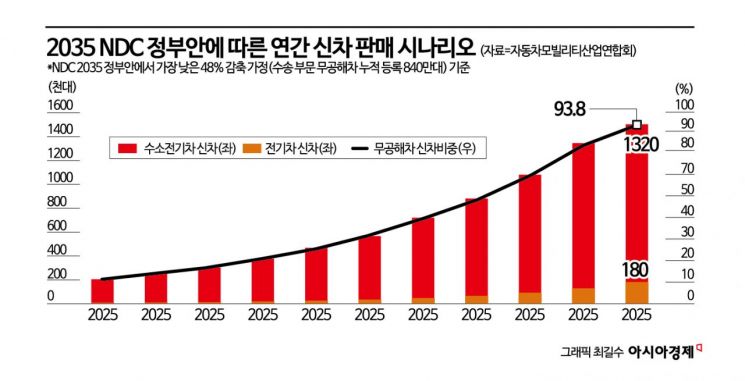
Japan Includes Hybrids as Zero-Emission Vehicles...
The industry argues that expanding the definition of zero-emission vehicles is the only realistic alternative. They are demanding that a variety of transport energy sources, such as HEVs and e-fuels, be included in the NDC targets. The argument is that including HEVs, where Korean companies have global strengths, in policy frameworks is necessary to maintain industrial leadership and prevent the collapse of the domestic parts ecosystem.
An analysis of HEV sales trends in major global markets from January to September this year shows that Hyundai Motor and Kia recorded the highest year-on-year growth in HEV sales among major brands. In particular, in the rapidly growing U.S. HEV market, Hyundai Motor and Kia's HEV sales increased by 48.5% year-on-year, outpacing Toyota's growth rate (32.9%) during the same period.
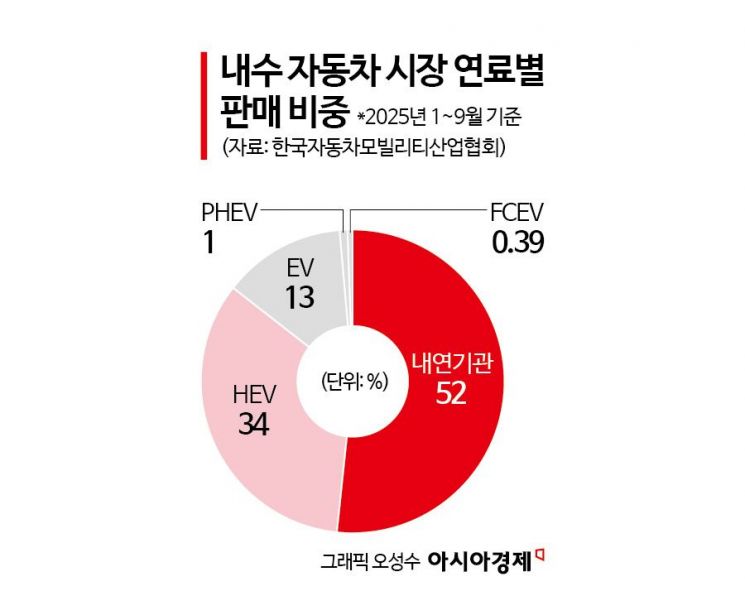
The HEV boom continues in Korea as well. From January to September this year, domestic HEV sales reached 426,186 units, surpassing internal combustion engine vehicle sales (425,373 units). HEVs accounted for 41% of new car sales, the same as internal combustion engine vehicles (41%), and both the sales volume (169,735 units) and market share (16%) of pure electric vehicles (EVs) were only about 2.5 times lower than those of HEVs.
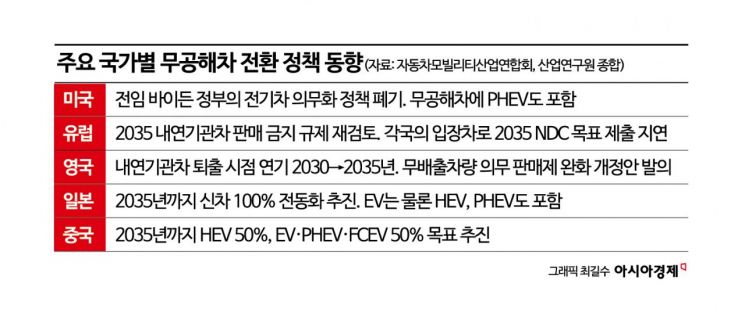
Major automobile-producing countries such as the United States and Japan are also moving to broaden the definition of zero-emission vehicles or lower emission reduction targets. This is due to slower-than-expected electric vehicle sales, a lack of charging infrastructure, and concerns about declining industrial competitiveness.
In the United States, the carbon neutrality target for 2035 was effectively scrapped under the second Donald Trump administration. The European Union (EU) is reconsidering its ban on the sale of internal combustion engine vehicles by 2035. Major automaking countries such as Germany, France, Italy, Hungary, and Slovakia are opposing the ban out of concern for industrial competitiveness, which has delayed the EU's submission of its 2035 NDC. Japan has also declared a "100% electrification" goal for 2035, but this includes not only electric vehicles but also HEVs.
Additionally, there are concerns that the burden of carbon reduction is being concentrated solely on the transportation sector, such as automobiles, in Korea. An official from the automotive industry pointed out, "Even within the transportation sector, carbon emissions could be reduced through logistics and transportation policies, and various sectors such as industry, construction, and agriculture should share responsibility in a balanced manner."
© The Asia Business Daily(www.asiae.co.kr). All rights reserved.