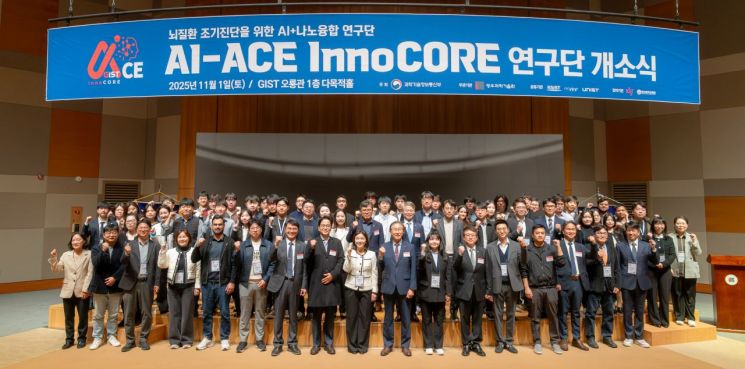
 Gwangju Institute of Science and Technology held the opening ceremony of the "AI+Nano Convergence for Early Diagnosis of Brain Diseases (AI-ACE InnoCORE) Research Group," supported by the Ministry of Science and ICT. Photo by Gwangju Institute of Science and Technology
The Gwangju Institute of Science and Technology (GIST) announced on November 3 that it held an opening ceremony for the "AI+Nano Convergence for Early Diagnosis of Brain Diseases (AI-ACE InnoCORE) Research Group," which is supported by the Ministry of Science and ICT, officially launching its research activities.
The ceremony, held on November 1 in the multipurpose hall on the first floor of the Oryong Building at GIST, was attended by key figures from various sectors, including Min Hyungbae, a Democratic Party lawmaker representing Gwangsan-eul in Gwangju; Ahn Dogeol, a lawmaker representing Dongnam-eul in Gwangju; Kim Kyungtaek, Director of the Relativistic Laser Science Research Center at the Institute for Basic Science (IBS); Seo Sungbae, Professor at GIST's Department of Life Sciences and incoming Director (from December) of the IBS Microbiome-Gut-Brain Physiology Research Center; and Kim Byungjun, Director at Amazon Web Services (AWS) Korea. Over 100 participants from GIST, including President Lim Ki-chul, Vice President for Academic Affairs Jung Sungho, Vice President for Research Kim Yongcheol, other key administrators, faculty, staff, and students, were also present.
The AI-ACE InnoCORE research group, led by Professor Lee Eunji of the Department of Materials Science and Engineering at GIST, is composed of postdoctoral researchers with experience and expertise both domestically and internationally as its core research members. The group aims to develop fundamental technologies for the early diagnosis of brain diseases by integrating artificial intelligence (AI) and nanotechnology.
The opening ceremony began with a welcome speech by President Lim Ki-chul, followed by congratulatory remarks from lawmakers Ahn Dogeol and Min Hyungbae, as well as IBS Director Kim Kyungtaek. Professor Lee Eunji then introduced the research group, and the event concluded with an unveiling ceremony.
Centered around GIST as the lead institution, the AI-ACE InnoCORE research group brings together the core capabilities of the four major science and technology institutes in Korea: Korea Advanced Institute of Science and Technology (KAIST), Daegu Gyeongbuk Institute of Science and Technology (DGIST), and Ulsan National Institute of Science and Technology (UNIST). The group is building an "open convergence research group" network that includes top-tier domestic and international research institutions such as Chonnam National University Hospital (clinical research), Korea Institute of Science and Technology (KIST, nanotechnology), and Harvard University (global collaboration). Through this network, the group aims to accelerate the practical application and global competitiveness of early diagnosis technologies for brain diseases.
Professor Lee Eunji, who leads the research group, is recognized as a global expert in the design of organic and polymer nanomaterials and advanced transmission electron microscopy analysis. Recently, she has pioneered a new research paradigm through her convergence research on "real-time protein imaging and AI analysis" for the early diagnosis of degenerative brain diseases such as Alzheimer's disease.
GIST President Lim Ki-chul stated, "I am confident that the newly launched 'AI-ACE InnoCORE Research Group' will become a beacon of hope in overcoming brain diseases, which are a major challenge facing humanity in this era of super-aging." He added, "I expect the group to present innovative solutions to the national challenge of early diagnosis of brain diseases by combining the sharp analytical power of AI with the ultra-fine precision of nano-convergence technology."
Professor Lee Eunji remarked, "Our goal is to open new avenues for early diagnosis of brain diseases and precision medicine through the convergence of AI and nanotechnology." She added, "By consolidating the capabilities and infrastructure of the four major science and technology institutes and working closely with domestic and international partner organizations, we aim to contribute to the improvement of human health."
© The Asia Business Daily(www.asiae.co.kr). All rights reserved.

![Clutching a Stolen Dior Bag, Saying "I Hate Being Poor but Real"... The Grotesque Con of a "Human Knockoff" [Slate]](https://cwcontent.asiae.co.kr/asiaresize/183/2026021902243444107_1771435474.jpg)














