Samsung Expected to Enter Semiconductor Super Cycle
SK Hynix Leads in HBM Shipments
Samsung vs. SK: Duopoly to Begin Next Year
"Strong HBM Demand, Positive Outlook for Both Companies"
As demand for "artificial intelligence (AI) semiconductors" surges, forecasts indicate that Samsung Electronics' sales of high-bandwidth memory (HBM) next year will increase by more than 2.5 times compared to this year. As the market shows signs of recovery, competition among Korean memory semiconductor companies, including SK Hynix, is intensifying, and expectations are rising for the arrival of a "supercycle."
According to industry sources on November 3, Samsung Electronics is expanding production capacity for its 10-nanometer 6th generation (D) 1c line to meet growing demand for HBM4. Internally, the company expects next year's HBM sales volume to be more than 2.5 times higher than this year. Actual sales are expected to increase even further. This is attributed to a significant rise in demand across high-performance memory semiconductor products such as "HBM4" and "HBM3E."
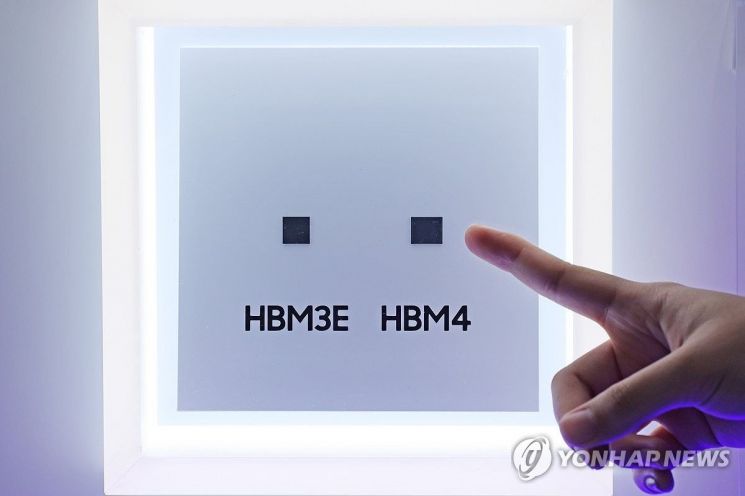 On October 22, at the Samsung Electronics booth set up at the Semiconductor Exhibition (SEDEX) 2025 held at COEX in Gangnam-gu, Seoul, actual models of the 6th generation high-bandwidth memory, HBM4 and HBM3E, were exhibited. Photo by Yonhap News.
A Samsung Electronics official stated, "The sales volume we presented is based on the maximum output we can achieve if we continue to increase our facility investments," adding, "With the market experiencing rapid growth and strong customer demand, actual market demand is even higher than this."
Recently, Samsung Electronics has expanded shipments of HBM3E and begun supplying to its key client, Nvidia. Furthermore, the company revealed that it is discussing HBM4 supply with Nvidia at the upcoming 2025 Asia-Pacific Economic Cooperation (APEC) CEO Summit, which is seen as a signal that Samsung could regain leadership in the HBM market.
There are predictions that if Samsung Electronics, which already has the largest memory production capacity, also increases its HBM market share, the industry landscape will shift. According to Counterpoint Research, HBM market share in the second quarter was 62% for SK Hynix, 21% for Micron, and 17% for Samsung Electronics. The industry expects Samsung Electronics' share to rise to about 30% next year, and that a two-horse race between Samsung Electronics and SK Hynix will become more pronounced after next year.
Kim Yongseok, Distinguished Professor at Gachon University’s College of Semiconductor, who previously worked at Samsung Electronics, said, "Since it is taking time for Micron to enter the HBM4 market, the duopoly between Samsung Electronics and SK Hynix is likely to continue for the time being," adding, "Because the HBM4 market is so large, the two companies will be able to engage in positive competition and share the market." However, there are also concerns about oversupply. Goldman Sachs predicted that if Samsung Electronics begins supplying to Nvidia, HBM prices could fall by as much as 35%. In response, Professor Kim Yongseok said, "Until Chinese companies make a full-scale entry, the price impact will not be significant," adding, "This is an opportunity for Korean companies."
© The Asia Business Daily(www.asiae.co.kr). All rights reserved.












