The Critical Importance of HBM for GPUs
Korea Is the Only Country, Excluding China, Capable of Managing AI Factories
Kim Joungho, KAIST Professor: "The Era of AI Factory and AI Memory Factory"
Chey Tae-won: "Memory Bottlenecks... Challenged by Su
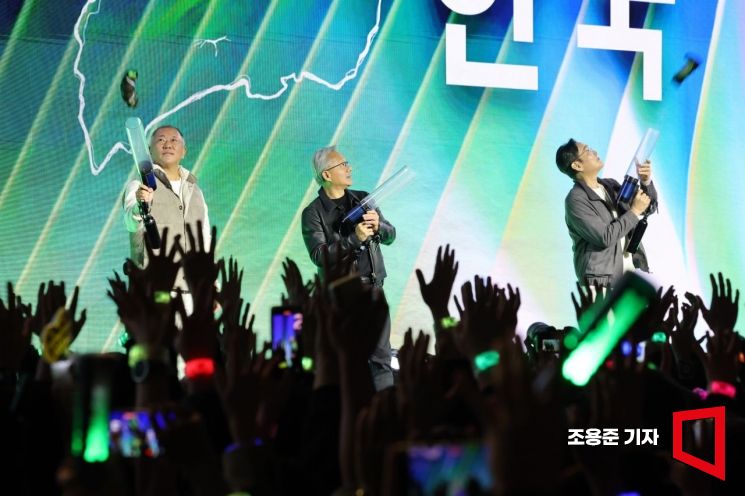 Jensen Huang, CEO of Nvidia, Lee Jae-yong, Chairman of Samsung Electronics, and Chung Eui-sun, Chairman of Hyundai Motor Group, took the stage at Nvidia's GeForce GPU 25th anniversary event held at COEX in Seoul on the 30th of last month, performing together. It was interpreted as a celebratory signal marking the launch of the Korea AI Factory.
Chey Tae-won, Chairman of SK Group, has addressed the bottleneck in memory semiconductor supply. As Nvidia secures a large volume of graphics processing units (GPUs), there is growing consensus that this presents a quantum leap opportunity for Korea’s manufacturing artificial intelligence (AI) sector, while also signaling that the semiconductor supercycle is now in full swing.
During his keynote speech at the "SK AI Summit 2025," Korea’s largest AI conference held at COEX in Seoul on November 3, Chairman Chey stated, "We are entering an era where the issue is not memory performance, but rather supply bottlenecks," adding, "We are receiving so many supply requests from numerous companies that we are grappling with how to respond to them all."
Amid the AI-driven semiconductor boom, Korea has secured a supply of 260,000 Blackwell GPUs from Nvidia. This marks a turning point for Korea to emerge as a global "AI manufacturing hub."
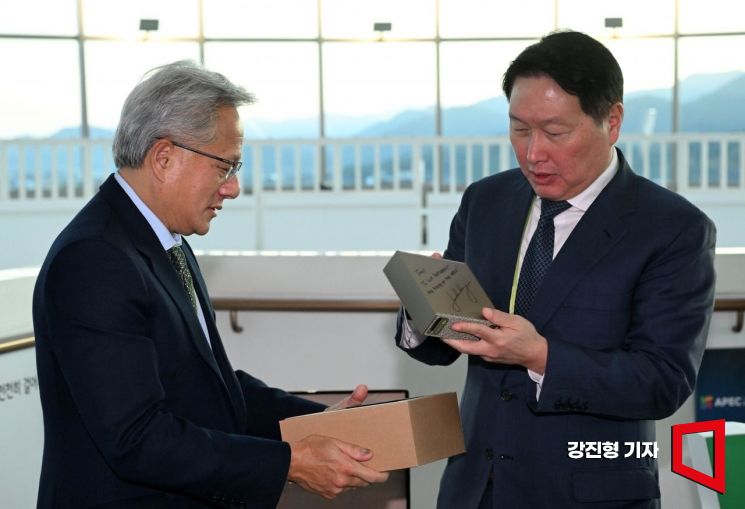 Jensen Huang, CEO of Nvidia, attended the Asia-Pacific Economic Cooperation (APEC) CEO Summit held on the 31st of last month at Gyeongju Arts Center in Gyeongju, Gyeongsangbuk-do, where he met with Chey Tae-won, Chairman of the Korea Chamber of Commerce and Industry, and presented the AI supercomputer 'DGX Spark' as a gift.
Kim Joungho, Professor at the School of Electrical Engineering at KAIST, who led the development of high bandwidth memory (HBM) and made a decisive contribution to enabling GPUs to train and infer AI, also wrote in a special contribution to The Asia Business Daily on this day, "Just as the Ford automobile factory revolutionized the history of modern manufacturing with the conveyor system, now the 'AI Factory' is becoming the new factory of the AI era."
According to Professor Kim, an "AI Factory" is a massive integrated facility where tens of thousands of GPUs and hundreds of thousands of HBMs are densely connected via optical communication. Without an AI Factory, neither AI services nor technology development are possible. In particular, it is essential infrastructure for integrating AI into all industries, including education, healthcare, and finance.
In the AI era, GPUs are the most critical resource. They play a role similar to "coal" during the Industrial Revolution. The 260,000 units secured this time represent the minimum foundational quantity needed to launch an AI Factory.
Jensen Huang, CEO of Nvidia, set foot in Korea last week for the first time in 15 years. Analysts say his visit was inevitable, as, as Chairman Chey pointed out, securing HBM has become crucial for him. Professor Kim analyzed, "GPUs are impossible without HBM," and added, "If you dream of a future market of 10 million GPUs, you would need 80 million HBMs, and even if you take all the supply from Samsung Electronics and SK Hynix, it would still not be enough."
Aside from China, Korea is the only country capable of handling everything from the "physical AI" that CEO Huang emphasizes to the AI Factory itself. Without collaboration with Korea's manufacturing sectors-such as automotive, electronics, chemicals, steel, shipbuilding, and nuclear power-the AI Factory would be meaningless. Now, that opportunity has come to Korea.
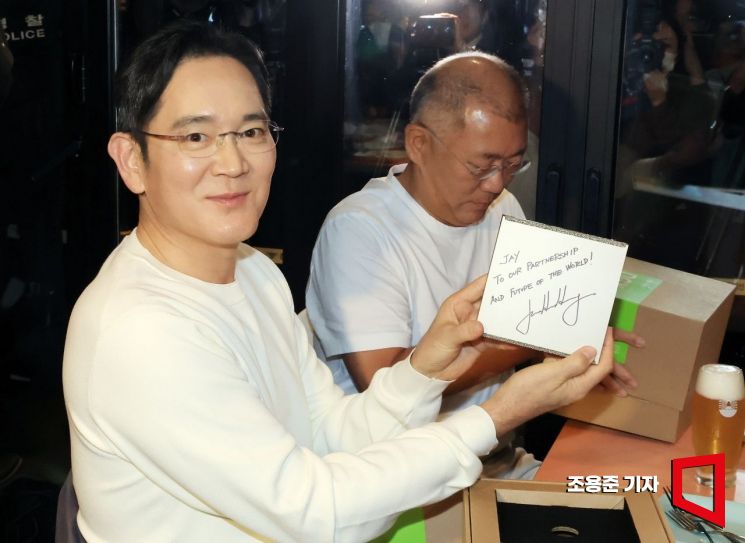 Samsung Group Chairman Jay Y. Lee is revealing the gift and autograph he received during a chicken meeting with Jensen Huang, CEO of Nvidia, at the Kkanbu Chicken restaurant near Samsung Station in Gangnam-gu, Seoul, on the afternoon of the 30th of last month. Hyundai Motor Group Chairman Chung Eui-sun is examining the gift. The gift from CEO Huang is the latest ultra-compact supercomputer called the "DGX Spark." Huang also personally visited Elon Musk, CEO of SpaceX, and Sam Altman, CEO of OpenAI, to present them with DGX Spark.
◆Korea Seizes the Opportunity as an 'AI Manufacturing Hub' = CEO Huang has proactively supplied GPUs to his home country, Taiwan, and presented a vision for manufacturing innovation using AI with local companies. Earlier this year, when he declared the era of physical AI symbolized by robots during his keynote speech at CES, the world’s largest electronics and IT exhibition, Korea could only watch. This was due to a shortage of GPUs, the core foundation for research.
In July, Chanhoon Park, Head of the Autonomous Growth AI Humanoid Global TOP Strategy Research Group at the Korea Institute of Machinery and Materials, had a small box in his office. Director Park said he was using Nvidia’s older "GeForce 3090" GPU, released in 2020. He explained that it was difficult to secure better GPUs and equally challenging to distribute the GPUs he had to researchers. Major big tech companies and governments around the world have had their heads of state directly involved in securing GPUs to foster AI and their domestic industries, but Korea had not. This was because CEO Huang, at the request of U.S. President Donald Trump, had headed to the United Arab Emirates (UAE). Securing GPUs is a competition at the highest level of government.
Amid the rapid changes of the AI era, the Korean government at one point mistakenly believed that developing domestic semiconductors would be enough to become an AI powerhouse. Former Minister of Science and ICT Yoo Sangim, who took office last August, said, "Securing GPUs was necessary to put out the most urgent fires. I went to San Francisco last May to meet CEO Huang." However, former Minister Yoo was unable to meet him.
The situation has changed. CEO Huang’s chicken and beer gathering with Samsung Electronics Chairman Jay Y. Lee and Hyundai Motor Group Chairman Chung Euisun, followed by his appearance on stage to deliver a message to the Korean people, happened for this reason. During his visit, CEO Huang presented the ultra-mini supercomputer "DGX Spark" to Chairman Lee, Chairman Chung, and Chairman Chey. Only a few, such as Elon Musk, CEO of Tesla, and Sam Altman, CEO of OpenAI, have received this gift directly from CEO Huang. Companies that have received the DGX Spark directly from him are in the rocket, AI, semiconductor, and automotive industries. Excluding U.S. companies, Korean companies are the main recipients. This effectively certifies that Korea will be at the center of manufacturing innovation research revolving around GPUs in the future.
After much negotiation, CEO Huang has agreed to provide 260,000 GPUs to Korea. This not only means that Korea has secured its position as the world’s third-largest AI chip powerhouse after the United States and China, but also places a heavy "responsibility" on the government and companies that have secured these GPUs. Simply stockpiling the "heart" of the AI Factory does not make Korea a leading AI manufacturing nation.
Securing GPUs cannot be the end goal. From now on, the design of "AI manufacturing projects" must be accelerated. Each company must implement concrete plans for technology development and capital investment based on the GPUs they have secured. Securing core AI talent to operate the software, algorithms, and AI server technology is also an urgent task. Blind dependence on Nvidia must also be avoided.
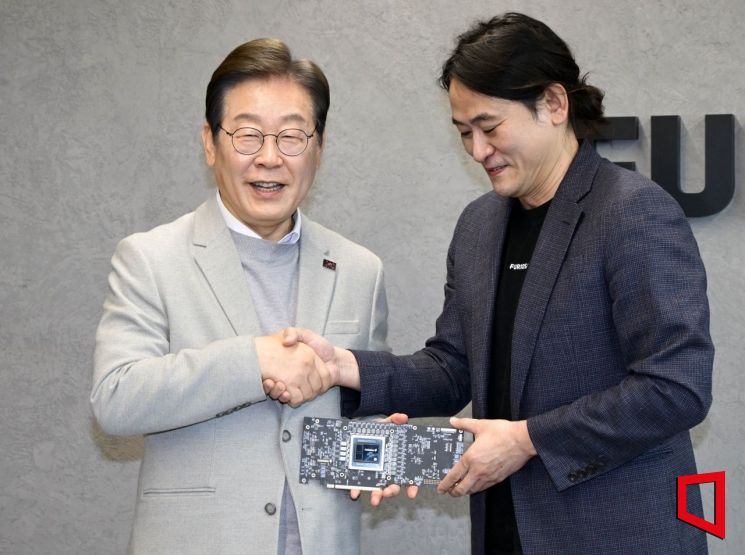 President Lee Jae-myung is shaking hands with Baek Joonho, CEO of Puriosa AI, in Gangnam-gu, Seoul, in May when he was a preliminary presidential candidate for the Democratic Party of Korea. 2025.4.14 Photo by the National Assembly Press Photographers Group
Baek Joonho, CEO of Puriosa AI, a domestic neural processing unit (NPU) semiconductor company, stated, "It is difficult to become an AI powerhouse without computational independence. We are doing our utmost to ensure that our AI semiconductors secure global competitiveness. The government must also pursue both GPU expansion and NPU development as a two-track strategy."
Another urgent challenge is to address the "reality barrier" of social infrastructure. Supplying gigawatt-level power and massive amounts of cooling water to a single AI Factory is necessary. Government-level energy supply planning and site selection are of utmost importance.
© The Asia Business Daily(www.asiae.co.kr). All rights reserved.














