Nvidia CEO Jensen Huang’s Choice of Chicken Brand Brings Unexpected Opportunity
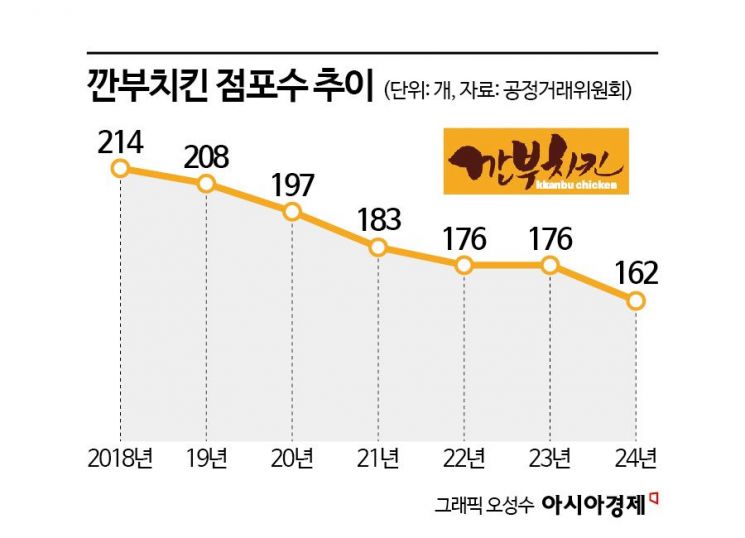
Store Count Drops Below 200... Average Franchise Sales Decline
Head Office’s Product Sales Surge, Cost Ratio Falls, Performance Rebounds
Chairman Jay Y. Lee’s Jacket: LANSMERE Piece Priced at 890,000 Won
The chicken franchise where Nvidia CEO Jensen Huang, Samsung Electronics Chairman Jay Y. Lee, and Hyundai Motor Group Chairman Chung Euisun held their "chimaek meeting" has drawn significant public attention. The fact that CEO Huang personally chose "Kkanbu Chicken" as the meeting venue is seen as giving the meal a symbolic significance beyond just dining.
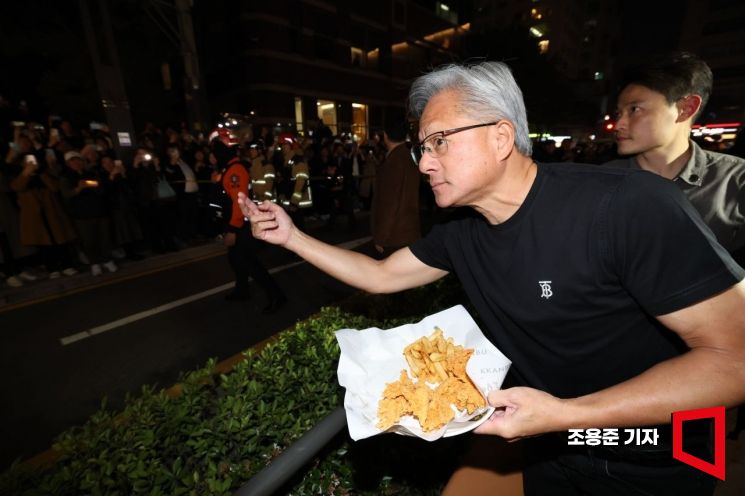 Nvidia CEO Jensen Huang is offering chicken to citizens during a meeting with Samsung Electronics Chairman Jay Y. Lee and Hyundai Motor Group Chairman Chung Euisun at Kkanbu Chicken in Gangnam-gu, Seoul on October 30, 2025. Photo by Cho Yongjun
According to industry sources on October 31, CEO Huang met with Chairman Lee and Chairman Chung the previous evening at the Kkanbu Chicken branch in Samseong-dong, Gangnam-gu, Seoul, enjoying chicken and alcoholic beverages together for dinner.
CEO Huang stated, "I really like chicken and I also enjoy beer. Especially, I love sharing them with friends," adding, "That’s why I thought Kkanbu was the perfect place for such a gathering." The table that evening featured boneless and bone-in chicken, cheese balls, and cheese sticks, accompanied by Terra beer and Chamisul soju. The jacket worn by Chairman Jay Y. Lee was a faux suede blouson (ash) from the Samsung C&T Fashion division's brand LANSMERE, priced at 890,000 won.
"Kkanbu" became internationally known through the 2021 Netflix drama "Squid Game," with the line "We are Kkanbu, aren’t we?" The term "Kkanbu" is Korean slang meaning "close friend" or "companion." The choice of Kkanbu Chicken as the location for a "chimaek meeting" between a global CEO and Korea’s leading chairmen is seen as significant for this reason.
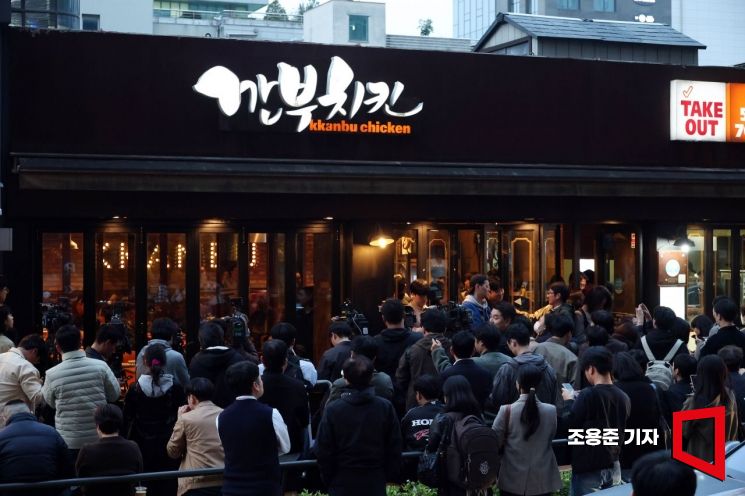 The area around a chicken restaurant in Samseong-dong, Seoul, where Lee Jae-yong, Chairman of Samsung Electronics, Chung Eui-sun, Chairman of Hyundai Motor Group, and Jensen Huang, CEO of Nvidia, are reported to meet on the afternoon of the 30th, is bustling with reporters and onlookers. 2025.10.30 Photo by Jo Yongjun
A Brand That Sparked a Craze with the 'Chicken Cafe' Concept
Kkanbu Chicken was founded by CEO Kim Seungil in 2006 and incorporated in 2008. With the slogan "Honest chicken I want to eat," the company broke away from the delivery-focused market and was the first to introduce the "chicken cafe" concept, allowing customers to enjoy chicken and beer in-store.
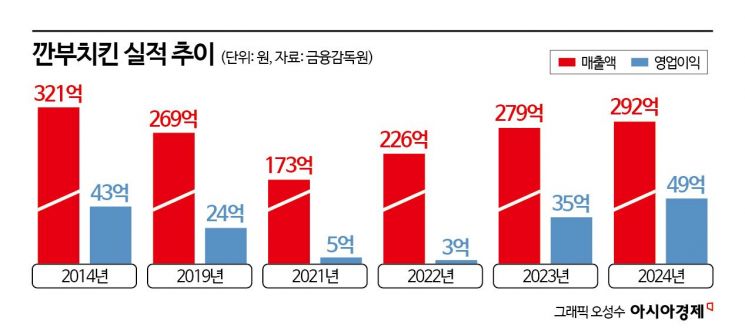
This strategy changed the dining-out trend at the time. In 2014, the company reached its heyday with sales of 32.1 billion won, operating profit of 4.3 billion won, and 256 stores. However, after a failed attempt to sell management rights in 2016, growth stalled. While the delivery market grew explosively, Kkanbu Chicken stuck to its "in-store strategy," and as franchise fees increased by nearly 40% after 2020, the influx of new franchisees slowed. Even marketing efforts leveraging "Squid Game" failed to boost performance.
The COVID-19 pandemic dealt a direct blow to Kkanbu Chicken. In 2021, sales fell 22% year-on-year to 17.3 billion won. Franchise sales plummeted from 3.7 billion won to 1 billion won, a drop of over 70%. Operating profit decreased from 1.8 billion won to 500 million won, and net profit turned negative. The number of stores also dropped from 208 in 2019 to 183 in 2021. The debt ratio surged from 69% in 2018 to 273% in 2022.
Expanding Product Sales... The Chicken Chain on the Rise Again
A rebound began in 2023. Sales rose to 27.9 billion won and operating profit to 3.5 billion won, more than a tenfold increase from the previous year. Net profit also turned positive at 2.1 billion won. The main driver of growth was a surge in product sales-such as fresh chicken, sauces, and frying oil-supplied to franchisees. Although the number of franchise stores declined, product sales increased by 4.7 billion won (21.4%) year-on-year to 26.7 billion won. During this period, the cost of goods sold for products rose by only 13%.
As a result, the cost of goods sold ratio (the proportion of total sales spent on raw materials and other product-related costs) improved from 61.1% to 57.5%. The lower this ratio, the greater the profit margin for the same sales. With the sales growth rate exceeding the cost increase rate by more than double, the company’s operating profit soared.
Last year, sales reached 29.2 billion won, operating profit 4.9 billion won, and net profit 2.9 billion won. The operating margin reached 16%. The cost of goods sold ratio dropped further to 50.5%.
However, the financial structure remains fragile. Out of total assets of 45.1 billion won, total liabilities stand at 30.6 billion won, resulting in a debt ratio of 211%. Borrowings (both short- and long-term) amount to 26.1 billion won, accounting for 58% of total assets, with annual interest expenses reaching 900 million won. This has led to criticism that the company’s growth has been fueled by debt.
The company’s strong performance has not translated into increased profits for franchise owners. The average sales per Kkanbu Chicken franchise fell by 4% from 471.98 million won in 2022 to 453.09 million won in 2024. Average sales per 3.3 square meters (1 pyeong) also decreased by 5.9%, from 17.64 million won to 16.59 million won. This means that while the company’s operating margin improved, sales efficiency at the store level declined.
Attention is now focused on whether this "chimaek meeting" will lead Kkanbu Chicken into a second golden era. Having gained global recognition through "Squid Game," the brand has now been chosen by a figure representing the world’s semiconductor and artificial intelligence (AI) industries. A franchise industry insider commented, "Rather than relying on temporary publicity effects, the company must strengthen its brand and improve franchisee profitability at the same time."
© The Asia Business Daily(www.asiae.co.kr). All rights reserved.














