2025 Real GDP Growth Forecast Raised to 0.7%
The Bank of Japan (BOJ), Japan's central bank, kept its benchmark interest rate unchanged at 0.5% on October 30. This decision appears to reflect the BOJ’s intention to align with the newly launched Sanae Takaichi Cabinet while monitoring the impact of U.S. tariff policies on the Japanese economy.
According to the Nihon Keizai Shimbun (Nikkei) and Kyodo News, the BOJ decided at its two-day monetary policy meeting ending that day to maintain the short-term policy interest rate, which serves as the benchmark rate, without any adjustment.
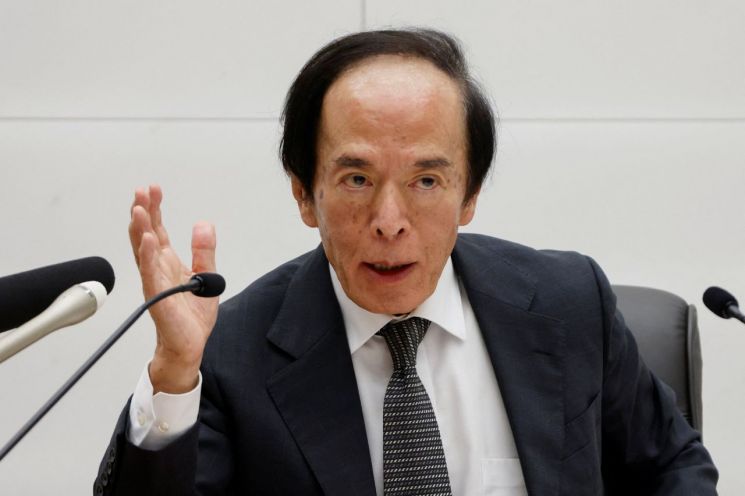
As in the previous month, two out of nine policy board members proposed raising the rate by 0.25 percentage points to 0.75%, but the proposal was rejected. The BOJ had raised the short-term policy rate from "around 0.25%" to "around 0.5%" in January. Since then, the bank has decided to keep rates unchanged at all six meetings up to and including this one.
Kazuo Ueda, Governor of the Bank of Japan, stated at a press briefing on the 3rd that "the real interest rate remains extremely low," indicating his intention to continue the policy of raising the policy rate.
However, Nikkei reported that there are concerns that the tariff measures taken by the Donald Trump administration in the United States could potentially dampen employment and consumption in Japan, given that their impact on the Japanese economy has not yet become clear. Additionally, if the global economy slows, the momentum for wage increases next year could weaken. The report also noted that, due to the U.S. federal government shutdown, the release of economic indicators has been suspended, making it difficult to accurately assess the real state of the U.S. economy. As a result, many believe that further observation is necessary.
Japanese media further analyzed that the BOJ likely postponed a rate hike in order to coordinate policy with the Takaichi Cabinet, which was inaugurated on the 21st of this month. Prime Minister Takaichi, who has pledged to continue the economic policies of former Prime Minister Shinzo Abe, known as "Abenomics," has stated her intention to pursue "active fiscal policy." She also expressed a negative stance toward rate hikes during last year’s Liberal Democratic Party leadership election.
Nikkei reported that market participants widely expect the BOJ to raise rates in December. Kyodo News and NHK predicted that the main focus going forward will be the extent to which support for a rate hike spreads within the BOJ.
The BOJ also released its quarterly "Outlook for Economic Activity and Prices" report that day.
The bank slightly revised its real gross domestic product (GDP) growth forecast for fiscal 2025 (April 2025 to March 2026) upward by 0.1 percentage points, from 0.6% to 0.7%. The forecast for the consumer price index (excluding fresh food) inflation rate for fiscal 2025 was maintained at 2.7%.
The real GDP growth forecasts for fiscal 2026 and 2027 remained unchanged at 0.7% and 1.0%, respectively. The inflation forecasts for fiscal 2026 and 2027 were also reaffirmed at 1.8% and 2.0%, respectively.
The BOJ maintained its projection that the 2% inflation target would be achieved sometime between the second half of fiscal 2026 and fiscal 2027.
© The Asia Business Daily(www.asiae.co.kr). All rights reserved.











