Korean Shipbuilders to Lead Investment, Planning, and Construction
$150 Billion Allocated, Including Financial Guarantees
Hanwha Philly Shipyard Expansion to Accelerate
Pilot Model Expected for Shipbuilding Industry Cooperation
With the governments of South Korea and the United States reaching an agreement on the details of tariff negotiations, the MASGA (Maritime Shipbuilding and Growth Act) project, which aims to revitalize the U.S. shipbuilding industry, is expected to gain further momentum. In particular, as both governments agreed that Korean companies will take the lead in investment for the MASGA project, including indirect investment methods such as guarantees, shipbuilders like Hanwha Group, HD Hyundai, and Samsung Heavy Industries are expected to accelerate their efforts.
According to industry sources on October 30, the MASGA project, which the two governments agreed upon the previous day, will proceed in a way that allows Korean shipbuilders to take the lead in investment, planning, and construction. The United States will provide shipyards and clients for ship orders, while Korean companies will contribute their technology and capital. In other words, Hanwha, HD Hyundai, and Samsung Heavy Industries will play a central role in rebuilding U.S. shipbuilding infrastructure and constructing new ships.
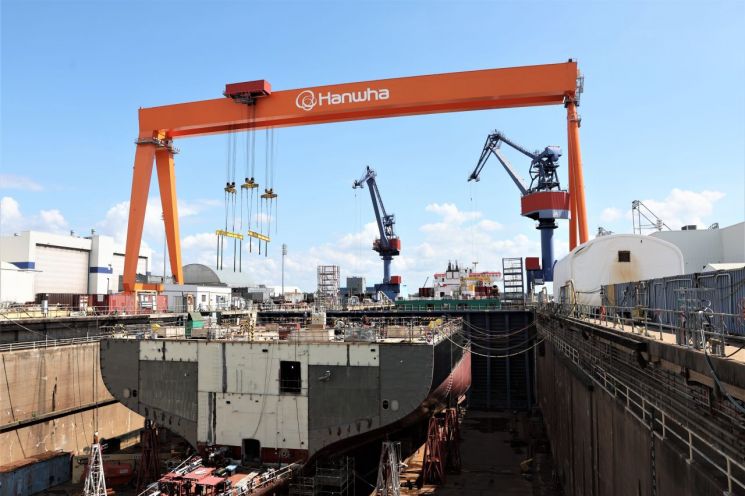 A national security purpose vessel is being constructed at Hanwha Philly Shipyard 4 Dock, Hanwha Philly Shipyard, Philadelphia, Pennsylvania, USA. Yonhap News Agency
The $150 billion allocated for the MASGA project includes not only direct investment but also financial guarantees. Usually, shipowners secure funding from financial institutions using the ships under construction as collateral and pay the shipbuilders. With ship financing now available, Korean shipbuilders will have a foundation to recover their investments if they win orders from U.S. shipping companies. The Export-Import Bank of Korea (KEXIM) and Korea Trade Insurance Corporation (K-SURE) are expected to participate in providing these financial guarantees. If both institutions participate, it is anticipated that the risk for U.S. shipping companies placing orders will be significantly reduced.
The expansion of Hanwha Philly Shipyard, which Hanwha Group is currently pursuing, is also expected to accelerate with this financial support. Previously, in August, Hanwha Group announced an additional investment of $5 billion (7 trillion won) in Hanwha Philly Shipyard as part of the MASGA project. At that time, Hanwha Group stated that through this facility investment, it plans to increase its shipbuilding capacity from the current one to 1.5 ships per year to as many as 20 ships annually.
HD Hyundai is also expected to benefit. In particular, its joint project with Huntington Ingalls for naval vessels is likely to gain speed. In addition, the maintenance, repair, and overhaul (MRO) project for U.S. Navy logistics support vessels, which HD Hyundai Heavy Industries secured in August, is expected to proceed smoothly. Samsung Heavy Industries is also likely to see expanded opportunities to participate in MRO projects for the U.S. Navy and Navy support vessels. Previously, in August, Samsung Heavy Industries signed a strategic partnership (MOU) with Vigor Marine Group regarding MRO.
The industry views this agreement as a "pilot model" for shipbuilding cooperation between South Korea and the United States. However, some point out that structural challenges remain, such as U.S. protectionist policies for its shipbuilding industry, labor shortages, and outdated facilities, which will require adjustments before the project can be fully commercialized.
© The Asia Business Daily(www.asiae.co.kr). All rights reserved.












