"Not Pursuing an 'Asian NATO'...
Focusing on Bilateral and Trilateral Cooperation"
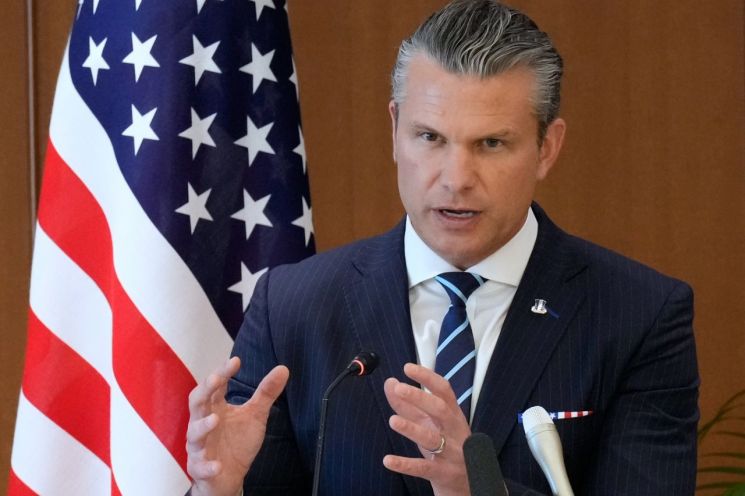
Pete Hegseth, U.S. Secretary of Defense, said on the 29th (local time) that he believes the Lee Jaemyung administration's push for the transfer of wartime operational control is "a great thing."
While on an Asian tour, Secretary Hegseth responded to questions from reporters aboard the U.S. Secretary of Defense's official plane en route to Malaysia, saying, "South Korea is an excellent example of a reliable partner in combat."
This is the first time since the launch of the second Trump administration that a key cabinet member has clearly expressed support for South Korea's transfer of wartime operational control.
Secretary Hegseth, referencing the presence of U.S. Forces Korea, said about South Korea, "Not only that, but they increasingly want to take on a leading role, and they should."
He continued, "This does not mean we are stepping back from the defense of South Korea, nor does it mean we will not provide support." He added, "Frankly, this is just common sense. Why would your country, which is wealthy, strong, and motivated with the ability to do so, want a relationship where only American leadership is needed in emergencies?"
Secretary Hegseth's remarks are interpreted as being based on President Donald Trump's "America First" security policy. By reducing the burden on the United States, while expecting South Korea to take on a greater role in areas such as defense against North Korea, he is supporting the transfer of wartime operational control linked to strengthening South Korea's independent defense capabilities and operational competence.
The operational control of the South Korean military was transferred to the UN Commander during the Korean War in June 1950, and then to the Commander of the ROK-U.S. Combined Forces Command when it was established in 1978. On December 1, 1994, during the Kim Youngsam administration, peacetime operational control was returned to the South Korean military, but wartime operational control still remains with the Commander of the ROK-U.S. Combined Forces Command. The Lee Jaemyung administration maintains that the transfer of wartime operational control is possible within its term and plans to continue negotiations with the United States on this matter.
When asked whether the United States is envisioning an "Asian version of NATO" in the Indo-Pacific region, Secretary Hegseth replied, "I cannot say that," adding, "We are cooperating through bilateral and trilateral relationships."
Regarding some media reports that Japan may be included within the defense perimeter in the new National Defense Strategy (NDS) being developed by the United States, while South Korea and Taiwan may be excluded, he said, "I am not aware of that," and added, "I do not believe those reports are accurate."
He also addressed the suggestion that the second Trump administration's defense strategy is focusing on the defense of the Western Hemisphere centered on the Americas, and that the emphasis on deterring threats from China is being reduced, stating that allocating resources to the Western Hemisphere does not mean dispersing resources needed to deter threats from China.
© The Asia Business Daily(www.asiae.co.kr). All rights reserved.












