Vacancy Rate Reaches 26%, Heightening Local Economic Crisis
Launching Data-Driven Policy Research for Commercial District Recovery
Accelerating the Establishment of a Resident-Participatory "Livelihood Policy Platform"
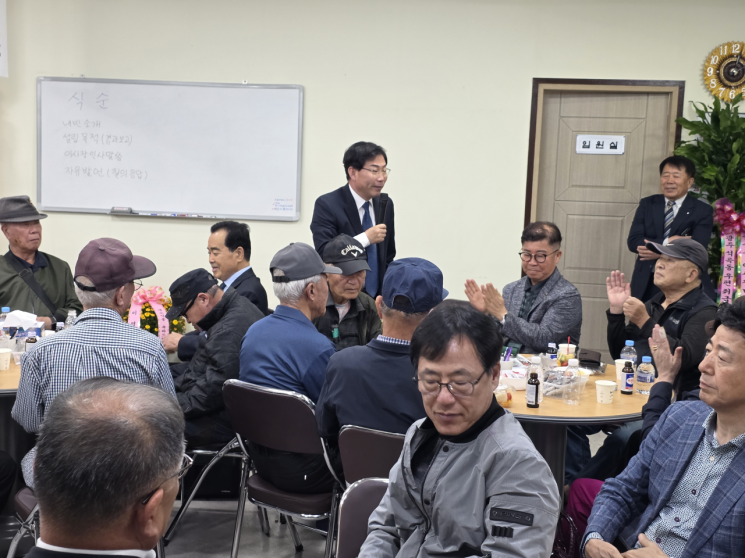 At the opening ceremony of the Gwangju Buk-gu People's Livelihood Economic Research Institute held on the 24th, Chairman Seungjong Song met with residents of Buk-gu to exchange various opinions on local economic issues. Provided by Gwangju Buk-gu People's Livelihood Economic Research Institute
The Gwangju Buk-gu People's Livelihood Economy Research Institute, established with the goal of revitalizing the local economy in Buk-gu, Gwangju and improving residents' quality of life, has officially launched its operations at Songmi Building, 6th floor, 158 Dongmun-daero, Buk-gu, Gwangju.
The Gwangju Buk-gu People's Livelihood Economy Research Institute held its opening ceremony on the 24th and began its full-scale activities. Around 200 people, including small business owners and self-employed individuals from Buk-gu, attended the event, demonstrating strong interest in the recovery of the local economy.
There are approximately 25,000 small business establishments in Buk-gu, Gwangju, with food service and retail businesses accounting for 63% of the total. As of the second quarter of this year, the vacancy rate for medium and large commercial properties in Gwangju's main commercial districts was 26.42%, while the vacancy rate for small properties was 13.56%. In particular, the commercial district around Chonnam National University recorded the highest vacancy rates in the area, with 37.11% for medium and large properties and 19.72% for small properties. The Unam, Munheung, and Ilgok districts had a vacancy rate of around 9.2%.
Recently, local neighborhood commercial areas in Buk-gu have also been losing vitality due to the economic downturn, reduced consumer spending, outflow of young people, and the stagnation of traditional markets.
In some cases, the vacancy rate in designated alley-type shopping districts has actually increased after designation. In one commercial district, the vacancy rate rose from 10.28% in the first quarter of 2021 to 19.72% in the first quarter of 2025, an increase of 9.44 percentage points.
This worsening economic situation felt by self-employed individuals and small business owners is pointed out as a structural issue that cannot be resolved by administrative support alone.
Based on this reality, the Gwangju Buk-gu People's Livelihood Economy Research Institute aims to propose policy alternatives that are field-oriented, livelihood-focused, and data-driven. It has positioned itself as a "participatory livelihood policy platform" where residents and merchants, rather than government administrators, directly participate in diagnosing problems and finding solutions.
The institute is focusing on realizing "a prosperous Buk-gu for businesses and a happy Buk-gu for people" by linking local industrial, educational, welfare, and cultural resources. In particular, it has presented five key tasks for fundamentally improving the structure of Buk-gu's economy.
First, the institute will investigate the current state of the local economy and establish a data-driven policy development system. It will also develop support measures for small business owners, traditional markets, and young entrepreneurs to revitalize stagnant commercial districts. In addition, it plans to develop a Buk-gu-style green economy (RE100) implementation model to drive the transition to a sustainable local economy, and to establish a policy governance structure that enables residents to directly participate in policy formulation and execution. Alongside these efforts, the institute will lay the foundation for cooperation and mutual growth by activating a social economy network centered on the local community.
Seungjong Song, Chairman of the Gwangju Buk-gu People's Livelihood Economy Research Institute, stated, "Livelihood policies that small business owners can truly feel must be found in the field. We will go out and listen to their difficulties in person, and work together with residents and merchants to develop practical solutions."
© The Asia Business Daily(www.asiae.co.kr). All rights reserved.












