Minister Kim Yoonduk Holds Press Briefing with Reporters on the 29th
Although signs of overheating have become evident in certain segments of Seoul's housing market, the government has decided not to introduce one-off measures. The recent sharp rise in housing prices in some areas is largely attributed to market sentiment anticipating additional government regulations. This decision is based on the assessment that frequent real estate policies during the previous Democratic Party administration contributed to confusion in the market.
At a press briefing with the press corps on the 29th, Kim Yoonduk, Minister of Land, Infrastructure and Transport, stated, "It is too early to say whether additional (real estate) measures are necessary or not at this point, and we are monitoring market conditions to assess the need for such measures." He added, "There were opinions that some response was needed before the Chuseok holiday, but during the previous Democratic Party administration, ad hoc responses led to many negative consequences. Fundamentally, we intend to maintain a framework based on comprehensive measures coordinated among relevant ministries."
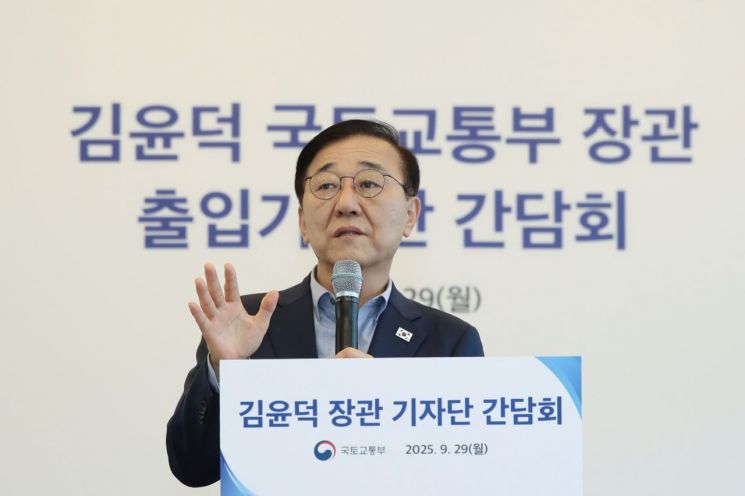 Kim Yoonduk, Minister of Land, Infrastructure and Transport, is answering questions at a press briefing on the 29th. Photo by Ministry of Land, Infrastructure and Transport
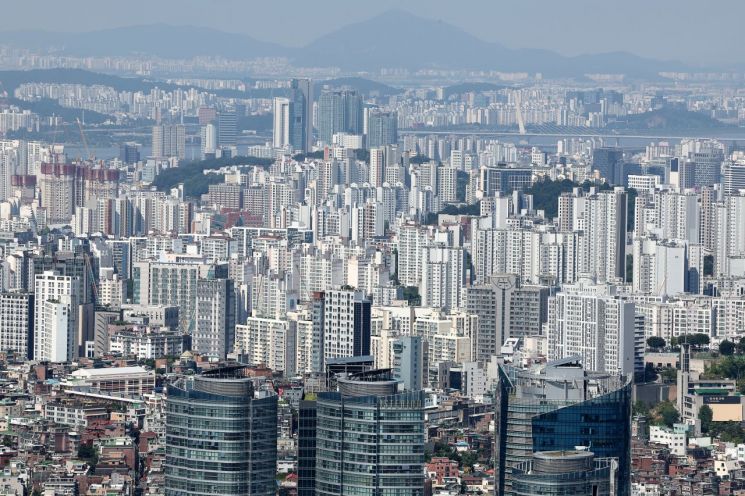
In areas such as Mapo and Seongdong districts in Seoul, as well as Bundang, which have not yet been designated as land transaction permit zones, there has been a surge in buying activity within a short period, resulting in a sharp increase in apartment prices and signs of overheating. In addition, the decrease in the number of rental properties has fueled concerns among citizens about housing insecurity and growing fears that it will become even more difficult to narrow the asset gap in the future.
When asked how he analyzes the recent market situation, Minister Kim responded, "The economy is sluggish, and after several years of reduced (housing) supply, we are seeing a complex pattern where demand is relatively concentrated. The weekly apartment sales trend has risen significantly to around 0.19, which we view as a very serious situation."
Regarding demand-suppression measures such as property holding taxes, he said, "This is outside the authority of the Minister of Land, Infrastructure and Transport," but also expressed a basic position that, if necessary, he would work closely with other relevant ministries. On real estate speculation, he stated, "We will respond with strong determination and, if necessary, consider additional institutional measures." Regarding the issue of the reconstruction excess profit levy, which some have called to abolish, he said, "Since a bill to amend the law has been submitted, it is a priority to observe the outcome of discussions in the National Assembly."
On the slow recovery of the regional construction market, he announced plans for additional measures linked to balanced regional development. Minister Kim said, "The number of unsold homes in the provinces is about 13,000 units above the average, and if possible, we will consider purchasing this volume. We are also reviewing the option of purchasing homes larger than 85 square meters in exclusive area." He added, "From a mid-term perspective, revitalizing local social overhead capital (SOC) improvement projects, so-called SOC New Deal projects, would also help boost the regional economy."
Responding to criticism that the housing supply expansion plan (the September 7 real estate measures) announced earlier this month lacked tangible benefits for the public and was ineffective or even fueled housing prices, he said, "There are various perspectives, but we are analyzing the reasons for past policy failures and proceeding by enacting special laws. Once these aspects become visible, such concerns will be alleviated."
Regarding the construction of the new airport on Gadeokdo, he noted that a variety of opinions are being expressed by local governments, experts, and industry stakeholders. "It would not be desirable to immediately implement the originally planned 84-month schedule," he said. "We plan to make a decision within this year and, at the Ministry of Land, Infrastructure and Transport level, will set a direction by October or early November."
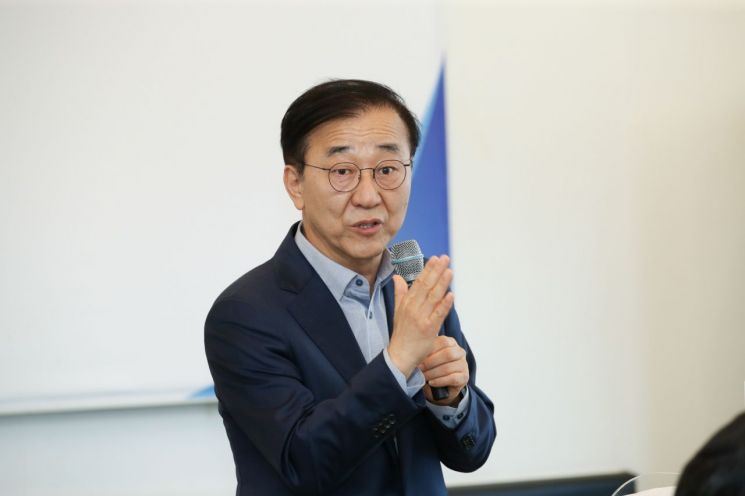 Kim Yoonduk, Minister of Land, Infrastructure and Transport, is answering questions at a press briefing with reporters on the 29th. Photo by Ministry of Land, Infrastructure and Transport
On the issue of integrating high-speed rail operators, he stated, "We plan to proceed gradually, taking into account various opinions." The integration of Korea Railroad Corporation, which operates KTX, and SR, the operator of Suseo High-Speed Railway (SRT), was also a presidential campaign pledge by President Lee Jaemyung. Minister Kim said, "On the surface, integration may seem efficient, but we have experienced that unprepared integration, complicated by emotions and other factors, can undermine effectiveness and leave negative consequences." He made it clear that they would proceed first with what can be done immediately, but would not rush the process.
When asked about his views on comprehensive real estate holding taxes, such as the comprehensive real estate tax, he prefaced his comments as his personal opinion, not as the Minister of Land, Infrastructure and Transport, and said, "I believe they should be increased." Regarding concerns about discord between the Seoul city government and national housing and real estate policies, he responded, "Rational coordination and dialogue are proceeding well, and we share the understanding that we must work together on real estate issues."
© The Asia Business Daily(www.asiae.co.kr). All rights reserved.














