KOSPI Recovers 3,400 Mark in Just One Day
Increased Volatility Unavoidable Ahead of Long Chuseok Holiday
Focus on Exchange Rates and Earnings After Chuseok
The KOSPI rebounded to the 3,400-point level in just one day. After plunging more than 2% and falling below 3,400 on the 26th, the KOSPI has quickly recovered from the shock and is showing signs of stabilization. However, with the long Chuseok holiday approaching and ongoing domestic and global uncertainties, volatility is expected to increase for the time being.
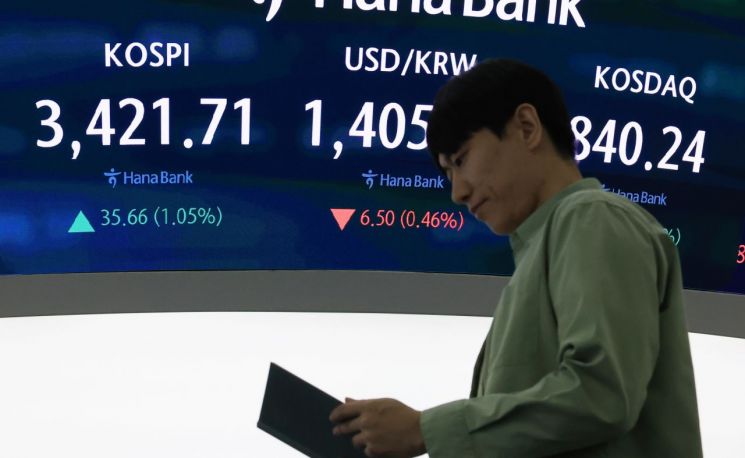
As of 9:30 a.m. on the 29th, the KOSPI was trading at 3,435.15, up 49.10 points (1.45%) from the previous session. The KOSDAQ rose 9.80 points (1.17%) to 844.99.
Last week, the KOSPI fell 1.72%, marking its first decline in five weeks. On the 26th, it dropped 2.45%, recording the largest single-day fall since "Black Friday" on August 1, when disappointment over the tax reform plan triggered a sharp sell-off. The 3,400-point level was lost for the first time in ten days.
On the 29th, the market is rising due to inflows of bargain hunters, but with the long Chuseok holiday ahead, increased volatility this week appears inevitable. Han Jiyeong, a researcher at Kiwoom Securities, said, "This week, the Korean stock market will enter a phase of searching for direction around the 3,400-point level, influenced by factors such as changes in the outlook for U.S. Federal Reserve rate cuts following the September U.S. nonfarm payroll report, key economic indicators like the September U.S. ISM Manufacturing PMI and Korean exports, changes in the won-dollar exchange rate, and a supply-demand vacuum due to the long domestic holiday. It is advisable to prepare for increased supply-demand volatility coupled with macroeconomic uncertainties during the week."
After Chuseok, the stock market is expected to be influenced by the exchange rate and corporate earnings. Kim Daejun, a researcher at Korea Investment & Securities, analyzed, "Currently, the market is at a crossroads of positive and negative factors: earnings forecasts are rising, but the exchange rate, which determines foreign investor flows, has also reached a burdensome level. Depending on the movements and impact of these two variables, the KOSPI's trend may change. It is time to focus on changes in earnings and the exchange rate." Korea Investment & Securities presented a projected KOSPI band of 3,200 to 3,500 for this month.
Lee Kyungmin, a researcher at Daishin Securities, pointed out, "Every October, the KOSPI has shown a clear seasonal tendency to underperform compared to global markets. This is due to the recurring earnings pattern: third-quarter results usually fall short of market expectations, leading to downward revisions for the fourth quarter and the following year's outlook after third-quarter earnings are confirmed. As a result, the 12-month forward earnings per share (EPS) either stagnates or enters a decline. With the KOSPI now in a resistance zone, third-quarter earnings could trigger further volatility."
In October, a process of short-term overheating correction is expected. Lee further analyzed, "In October, the KOSPI is likely to enter a phase of correcting short-term overheating and digesting supply overhang. It is difficult to expect the KOSPI to rise above 3,500 in the short term; instead, time is needed to secure upward momentum after a period of mid- to short-term adjustment at the current level." He added, "Above the 3,400-point level, it is important to be wary of increased short-term volatility and focus on risk management. If the KOSPI falls to the 3,200-point range, rotational trading from a short-term trading perspective would be effective."
© The Asia Business Daily(www.asiae.co.kr). All rights reserved.












