"We Will Not Recognize Palestine as a Sovereign State"
While supporting the 'two-state solution' for Israel and Palestine, New Zealand has stated that it will not recognize Palestine as a sovereign state for the time being.
Winston Peters, New Zealand's Deputy Prime Minister and Minister of Foreign Affairs, said in a speech at the United Nations General Assembly in New York, USA, on the 26th (local time), "There are still many questions remaining before recognizing Palestine as a state," adding, "It would be imprudent to declare recognition at this point."
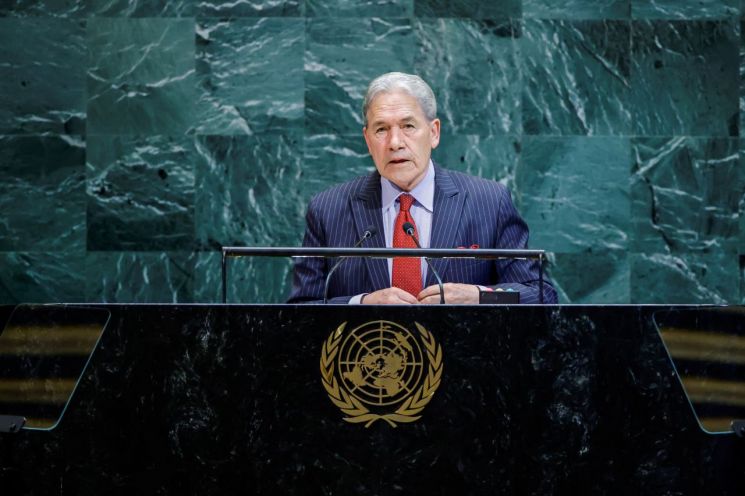 Peter's New Zealand Foreign Minister speaking at the United Nations General Assembly. Photo by Reuters Yonhap News
Deputy Prime Minister Peters cited Hamas's control of the Gaza Strip as a reason. He emphasized, "The war between Israel and Palestine is intensifying, and with Hamas remaining the de facto government of the Gaza Strip, there is a lack of clarity regarding future actions." He also expressed concern that "if the focus is placed solely on the issue of state recognition now, both Israel and Hamas may adopt a more hardline stance, which could hinder the ceasefire process." Nevertheless, he reaffirmed his support for the two-state solution itself.
The two-state solution aims for Israel and Palestine to establish independent sovereign states and coexist peacefully.
Previously, at the United Nations General Assembly held on the 12th, a resolution urging the two-state solution was adopted by an overwhelming margin, with 142 votes in favor, 10 against, and 12 abstentions. The United States and Israel voted against the resolution.
The resolution also condemned the surprise attack on Israel by the Palestinian militant group Hamas on October 7, 2023, while criticizing Israel's blockade and airstrikes on the Gaza Strip, as well as actions causing starvation. This was the first United Nations General Assembly resolution to explicitly condemn Hamas's attack.
The New Zealand government also reiterated in a separate press release that it "wants to recognize Palestine as a state when the prospects for negotiations improve." In contrast, the opposition Labour Party strongly criticized the government's decision, stating that it was "standing on the wrong side of history."
© The Asia Business Daily(www.asiae.co.kr). All rights reserved.












