Special Exhibition for the 80th Anniversary of Liberation: "Samcheongdodo"
100 Works by Loyalists Who Endured War and Turmoil on Display
All 56 Pages of the Masterpiece "Samcheongcheop" Unveiled for the First Time
The bamboo painting featured on the back of the 50,000 won bill is "Pungjukdo" (風竹圖) by Tan-eun Lee Jung (1554-1626), a renowned ink bamboo artist of the mid-Joseon period. Lee Jung, a great-grandson of King Sejong, depicted bamboo swaying in the wind to symbolize the unwavering integrity and resilience of the Korean people, unbroken even by strong winds. In celebration of the 80th anniversary of Liberation, the Daegu Kansong Art Museum has opened the exhibition "Samcheongdodo: Plum, Bamboo, Orchid-An Unending Story," composed around the "Samcheongcheop."
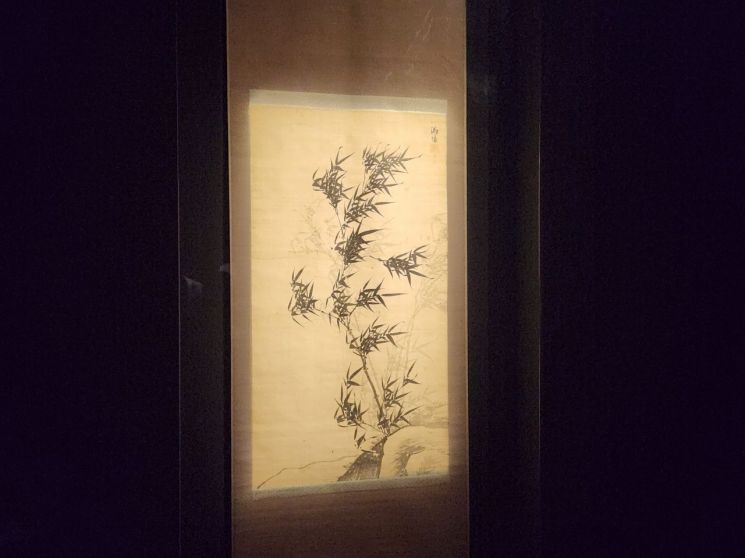 The bamboo painting on the back of the 50,000 won bill, "Pungjukdo" (風竹圖) by Lee Jung. The bamboo standing resolutely against the wind and rain symbolizes the spirit and indomitable will of the Korean people. Photo by Seo Mideum
"Samcheong" (三淸) refers to the plum blossom, bamboo, and orchid, which symbolize the attitudes and virtues that a true gentleman should possess. The exhibition reflects on the spiritual and cultural strength of the Korean people, who persevered through the Imjin War, the Manchu Invasion, and the dark era of Japanese colonial rule, all the way to Liberation. A total of 100 works from 35 collections are on display, and for the first time, all 56 pages of the "Samcheongcheop" are being unveiled.
The "Samcheongcheop" is an album that combines paintings and poems by Tan-eun Lee Jung. He completed it after two years of recovery from serious injuries sustained during the Imjin War. With additional writings from Choi Rip, Han Ho, and Cha Cheonro-leading literary figures of the time-the album is considered a masterpiece with a unique place in the history of Korean painting.
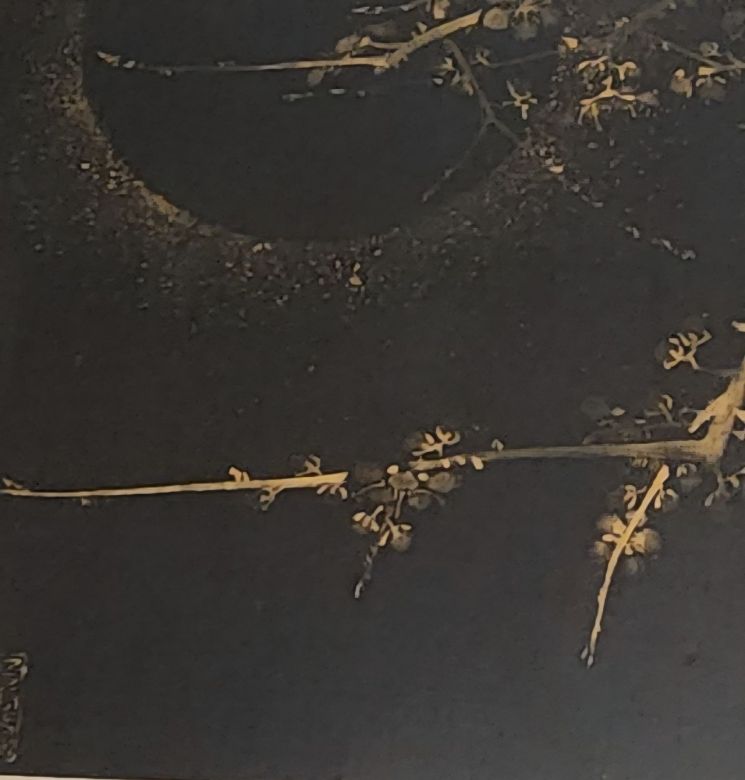 Lee Jung's "Wolmae." A work depicting plum blossoms on a moonlit night in black-and-white ink wash painting, characterized by its simple expression of the elegance of plum blossoms symbolizing integrity. Photo by Seo Mideum
The "Samcheongcheop" features paintings of the three noble plants (plum, bamboo, orchid) rendered in gold pigment on black silk. It was designated a Treasure in 2018 in recognition of its artistic harmony of painting and calligraphy. The album narrowly escaped destruction in a fire during the Manchu Invasion and endured the ordeal of being taken to Japan during the Japanese colonial period. Thanks to Kansong Jeon Hyeongpil, it was returned to Korea in 1935. Kansong paid 455 won for its return-a considerable sum, given that a luxury tile-roofed house in Gyeongseong at the time cost 1,000 won-thus reclaiming a vital part of Korean heritage.
The "Samcheongcheop," whose cover was burned in the fire during the Manchu Invasion and suffered severe whitening due to poor storage, was revealed to the public after more than two years of restoration. Director Jeon Ingeon stated, "It was a painstaking process to remove the whitening from the silk fibers one by one with tweezers. We were very careful to restore the original colors without damaging the original form."
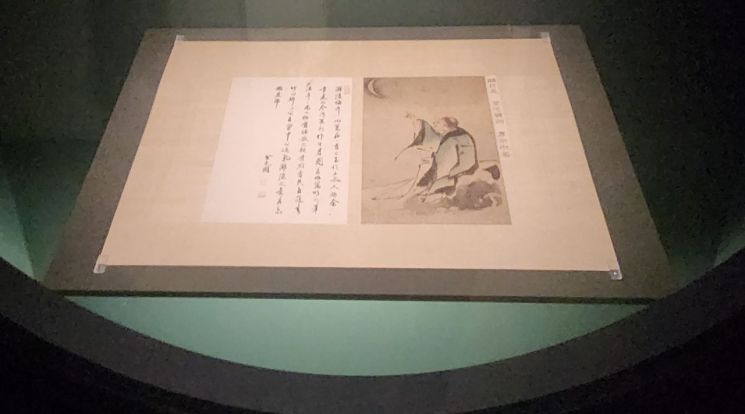 The only portrait painted by Lee Jung is "Moonwoldo." It depicts a scholar reading a book under the moonlight. Photo by Seo Mideum
In addition, the exhibition features "Yugeumgangsan-gwon," a collaboration of writings by Choi Rip-celebrated in China as one of the "Three Masters of the East Sea" for his poetry, calligraphy, and painting-calligraphy by Han Ho, and ink bamboo paintings by Lee Jung. Also on display are the "Taneun Samcheongcheop," which combines Lee Jung's works with writings by literary figures, the iconic ink bamboo painting "Pungjuk," and "Moonwoldo," the only portrait Lee Jung ever painted.
A museum representative commented, "It is said that Lee Jung built a house in Chungcheong Province and lived among hundreds of thousands of bamboo trees. Through this exhibition, we wanted to convey what it might feel like to live in such a place."
Although these works have not previously received much attention for their artistic value, the exhibition also introduces 13 pieces from 11 "Samcheong" works by independence activists who longed for liberation. Among them are ink bamboo paintings by Kim Jinwoo, who worked for the Provisional Government in Shanghai and whose works resemble drawn swords; works by Lee Heeyoung, a foundational figure in the anti-Japanese independence army; Park Gijeong, a participant in the Eulmi Righteous Army; Yoon Yonggu, who refused Japanese appeasement and lived in seclusion; and Kim Jinman, a Daegu-born independence activist and member of the Korean Liberation Association who raised funds for the independence movement.
Director Jeon Ingeon of the Daegu Kansong Art Museum stated, "In commemoration of the 80th anniversary of Liberation, this exhibition was designed to reflect on the paintings left by loyalists throughout history and the sentiments they embody, and to consider what meaning and value they hold for us today." The exhibition runs until December 21 at Exhibition Hall 4 of the Daegu Kansong Art Museum.
© The Asia Business Daily(www.asiae.co.kr). All rights reserved.














