Differences Over U.S. Investment Fund Method as Trump Emphasizes "Up Front"
WSJ: "Lutnick Requests South Korea to Increase Investment... Negotiations on Shaky Ground"
"100% Tariff on Pharmaceuticals Except for Companies Building U.S. Plants Star
On September 25 (local time), U.S. President Donald Trump emphasized that the $350 billion (approximately 493 trillion won) fund that South Korea has agreed to invest in the United States would be "up front." This statement is interpreted as an attempt to pressure South Korea to agree to the terms the U.S. desires by abruptly raising the issue of an "up front" payment as a precondition for tariff reductions, amid stalled negotiations due to differences between the two countries over how the investment will be carried out.
Concerns are mounting that the trade negotiations between the two countries could take a more challenging turn, as local media have reported that the United States has also demanded an increase in South Korea's investment amount.
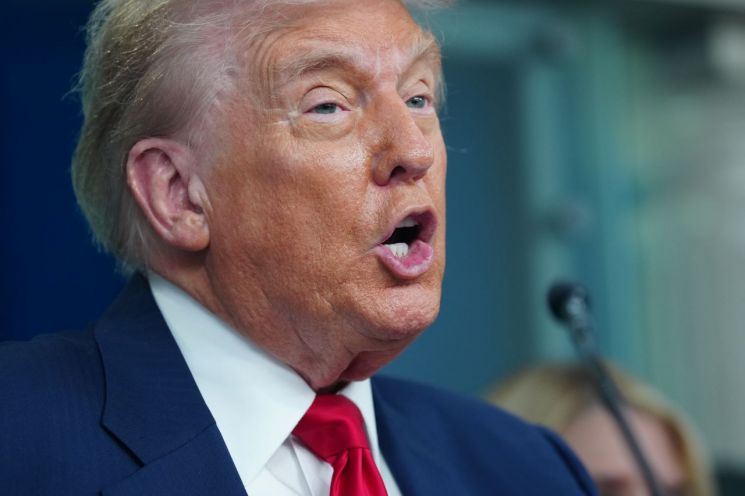
After signing an executive order at the White House on the sale of the U.S. operations of the Chinese video platform TikTok, President Trump told reporters, "During the past four years under the previous Biden administration, we were not treated properly by other countries, but now we are doing well. We have never done this well before."
He stated that trade negotiations with several countries, including China, are progressing smoothly, saying, "Tariff revenues are coming in and new agreements are being made," and emphasized, "In some cases, $950 billion is coming in."
He then mentioned South Korea and Japan, saying, "As you know, $550 billion is coming in from Japan and $350 billion from South Korea," adding, "This is up front." He stressed, "We are earning tremendous amounts of money through tariffs, and this is unprecedented in scale."
The $950 billion mentioned by President Trump appears to refer to the case of the European Union (EU). Howard Lutnick, U.S. Secretary of Commerce, who led the trade agreements with South Korea and Japan, previously announced plans to use foreign investment funds to establish the U.S. National Economic Security Fund and invest it in domestic infrastructure reconstruction.
President Trump's remarks came as the two countries have yet to narrow their differences over the $350 billion investment fund, which has become a key issue in recent U.S.-South Korea trade negotiations. In particular, his mention of "up front" is seen as a move to increase pressure on South Korea and drive an agreement on U.S. terms regarding the implementation of the investment.
At the end of July, the two countries agreed that South Korea would invest $350 billion in the United States in exchange for the U.S. lowering reciprocal and automobile tariffs on South Korean imports to 15%. However, the two sides are at odds over the investment method, with the U.S. favoring direct investment and South Korea preferring a guarantee and loan-based approach. As a result, the U.S. continues to impose a super-high tariff rate of 25% on South Korean automobiles. In contrast, the U.S. has implemented a 15% reduction in automobile tariffs for vehicles imported from Japan and the European Union under separate trade agreements.
The South Korean government has requested that the U.S. establish a currency swap agreement, arguing that a large-scale cash investment could cause shocks to the foreign exchange market. President Lee Jaemyung, who is visiting New York for the United Nations (UN) General Assembly High-Level Week, also met with U.S. Treasury Secretary Scott Besant the previous day to directly explain the need for a currency swap agreement. However, it has been reported that the U.S. remains negative on the issue.
Meanwhile, The Wall Street Journal (WSJ) reported that Secretary Lutnick has requested a slight increase in South Korea's investment amount from the previously agreed $350 billion. The media outlet noted the ongoing disagreement between the two countries, stating, "Trade negotiations with South Korea are on shaky ground."
On the same day, President Trump announced on his social networking service, Truth Social, that "starting October 1, 2025, a 100% tariff will be imposed on all brand-name or patented pharmaceuticals, except for companies that are building pharmaceutical factories in the United States." He added, "'Building' is defined as 'breaking ground' and 'under construction,'" clarifying, "Therefore, if construction has begun, those pharmaceuticals will not be subject to the tariff."
Prior to his recent state visit to the United Kingdom, President Trump compared automobiles, semiconductors, and pharmaceuticals, on which tariffs have been imposed, and stated that higher tariffs could be imposed on items with higher profit margins.
He also announced tariffs on furniture and trucks. Starting next month, a 50% tariff will be imposed on kitchen cabinets, bathroom storage units, and related products, and a 30% tariff will be imposed on upholstered furniture such as sofas covered in fabric or leather. In addition, a 25% tariff will be imposed on large trucks.
© The Asia Business Daily(www.asiae.co.kr). All rights reserved.












