30 Don Awarded After 35 Years at Hyundai E&C,
Valued at Over 20 Million Won at Current Prices
Hanwha Still Offers Gold Bars,
Samsung and GS Give Gold Medals
Daewoo E&C and DL E&C Switch to Cash Rewards,
Engineering Sector Largely Abolishes Gold Rewards
"Shift Toward Cash and Welfare-Based Benefits Expected"
As the price of gold continues to hit record highs, with the price for one don (3.75g) of gold approaching 700,000 won, major construction companies are still upholding the tradition of giving "golden rewards." Some companies award as much as 30 don in gold, and with the recent surge in gold prices, employee preference for such rewards remains high. However, as generational shifts occur, more employees are expressing a preference for cash or welfare-based rewards. As a result, an increasing number of companies are either changing or abolishing their gold reward systems.
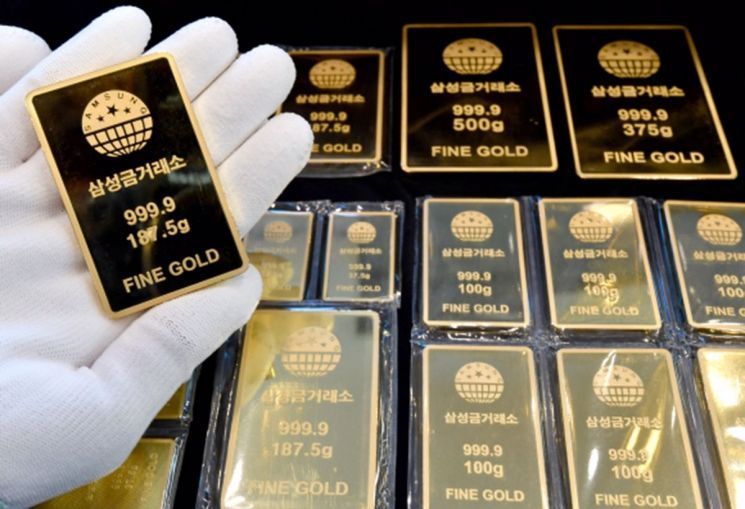 Despite the surge in gold prices, major construction companies continue the tradition of giving "golden rewards." The photo shows gold bars at Samsung Gold Exchange. Photo by Samsung Gold Exchange.
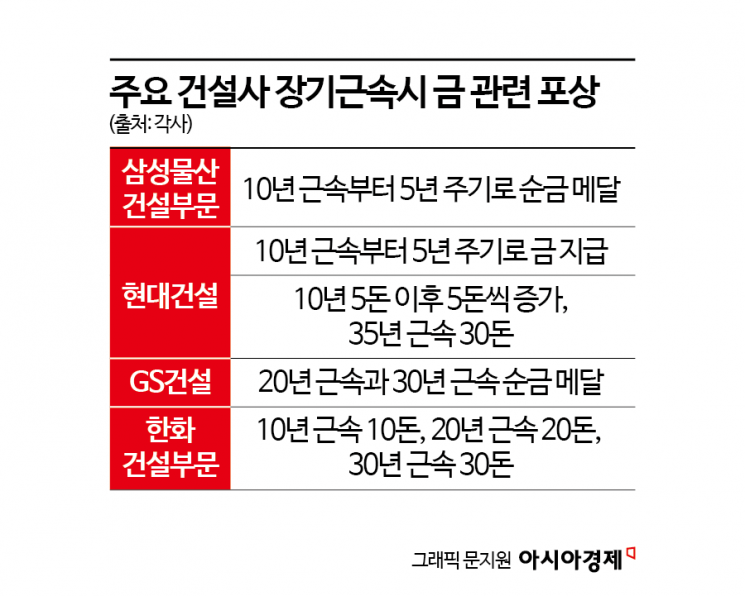
According to the construction industry on September 25, Hyundai Engineering & Construction maintains the most standardized gold reward system in the sector. Employees who have worked for 10 years receive 5 don of pure gold, and for every additional five years, the amount increases by 5 don, reaching 30 don for 35 years of service. According to Samsung Gold Exchange, as of this day, the standard price for one don of gold is 678,300 won. If converted, the 30 don received by a Hyundai Engineering & Construction employee after 35 years of service amounts to 20.34 million won. Hanwha Construction Division also offers substantial gold rewards: 10 don for 10 years, 20 don for 20 years, and 30 don for 30 years of service. All Hanwha Group affiliates share a similar reward structure.
Some companies provide "gold medals" instead of gold bars. The construction division of Samsung C&T offers gold medals every five years to employees with over 10 years of service. GS Engineering & Construction awards pure gold medals to employees who have served for 20 and 30 years.
Just as gold is traditionally given as a gift at a child's first birthday or at weddings, it has become institutionalized as a "symbol of heartfelt appreciation." Gold, as a tangible asset, tends to appreciate in value over time. Additionally, since the tax burden is relatively low when receiving gold, both companies and employees are generally satisfied. A representative from a construction company that maintains the "golden reward" tradition said, "In the past, the symbolic meaning was more significant, but recently, with the price of gold rising so much, the sense of reward has also increased."
While most employees keep the gold they receive as a token of recognition for long-term service, some do convert it to cash. In fact, listings for "long-term service gold bars" occasionally appear on secondhand trading websites. Despite employee preferences, some companies have abolished gold rewards altogether. DL E&C, after awarding gold for many years, recently switched to cash payments. Daewoo Engineering & Construction also used to give gold to long-term employees but switched to travel vouchers and now provides cash. A company representative explained, "We have shifted the system to focus on tangible benefits that employees can truly experience," adding that this change reflects generational differences in preferences.
With gold prices soaring by more than 50% over the past year, some companies have decided to discontinue gold rewards altogether. In the engineering sector, companies that still give gold are now rare. Even among major construction companies that still maintain gold rewards, it is difficult to reduce the amount given, so they are considering abolishing the system or finding alternatives. An industry insider remarked, "The symbolism and tradition of gold remain significant, but more employees now want practical rewards such as opportunities for self-development or rest," predicting that the trend toward replacing gold rewards with cash or welfare-based benefits will only accelerate in the future.
© The Asia Business Daily(www.asiae.co.kr). All rights reserved.













