Seoul Hosts "Golden Age of Science and Engineering" Forum
Mayor Oh: "Proactive Measures to Secure Science and Engineering Talent"
Comprehensive Support to Eliminate Tuition, Research, and Housing Burdens
Seoul Vows to Continue Urban Planning Support
Oh Sehun, Mayor of Seoul, has declared the "Golden Age of Science and Engineering." In response to the current trend of students flocking to medical schools, which is destabilizing the supply of science and engineering talent, the city will launch comprehensive support measures to shift the talent pipeline toward advanced industries such as semiconductors, artificial intelligence (AI), and mobility.
On September 25, at the "Now is the Golden Age of Science and Engineering Forum" held at Korea University’s Future Convergence Technology Building, Mayor Oh announced the "3NO 1YES" vision as the core of these new policies.
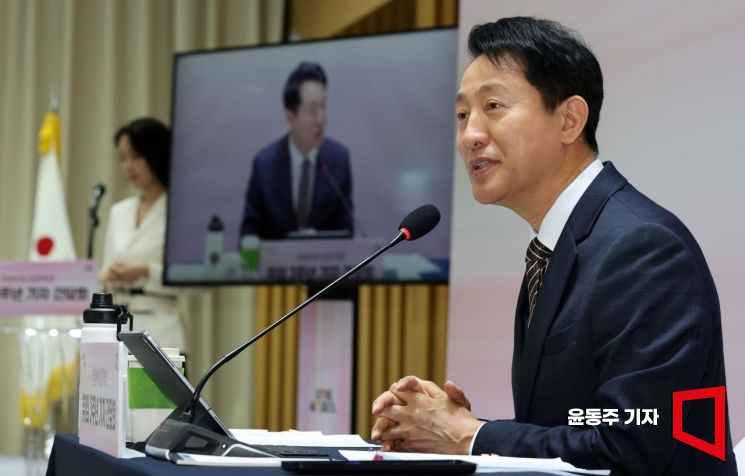
This support package, which stands for "No Worries About Tuition," "No Performance Pressure," "No Housing Cost Burden," and "Yes to Pride in Science and Engineering," is designed to enable science and engineering talent to fully focus on research, academics, and entrepreneurship.
First, to ensure that no one has to abandon research due to financial reasons, the city will introduce the "Science and Engineering Future Together Scholarship." The existing support, which was focused on master’s and doctoral programs, will be expanded to include postdoctoral researchers. Annual support amounts will also be increased to 20 million won for master’s students, 40 million won for doctoral students, and 60 million won for postdoctoral researchers.
Through the "Seoul RISE 10 Challenge," the city will also provide stable research funding for up to 10 years. This aims to free researchers from short-term performance pressures and allow them to pursue bold, risk-taking research without fear of failure. In addition, the city will establish "Growth Housing for Science and Engineering Talent" to ease the housing burden and help researchers and students focus on their work and studies. Furthermore, the city will create the "Seoul Scientist Award" to recognize outstanding achievements in science and technology and support participation in international conferences and global events such as CES.
At the forum, Mayor Oh emphasized that securing science and engineering talent is now a key task that will determine the future competitiveness of both the nation and the city, making proactive measures essential. In reality, the United States and China are strengthening their dominance in future industries by leveraging large-scale private investment to secure top research and development talent and technological capabilities. According to a national survey on research and development (R&D) personnel in strategic technologies, China has 410,000 AI-related researchers, the United States has 120,000, while Korea has only about 20,000. Additionally, the recently released "AI Index 2025" shows that the United States ranks first globally in the net inflow of AI talent, whereas Korea remains near the bottom, lagging in global talent competitiveness.
The Seoul Metropolitan Government also plans to review the related support measures it has implemented so far. Moving beyond short-term fixes, the city has worked to innovate the university, industry, and research ecosystem to build a foundation for the growth of science and technology talent. In 2022, through the "University Urban Planning Support Measures," the city improved regulations by relaxing building height limits in natural landscape zones, easing floor area ratio restrictions for innovation growth facilities, and loosening the 1.5D diagonal boundary limit at school perimeters, thereby significantly expanding university research and education spaces.
Korea University’s "Jung Unoh IT Liberal Arts Hall" is the first outcome of these efforts, providing educational spaces such as research and laboratories for the Department of Semiconductor Engineering (a contract department with SK Hynix) and the Department of Smart Mobility (a contract department with Hyundai Motor Company) to foster talent in advanced fields. The building was expanded from seven to ten stories, and the top floor was constructed with a ceiling height of 5.5 meters to house a state-of-the-art FAB laboratory for hands-on semiconductor process training. Other universities, including Chung-Ang University, Sejong University, Sungkyunkwan University, Hongik University, and Ewha Womans University, are also pursuing the construction of innovation growth facilities.
The city has also accelerated efforts to nurture talent and build an entrepreneurial ecosystem. Through programs such as the Youth Employment Academy and Campus Town, Seoul has fostered approximately 20,000 talents in advanced fields including AI, biotechnology, fintech, and quantum technology between 2021 and 2025. Additionally, by expanding startup hubs in collaboration with universities and local communities, Seoul has risen to 8th place globally in 2025 as a "city ideal for startups."
Kim Miyoung, Head of the Innovation Technology Team at the Economic Policy Division of the Seoul Metropolitan Government, stated, "To nurture science and engineering talent, both an environment that allows for long-term research and social recognition for scientists and engineers are essential. We will continue to provide urban planning support to ensure that science and engineering talent have the space to research and take on challenges to their fullest potential."
Meanwhile, at the forum, following Mayor Oh’s vision declaration, Kim Youngoh, Dean of the College of Engineering at Seoul National University, gave a presentation on "The Era’s Demand for Global Science and Technology Innovation Talent." The subsequent panel discussion, "Solutions for Nurturing Talent in the Age of Science and Engineering Crisis," was moderated by Won Yonggeol, President of the University of Seoul, and addressed topics such as "National Priorities for Science and Engineering Talent Policy and the Role of Local Governments." Panelists included Eom Mijeong, Director of the Science and Technology Talent Policy Center at the Science and Technology Policy Institute; Baek Jungwook, Head of Research and Development Human Resources at Hyundai Motor Group; and Kim Jaeseung, CEO of Mobile Tech.
© The Asia Business Daily(www.asiae.co.kr). All rights reserved.












