Korea Institute of Finance
Seminar on "Development Plans for a New Leap in the Banking Industry"
There are increasing calls to refer to Japan's experience for the development of the Korean economy and banking industry. Specifically, it is argued that easing regulations to allow banks to engage in non-financial services could help address issues threatening the sustainability of the Korean economy, such as regional depopulation. Some experts also suggested that when Korean financial institutions devise overseas expansion strategies, they should consider acquiring stakes in large, market-dominant local financial institutions, following the approach taken by Japanese banks.
On the afternoon of the 24th, the Korea Institute of Finance held a seminar titled "Development Plans for a New Leap in the Banking Industry" at the Bankers' Hall in Jung-gu, Seoul. Members of the institute presented on topics such as expanding the scope of banking work, strengthening the competitiveness of regional banks, and restructuring overseas expansion strategies for domestic financial institutions, referencing the strategies employed by Japanese banks and financial companies.
Kwon Heungjin, a research fellow, stated that to strengthen the role of finance amid threats to the sustainability of the Korean economy, such as demographic changes, it is necessary to vitalize non-financial work. He emphasized that addressing these issues requires large-scale investment, and thus, it is essential to encourage the participation of the banking sector, which attracts the largest amount of funds in the financial sector. He said, "To expand the contribution of banks, we need to broaden the scope of ancillary work and subsidiaries, and establish an incentive system that allows banks to profit through investments." He added that, similar to Korea, Japan had strictly regulated the scope of banking work but gradually relaxed these regulations, enabling banks to operate subsidiaries in various fields such as regional trading companies, renewable energy, and customer company innovation.
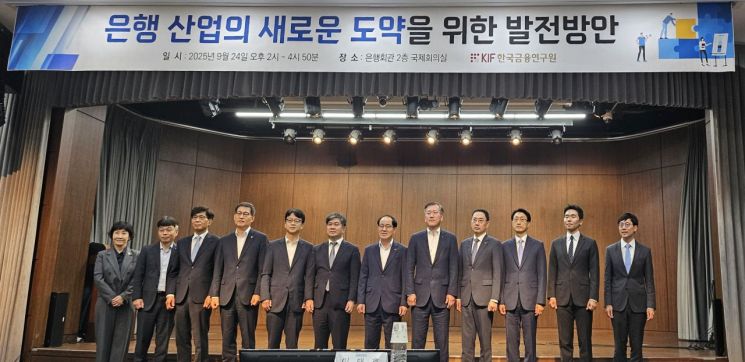 On the afternoon of the 24th, the Korea Institute of Finance held a seminar titled "Development Plans for a New Leap in the Banking Industry" at the Bankers' Hall in Jung-gu, Seoul. The presenters and discussants are taking a commemorative photo. Photo by Oh Kyumin
The Korea Institute of Finance believes that this approach can enhance the competitiveness of regional banks while simultaneously revitalizing local economies. Lee Byungyoon, a senior research fellow, explained that Japan established non-financial subsidiaries to promote regional economic growth, supporting local business succession, mergers and acquisitions (M&A), and startups. He stated, "Japanese regional banks provide not only financial services but also non-financial services to local businesses and customers, thereby promoting both regional economic revitalization and diversification of revenue sources." He also noted that management integration among regional banks has led to cost reduction and synergy effects, and argued that, to strengthen the competitiveness of holding companies owning multiple regional banks, measures such as sharing customer information and jointly using information technology (IT) systems among banks should be considered. Excluding the Japanese case, he suggested additional measures to enhance the competitiveness of regional banks, including: providing incentives for lending to local small and medium-sized enterprises, adding points for providing local financial services in regional reinvestment assessments, and offering incentives for attracting local government and court deposits.
Kim Seokki, a senior research fellow, said there are also lessons to be learned from Japan's approach to overseas expansion. He explained that Japanese financial companies entered the retail market by acquiring stakes in local banks, enabling them to generate profits quickly through localization and network building. Kim suggested, "Policy financial institutions should participate to enhance credibility, and banks should pursue scaling up by acquiring stakes in large local financial institutions."
The financial authorities expressed their intention to review measures for revitalizing local economies. Shin Jangsoo, Director of the Banking Division at the Financial Services Commission, said, "Expanding incentives for lending to local small and medium-sized enterprises is definitely worth considering." However, he emphasized that, since regional banks are strong in relationship banking-which involves sharing business performance through long-term trust relationships with companies by providing loans, equity investments, and management consulting services-they should also develop their own strategies to enhance competitiveness. Regarding expanding the scope of banking work, he noted that there are many factors to consider and maintained a reserved stance, saying that the current innovative financial services system could be fully utilized. He also stated that a financial advancement consultative body would be formed to provide maximum support for overseas expansion by financial institutions.
In the case of regional banks, it was argued that expanding the scope of work, sharing information among banks, and easing risk-weighted asset (RWA) regulations are all essential for strengthening competitiveness. Ha Geuncheol, head of the BNK Management Research Institute, stated that the separation of finance and industry is different from the separation of industry and finance. "While the financial dominance of industry should be prevented, financial companies should be encouraged to conduct business in connection with industry," he said. He also noted that if information sharing among banks under the same holding company is enabled, consumers could benefit from interest rate reductions of 50 basis points (bp; 1bp=0.01%), and that RWA standards for investment in local companies should also be relaxed.
© The Asia Business Daily(www.asiae.co.kr). All rights reserved.












