KOSDAQ Also Drops 1.29%
On September 24, the KOSPI index reversed its three-day upward trend and declined to the 3,470 level due to foreign investor selling. The KOSDAQ index also dropped by more than 1%, closing lower for the second consecutive day.
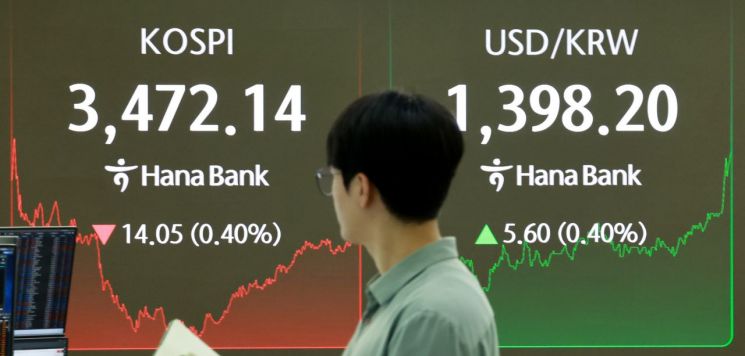
On this day, the KOSPI closed at 3,472.14, down 0.40% from the previous trading day. The index opened at 3,492.03, up 0.17% from the previous session, and climbed to an intraday record high of 3,497.95 early in the session before turning downward. In the late session, it partially recovered some of its losses.
Foreign investors led the decline by selling 251.7 billion won worth of stocks alone. In contrast, institutional investors and individuals made net purchases of 212.4 billion won and 4.9 billion won, respectively.
More sectors declined than advanced. The largest declines were seen in securities (-3.24%), entertainment and culture (-2.66%), insurance (-1.87%), chemicals (-1.45%), finance (-1.39%), food, beverage, and tobacco (-1.28%), non-metallic minerals (-1.23%), IT services (-1.22%), distribution (-1.21%), pharmaceuticals (-1.05%), and general services (-0.81%). Meanwhile, machinery and equipment (2.15%), transportation equipment and parts (1.31%), telecommunications (1.14%), construction (0.55%), and real estate (0.22%) closed higher. Notably, semiconductor-related stocks, which have recently led the rally, appeared to take a breather.
Among large-cap stocks, SK Hynix (-0.97%), LG Energy Solution (-2.52%), Hyundai Motor (-0.68%), and KB Financial Group (-0.09%) declined, while Samsung Electronics (0.83%), Samsung Biologics (0.97%), Hanwha Aerospace (5.38%), HD Hyundai Heavy Industries (1.31%), and Doosan Enerbility (4.44%) closed higher.
On the same day, the KOSDAQ closed at 860.94, down 1.29% from the previous session. The index started at 870.54, down 0.19% from the previous day, and at one point dropped to 851.38 during the session before showing a slight recovery in the late session. Foreign investors and institutions were net sellers of 253.2 billion won and 169.8 billion won, respectively, while individuals bought a net 435 billion won.
By sector, pharmaceuticals led the decline, dropping 3.16% due to increased selling pressure. Other notable declines included medical and precision devices (-2.70%), textiles and apparel (-1.87%), finance (-1.23%), entertainment and culture (-1.11%), manufacturing (-1.09%), paper and wood (-0.97%), distribution (-0.96%), construction (-0.95%), and transportation and storage (-0.91%). Non-metallic minerals (1.50%), metals (1.25%), publishing and media replication (0.35%), and telecommunications (0.13%) showed gains.
Among the top 10 KOSDAQ stocks by market capitalization, all declined except for HLB (0.77%). Decliners included Alteogen (-3.63%), Ecopro BM (-2.95%), Peptron (-5.84%), Ecopro (-2.22%), PharmaResearch (-1.72%), LIG ChemBio (-2.37%), Rainbow Robotics (-4.40%), Samchundang Pharm (-8.33%), and ABL Bio (-8.43%).
Kim Jiwon, a researcher at KB Securities, analyzed, "Concerns over an artificial intelligence (AI) bubble and debates about the overvaluation of the U.S. stock market have simultaneously emerged, spreading caution throughout the market. However, stocks in shipbuilding, defense, and nuclear power, which had taken a backseat during the semiconductor rally, showed strength and helped support the lower end of the index."
© The Asia Business Daily(www.asiae.co.kr). All rights reserved.












