Korea Economic Association Hosts Roundtable with Major Group CHOs
Attendees Include Samsung, SK, Hyundai Motor, and LG
Discussion on Expanding New and Regular Recruitment, Internships
Plans to Propose Policy Support Measures
In an effort to overcome the youth employment crisis and create high-quality jobs, major companies gathered together to exchange ideas and seek solutions.
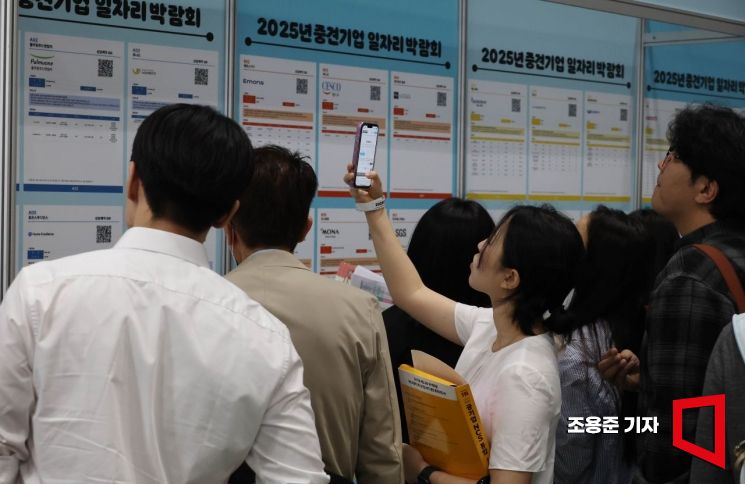 Job seekers visiting the 2025 Mid-sized Companies Job Fair held at COEX in Gangnam-gu, Seoul, are looking at the job posting board. 2025.4.23 Photo by Jo Yongjun
The Korea Economic Association invited Chief Human Resources Officers (CHOs) from major groups such as Samsung Electronics, SK, Hyundai Motor, and LG to the 'Major Groups Roundtable for Improving Youth Employment,' held on the 25th at the FKI Tower Conference Center in Yeouido.
This roundtable was organized to address the youth employment issue, which has been directionless at the societal level. Recently, the employment rate for young people (aged 15 to 29) has declined year-on-year for 16 consecutive months since May of last year, reaching 45.1% last month. The average number of young people who were classified as 'resting' between January and August this year was 437,000, the highest since 2003 when such statistics began to be compiled, excluding the COVID-19 pandemic year of 2020.
During the roundtable, the CHOs of these groups expressed deep concern about the current difficulties in the youth employment market and discussed ways to improve job conditions as experienced by young people. They also discussed providing more opportunities for work experience to young people who have lost motivation after prolonged unsuccessful job searches, through various channels such as internships and job fairs. Additionally, there was consensus on the need to establish an environment that would effectively promote regular recruitment, including increasing the proportion of new hires.
Kim Changbum, Executive Vice Chairman of the Korea Economic Association, said in his opening remarks, "The continued high rate of youth unemployment can lead to a weakening of human capital competitiveness and a decline in the country's economic growth potential, resulting in significant losses for both companies and the national economy. I hope this roundtable will serve as an opportunity to seek solutions for improving job opportunities for the youth who will be responsible for the future of our economy."
The groups also agreed that, despite a significant reduction in hiring capacity across companies of all sizes due to poor performance amid the recent economic downturn, active government support is needed for companies that are increasing youth employment.
According to the Korea Economic Association, operating profits in the first half of this year decreased compared to the same period last year for 5 out of the top 10 companies by sales. In addition, the Korea Exchange confirmed that 2 out of every 5 (38.6%, or 711 companies) listed companies on KOSPI and KOSDAQ recorded losses in the first half of this year.
The Korea Economic Association announced plans to collect the opinions of major groups and propose policy tasks to the government to support the expansion of companies' hiring capacity. The association and the major groups agreed that public-private cooperation is essential to create a sustainable youth employment environment, and identified key tasks such as expanding incentives like tax support for youth employment, increasing labor market flexibility, and adjusting the pace of extending the retirement age. Specifically, they suggested increasing the youth tax credit under the integrated employment tax deduction from 4 million won to 6 million won for large companies, and from 8 million won to 10 million won for mid-sized companies. They also proposed doubling the weighting for 'wage increases for regular young employees' in the corporate income recirculation system that promotes investment and win-win cooperation.
© The Asia Business Daily(www.asiae.co.kr). All rights reserved.

![Clutching a Stolen Dior Bag, Saying "I Hate Being Poor but Real"... The Grotesque Con of a "Human Knockoff" [Slate]](https://cwcontent.asiae.co.kr/asiaresize/183/2026021902243444107_1771435474.jpg)














