Presidential Office Discloses Special Activity Expenses for the First Time
Supporting Documents Will Not Be Released
Some Business Operation Expense Locations Redacted
"Potential Threats to the President from Hostile Forces"
Concerns O
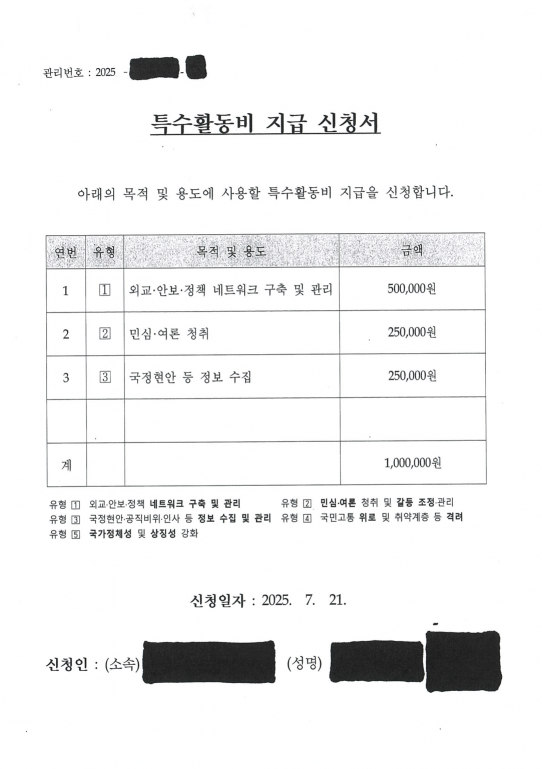
On September 23, for the first time in the history of previous administrations, the Presidential Office made public the details of its use of special activity expenses and specific business expenses. The scope of disclosure for business promotion expenses was also expanded compared to before. However, the Presidential Office withheld disclosure of supporting documents and certain spending details, citing the potential risk to the President’s safety and national security.
The total amount of special activity expenses used by the Presidential Office from June to August was 464,226,000 won. Special activity expenses are funds directly used for state affairs that require confidentiality, such as diplomacy and national security. In the past, the Presidential Office did not disclose special activity expenses, which often led to controversy over the “opaque” use of taxpayer money. The information released this time includes the date, type, purpose, and amount of each expenditure. For security reasons, some expenditure purposes were redacted using placeholders such as “0000.”
However, the Presidential Office refused to release supporting documents for special activity expenses. The office explained, “Supporting documents for special activity expenses contain sensitive information, such as details about the departments and staff involved in confidential activities, information on state affairs where special activity expenses were used, and information about the counterparties involved in special activities.”
The office further stated, “If such information were to be made public, it would be easy to infer the departments responsible for special activities, the types and scale of activities, and other details, which could directly and specifically hinder the Presidential Office’s state affairs that require confidentiality. We cannot rule out the possibility that this could significantly undermine the nation’s vital interests or disrupt the fair execution of official duties.”
Civic groups argued that supporting documents for special activity expenses should also be disclosed without exception. Ha Seungsoo, head of the group “Catch the Tax Thieves,” stated, “The Supreme Court precedent requires the disclosure of supporting documents as well,” adding, “After reviewing the information, we may need to file an additional request for disclosure.” Ha won an administrative lawsuit in 2022 against the Presidential Secretariat under the Yoon Suk Yeol administration, demanding the disclosure of special activity expense information.
"Risk of Harm to the President by Hostile Forces, Fierce International Information Warfare"
The office disclosed that 978,381,421 won was spent on business promotion expenses, but redacted some of the names and addresses of the venues where the funds were used. In particular, the Presidential Office stated that it could not reveal the names of suppliers of ingredients for presidential events, catering companies for official banquets and dinners, or establishments used for meetings.
The office pointed out, “There is a possibility that external forces with malicious intent could use this information to gain employment at these companies under false pretenses or approach company personnel to recruit them, thereby contaminating food and beverages supplied to the Presidential Office or causing harm to the President and other domestic and foreign dignitaries.”
The office also emphasized that it is engaged in work requiring a high level of security. “Meetings with external guests that require confidentiality must be held in independent spaces that are not easily accessible to the public,” the office explained. “Such venues are rare in general, and as a result, the number of establishments near the Presidential Office that can be used for these meetings is inevitably limited.”
The office expressed concern, stating, “Disclosing the full list of meeting venues would be equivalent to releasing statistics to the public about locations where confidential meetings are frequently held.”
The Presidential Office further explained, “External forces could attempt to eavesdrop, record, or wiretap sensitive information discussed at these meetings, which require a high level of security. The area around the workplace of the head of state is also a battleground for intense international information and intelligence warfare. It is difficult to rule out the possibility that disclosing such information could lead to major security breaches directly related to national security, diplomacy, or defense.”
© The Asia Business Daily(www.asiae.co.kr). All rights reserved.












