Seminar on Strategies for Entering the U.S. Market Held
Part of the 2025 SME Leaders Forum
Over 400 SME Leaders and Representatives Attend
A forum organized by the Korea Federation of Small and Medium Business was held to seek solutions to issues such as financial and legal challenges faced by Korean small and medium-sized enterprises (SMEs) when entering the U.S. market.
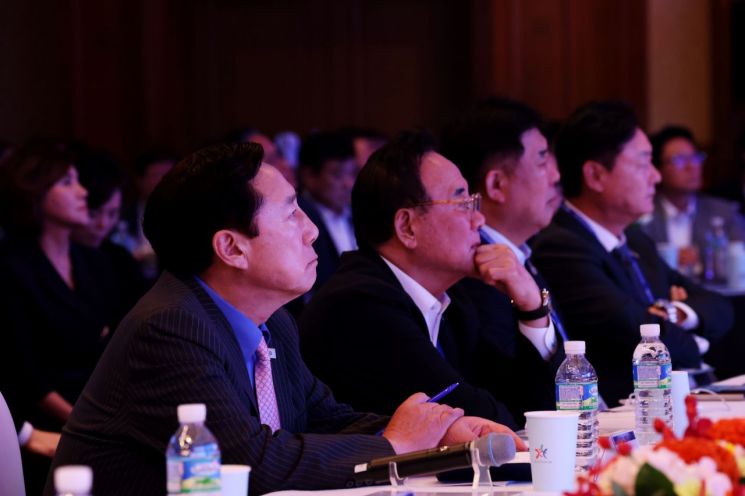 Kim Ki-moon, chairman of the Korea Federation of Small and Medium Business, is attending the opening ceremony of the "2025 SME Leaders Forum" held at Lotte Hotel Jeju in Seogwipo, Jeju Island on the 23rd, listening to a policy lecture. Korea Federation of Small and Medium Business
On September 24, the Korea Federation of Small and Medium Business held the "Seminar on Strategies for Entering the U.S. Market" at Lotte Hotel Jeju in Seogwipo City, Jeju Island, with the participation of SME representatives and domestic and international stakeholders.
At the event, SME representatives cited the complexity of local financial transaction procedures, such as remittance and payment methods, as one of the main difficulties encountered when entering the U.S. market.
Kang Donghan, CEO of Hanho Industry, said, "The biggest difficulty I faced during the process of entering the U.S. was the local financial system," adding, "In addition, I struggled with high legal costs and time consumption due to differences in state tax laws and labor laws."
In response, Barney Lee, President of Hanmi Bank, suggested actively utilizing the U.S. investment and financial environment as well as Hanmi Bank's infrastructure. He emphasized, "Hanmi Bank has a deep understanding of the institutional differences between Korea and the U.S. and offers Korean-language services, which can help minimize the trial and error for Korean companies."
Scott Lee, partner attorney at LBBS Law Firm, explained the U.S. legal guidelines, advising, "Companies must carefully review and apply for visas that match the purpose of stay and work content of their dispatched personnel," and stressed, "It is crucial to thoroughly comply with immigration laws and visa regulations."
There were also concerns raised about the increasing difficulties caused by U.S. environmental and consumer regulations. Han Jongwoo, CEO of Hanul Herbal Medicine, said, "As U.S. environmental and consumer regulations, such as mandatory product labeling, have been strengthened, it has become challenging to establish risk management measures," adding, "In addition, there are significant concerns regarding portfolio composition and insurance premium calculations due to differences in U.S.-Korea insurance systems, as well as selecting regions for entry due to cultural differences among states."
In response, attorney Scott Lee emphasized, "Lawsuits related to environmental and consumer issues are rapidly increasing, so advertising and labeling statements must be backed by scientific test results and supporting evidence," highlighting the need for legal preparedness. Park Kihong, Chairman of Herb International Insurance, added, "Companies entering the U.S. must mandatorily subscribe to workers' compensation insurance, product liability insurance, and employer's liability insurance," warning, "Failure to do so may result in substantial compensation payments, fines, and even criminal liability."
Additionally, Matt West, Deputy City Manager of Garden Grove, drew attention by introducing the advantages of Garden Grove City as a strategic base for entering the U.S. market. He explained, "Garden Grove City has a well-established Korean community and excellent logistics and transportation accessibility, making it easy to enter the market," and added, "We provide a wide range of administrative and financial support, from assistance with permits and zoning to small business loans and promotional support."
Kim Ki-moon, Chairman of the Korea Federation of Small and Medium Business, stated, "Although interest and demand for entering the U.S. market among domestic SMEs have grown due to the Trump administration's high tariff policies, as seen in the recent incident involving the detention of Koreans over visa issues in Georgia, there are many factors that require thorough pre-checks and preparation regarding local laws and regulations in the U.S." He added, "In particular, for the financial, insurance, legal, and administrative sectors, which are the most challenging for SMEs, actively utilizing the Korean-American infrastructure, which has a deep understanding of Korean corporate culture and high expertise, could be an effective solution."
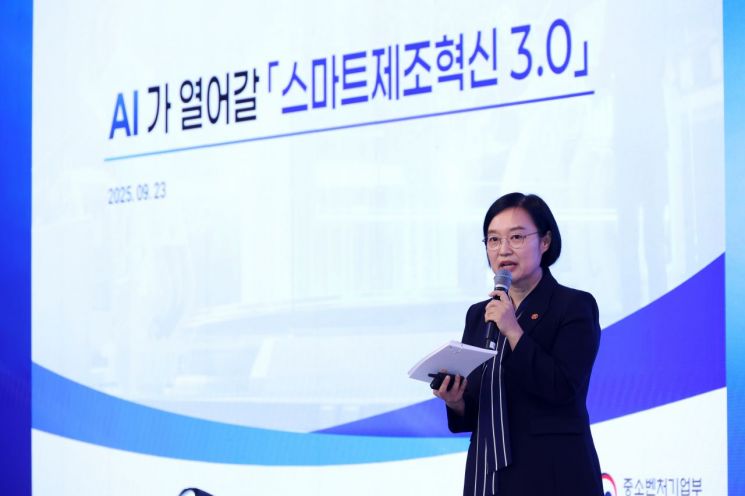 Hansung Sook, Minister of the Ministry of SMEs and Startups, is delivering a policy lecture at the opening ceremony of the "2025 SME Leaders Forum" held at Lotte Hotel Jeju in Seogwipo City, Jeju Island, on the 23rd. Photo by Korea Federation of SMEs
This seminar was held as part of the "2025 SME Leaders Forum," the largest annual industry event for discussing the future and policy direction of SMEs. The purpose was to provide practical information and discuss support measures in areas such as law and administration for SME representatives seeking to enter the U.S. market. The event was attended by Kim Ki-moon, Chairman of the Korea Federation of Small and Medium Business, Hwang Byunggu, Chairman of the Federation of Korean American Chambers of Commerce, and about 200 SME representatives from various industries.
The 2025 SME Leaders Forum, which kicked off the previous day, is being held for four days and three nights until the 26th under the theme "Challenge and Innovation, Toward the World and the Future!" More than 400 SME representatives and stakeholders are gathering to present new future visions and policy issues for SMEs and to share solutions for overcoming crises.
In his opening address the previous day, Chairman Kim Ki-moon identified the three major tasks for SME growth as ▲AI transformation ▲responding to low birth rates ▲resumption of inter-Korean economic cooperation, and urged, "When operating the National Growth Fund in the future, I ask for continued communication with the industry to ensure that SMEs in advanced sectors such as semiconductors, bio, and aerospace can benefit equally."
Hansung Sook, Minister of the Ministry of SMEs and Startups, who delivered the policy lecture, gave a presentation on "Smart Manufacturing Innovation 3.0 Driven by AI," stating, "AI adoption by SMEs is an unavoidable challenge," and added, "We will establish the legal and institutional foundation for fostering specialized smart manufacturing technology companies by enacting the Smart Manufacturing Industry Promotion Act within this year."
© The Asia Business Daily(www.asiae.co.kr). All rights reserved.

![Clutching a Stolen Dior Bag, Saying "I Hate Being Poor but Real"... The Grotesque Con of a "Human Knockoff" [Slate]](https://cwcontent.asiae.co.kr/asiaresize/183/2026021902243444107_1771435474.jpg)















