'Deputy Prime Minister for Science and Technology: Roles and Challenges' Forum
"R&D Achievements Should Be Measured by Social Impact, Not Just Papers"
Emphasis on Budget Stability and Talent Development
"Need to Establish a Cooperative System Beyond Ministerial Boundaries"
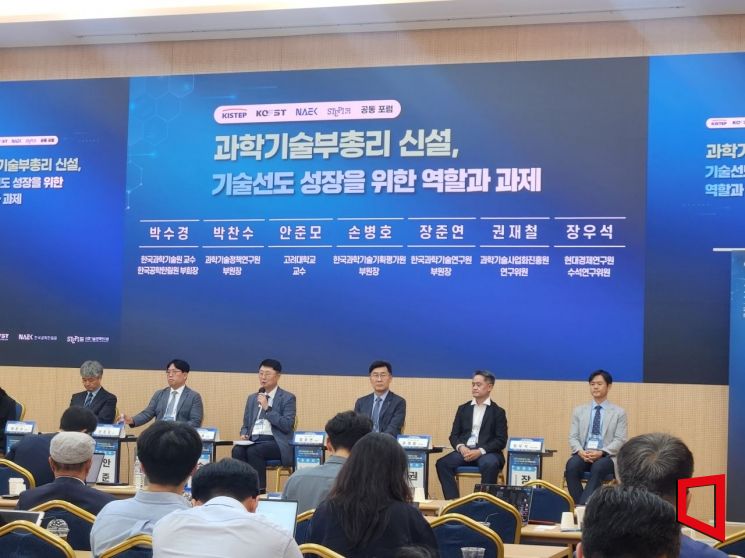 At the forum held on the 23rd titled "Establishment of the Deputy Prime Minister for Science and Technology, Roles and Tasks for Technology-led Growth." Photo by Park Yujin
The Deputy Prime Minister for Science and Technology system is being reinstated after 17 years. While the scientific community welcomes the elevation of science and technology's status within the government, experts emphasize that the role must go beyond simply managing research and development (R&D) support. They unanimously agree that it should serve as a control tower overseeing national strategic policies. To ensure stable budget allocation, the establishment of a dedicated standing committee within the National Assembly and the creation of a separate budget under the Deputy Prime Minister's authority have also been proposed.
At the forum held on the 23rd, jointly organized by the Korea Institute of S&T Evaluation and Planning (KISTEP), the Korean Federation of Science and Technology Societies, the National Academy of Engineering of Korea, and the Science and Technology Policy Institute (STEPI), experts shared a variety of opinions on the significance and challenges of the new system. Previously, on September 7, the government, the ruling party, and the Office of the President announced an organizational restructuring plan, officially confirming the elevation of the Minister of Science and ICT to the position of Deputy Prime Minister for Science and Technology. This marks the restoration of the system for the first time in 17 years, after the Ministry of Science and Technology was promoted to the Deputy Prime Minister level in 2004, then merged into the Ministry of Education, Science and Technology in 2008, leading to its abolition.
On this day, Professor An Junmo of Korea University cited Huawei's large-scale R&D investments, stating, "R&D is not merely a tool for growth, but a core asset that determines national security and diplomatic negotiating power." He added, "The Deputy Prime Minister must coordinate the policies of each ministry to achieve strategic effects at the national level and act as a mediator in situations where AI regulations and promotion policies clash between ministries." He also proposed, "About 5% of the government R&D budget should be allocated as a separate budget under the Deputy Prime Minister's authority to secure independent leadership," highlighting the need to improve the operational system and budget structure.
Park Chansu, Vice President of STEPI, emphasized, "Science and technology innovation policy must be mission-oriented at the national level. The Deputy Prime Minister should oversee budgets, talent, and strategic technologies, and large-scale R&D projects should be evaluated based on their social impact rather than just papers or patents." He continued, "It is necessary to secure a stable budget that is not shaken by external shocks," and insisted, "A dedicated standing committee for science and technology in the National Assembly is needed to prevent political fluctuations from affecting the budget." Regarding global talent competition, he added, "The cultivation of science and technology talent is connected to several ministries, including the Ministry of Justice, Ministry of Trade, Industry and Energy, and Ministry of Foreign Affairs. The Deputy Prime Minister should oversee national-level strategies for attracting and supporting overseas talent."
Park Sugyeong, Professor at KAIST and Vice President of the National Academy of Engineering of Korea, stated, "In a situation where technological hegemony competition is intensifying, the Deputy Prime Minister must go beyond being a mere coordinator and become an innovation control tower encompassing industry, basic research, and small and medium-sized enterprises." She pointed out, "A cooperative system that transcends ministerial boundaries must be institutionalized, as seen during supply chain crises for materials, components, and equipment or during the COVID-19 pandemic." She also noted, "During the previous administration, the Deputy Prime Minister for Science and Technology was limited to budget adjustments, resulting in policy mismatches. This time, it should evolve into collaborative governance, not just simple budget coordination."
Yoo Sangim, former Minister of Science and ICT, also attended the event and suggested, "In this era of AI transformation, the control tower role of the Deputy Prime Minister for Science and Technology is essential. The Deputy Prime Minister must demonstrate leadership for the system to succeed, especially given the current difficulties in inter-ministerial communication."
© The Asia Business Daily(www.asiae.co.kr). All rights reserved.

![Clutching a Stolen Dior Bag, Saying "I Hate Being Poor but Real"... The Grotesque Con of a "Human Knockoff" [Slate]](https://cwcontent.asiae.co.kr/asiaresize/183/2026021902243444107_1771435474.jpg)














