Perjury Complaints Possible by Plenary Resolution Even After Special Parliamentary Investigation Committees End
On September 23, a bill led by the Democratic Party of Korea passed the subcommittee of the National Assembly Steering Committee, allowing the National Assembly to file a complaint by resolution of the plenary session if a witness commits perjury during a parliamentary investigation or similar proceedings, but the responsible committee’s activities have ended and it is unclear who should file the complaint.
The Subcommittee on Operational Improvement of the National Assembly Steering Committee approved the partial amendment to the “Act on Testimony and Appraisal before the National Assembly” containing these provisions at its meeting on the same day. The People Power Party opposed the bill and walked out of the meeting room.
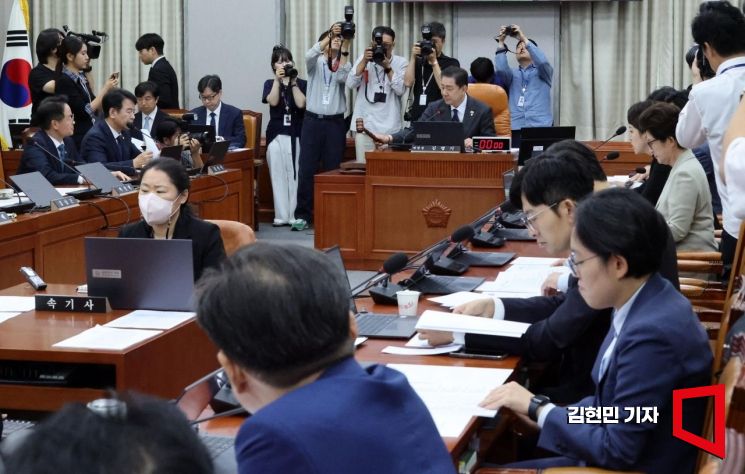 On the 22nd, at the plenary meeting of the Steering Committee held at the National Assembly, Chairman Kim Byunggi is striking the gavel. September 22, 2025 Photo by Kim Hyunmin
The amendment establishes a legal basis for the Speaker of the National Assembly to file a complaint by resolution of the plenary session if perjury is discovered after the dissolution of a committee with a fixed term, such as a special committee for a parliamentary investigation. Under the current law, only the relevant committee has the authority to file a perjury complaint, making it impossible to do so once the committee’s term ends. The amendment addresses this issue and also allows for retroactive application to past cases of perjury.
The Democratic Party of Korea stated that, through the amendment, it intends to file perjury complaints against former Prime Minister Han Ducksoo, former Minister of Economy and Finance Choi Sangmok, and former Minister of the Interior and Safety Lee Sangmin, who appeared before the special committee for the parliamentary investigation on martial law in January.
In contrast, the People Power Party argues that allowing the plenary session to inherit this authority is an arbitrary interpretation of the delegation of powers. They have opposed the bill, saying it would likely grant the majority party and the Speaker from the ruling party an additional means of filing complaints after the fact.
© The Asia Business Daily(www.asiae.co.kr). All rights reserved.












