Kim Heejeong of the People Power Party Analyzes Korea Expressway Corporation Data
The number of people failing to pay highway tolls has been steadily increasing recently. Over the past six years, the amount of unpaid tolls has approached 40 billion won.
According to data submitted by Assemblywoman Kim Heejeong of the National Assembly’s Land, Infrastructure and Transport Committee, which was obtained from Korea Expressway Corporation on September 23, the total number of unpaid highway toll cases from 2020 to July of this year reached 150 million. The combined amount totals 395.3 billion won.
The number of cases has shown a consistent upward trend: 19.94 million cases and 51.8 billion won in 2020; 21.943 million cases and 58 billion won in 2021; and 25.29 million cases and 65.6 billion won in 2022. The figures continued to rise to 29.94 million cases and 77.2 billion won in 2023, and 34.07 million cases and 88 billion won in 2024. As the toll collection rate has steadily declined, Korea Expressway Corporation was unable to collect tolls for 14.4 million cases, amounting to 38 billion won, over the past six years due to non-payment after the fact and similar reasons.
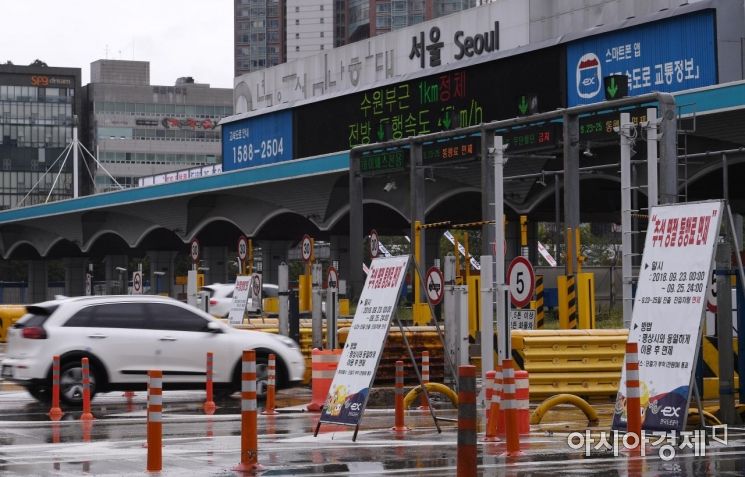 At the Traffic Control Room of Korea Expressway Corporation Traffic Center in Bundang-gu, Gyeonggi Province, employees are monitoring CCTV screens and checking and analyzing traffic conditions. Photo by Hyunmin Kim kimhyun81@
In accordance with relevant regulations, Korea Expressway Corporation issues a first notice to those who have not paid their tolls. If payment is still not made, a second and third notice is sent, requiring payment of a surcharge up to ten times the original toll. According to Assemblywoman Kim’s office, while the number of surcharge cases has increased each year, the collection rate has dropped significantly.
According to Korea Expressway Corporation, the number of surcharge cases was 930,000 (2.2 billion won) in 2020, which increased to 1.565 million cases (34.1 billion won) last year-a rise of about 60%. During this period, the collection rate dropped from 55% to 36%. As of July this year, the collection rate is only about 25%.
Assemblywoman Kim stated, "Illegal acts of habitually failing to pay tolls despite using the highways are increasing every year, and the burden is being directly shifted onto regular users." She added, "Effective measures must be implemented promptly, such as granting the authority to seize license plates from vehicles with habitual unpaid tolls."
© The Asia Business Daily(www.asiae.co.kr). All rights reserved.












