Popularity of K-Pop Demon Hunters' Tiger Character 'Duffy'
Japanese Atrocities, Including the Extinction of the Korean Tiger, Resurface
1.14 Million Views Spark Outrage Among Global Netizens
Anti-Japanese Sentiment Rises in China Amid Success of
"Japan drove Korean tigers to extinction," "Most comfort women were teenage girls," "Japan has still not apologized to Korea"
Recently, TikTok has seen an explosion of comments condemning Japan's war crimes and atrocities committed during the Japanese occupation. Ironically, the starting point was the global hit Netflix animation K-Pop Demon Hunters (hereafter referred to as K-Pop Demon Hunters). The fact that Japanese production company Sony Pictures participated in the project has, ironically, become a catalyst for revisiting Japan's past.
Exposing the Extinction of the Korean Tiger: 180,000 Likes and 1.2 Million Views
A foreign TikToker, captivated by the tiger character "Duffy" in K-Pop Demon Hunters, searched for information about Korean tigers and discovered that during the Japanese occupation, Japan labeled tigers as "harmful beasts" and systematically hunted them to extinction. He shared this story in a video, which quickly garnered 180,000 likes and 1.2 million views, spreading rapidly around the world.
The video featured narration stating, "While watching K-Pop Demon Hunters, I looked up the history of Korean tigers and found out that Japan hunted all the tigers on the Korean Peninsula last century." It also included a confession: "This scene made both me and my boyfriend completely heartbroken."
In fact, in 1917, Japan organized the "Tiger Suppression Army" to eradicate tigers on the Korean Peninsula. Hunters conducted large-scale captures in areas such as North Hamgyong Province and Gangwon Province, and after the 1920s, wild tigers disappeared from the Korean Peninsula. This was not simply the destruction of an ecosystem, but a colonial strategy to erase a national symbol.
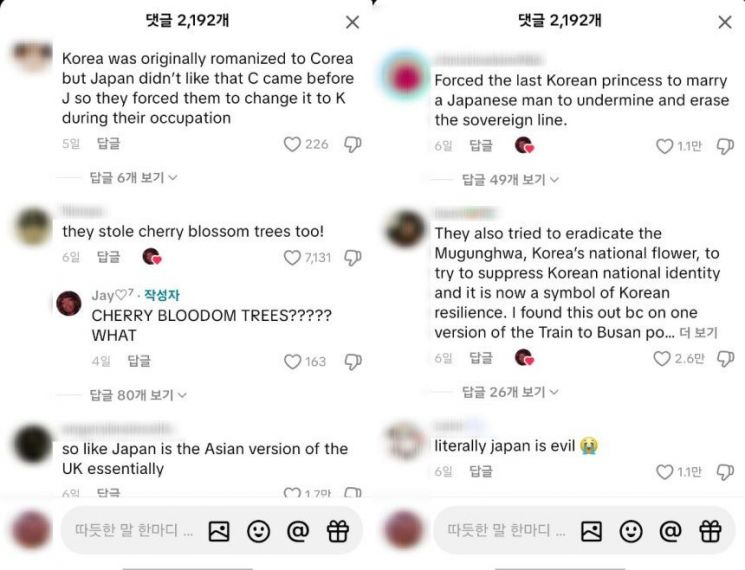 Over 2,000 comments were posted in the comment section of the video, with Japan's past history being repeatedly mentioned. Screenshot from TikTok 'JAY' channel
Comfort Women and Forced Marriages... A Parade of Japanese Atrocities Recalled
More than 2,000 comments have been posted under the video, with Japan's historical wrongdoings being repeatedly brought up. International users criticized, "Japan does not include its war crimes in history textbooks. Most Japanese people are unaware of their country's atrocities," "Japan has still not apologized," "I feel so sorry for Korea," and "Japan committed so many war crimes. Truly cruel and horrific."
Specific points were also raised, such as "Most comfort women were between 11 and 19 years old, with the average age being 14," and "Japan forced Korea's last princess to marry a Japanese man, damaging the royal lineage." One user remarked, "Japan's history is not beautiful, but for decades, it has focused only on rebranding." Korean users also responded, "K-Pop Demon Hunters accomplished what no one else could," "K-Pop Demon Hunters exposed Japan's atrocities to the world," "The power of culture is incredible," "I never thought I'd see a day like this," "The world must know the truth," and "It's time for Japan to finally apologize."
At the same time, some pointed out the irony that Sony, a Japanese company, participated in the production. Released on Netflix on June 20, K-Pop Demon Hunters set new global streaming records and created a huge buzz. This work, which modernizes Korean K-pop and mythology, was co-produced by Sony Pictures Animation and Sony Pictures Imageworks. While a Japanese company participated in creating a Korean story, the result has ironically served as a reminder of Japan's past atrocities.

In China, Anti-Japanese Sentiment Rises with the Film '731'
In China, content that directly exposes Japan's historical wrongdoings is also attracting attention. The recently released film 731 deals with the human experimentation atrocities committed by the Japanese Army's Unit 731 during World War II. On its opening day, the film earned 300 million yuan (about 58.5 billion won), setting a new record in Chinese cinema history. Released on September 18, the anniversary of the Manchurian Incident, the film is based on the fact that over 3,000 Chinese, Koreans, and Russians were victimized. Chinese audiences waved the national flag while watching the movie and raised their voices, saying, "The Japanese are too cruel. They cannot be forgiven."
 Chinese audiences are wiping away tears in the screening room of the movie '731'. Photo by Guizhou Daily
The Asahi Shimbun reported, "As the film began, some audience members were seen wiping away tears," and quoted a woman in her 40s who watched the movie with her husband as saying, "The Japanese are too cruel. They cannot be forgiven." Another viewer emphasized, "If you are Chinese, you should not go to Japan. We must remember this history." As anti-Japanese sentiment rises in China, the Japanese expatriate community is growing increasingly anxious. The Japanese Embassy in China advised its nationals to avoid speaking Japanese or wearing Japanese-style clothing in public, and Japanese schools in Beijing, Shanghai, and Suzhou suspended in-person classes and switched to online learning on the film's release day.
Experts describe this phenomenon as "an example of the power of cultural content to inform the world about history." They note that familiar forms like films and animation are becoming effective mediums for naturally spreading history and culture. Experts believe that strategically leveraging such trends could play an important role in raising historical awareness and building international consensus.
© The Asia Business Daily(www.asiae.co.kr). All rights reserved.














